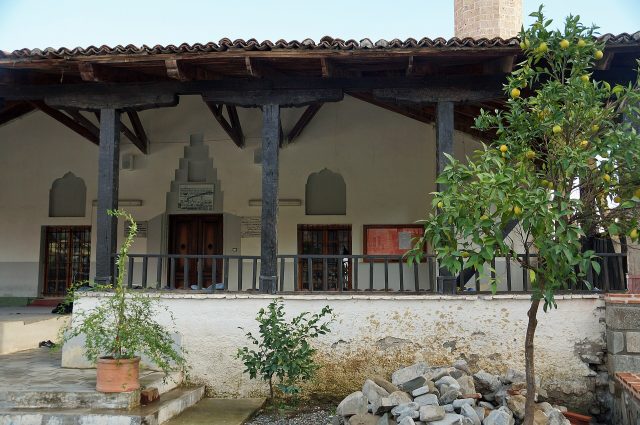
The Church of Saint Mary in Elbasan is one of those quiet places suspended in time. Built in the 18th century, it stands where empires and cultures intersected—under Ottoman rule, shaped by Orthodox traditions and local Albanian life. Elbasan was once a trading hub in the heart of the country, where merchants, artisans, and travelers left their mark. The church remains in the old quarter, where life moves slower.
Its architecture doesn’t stand out with grand facades or towering domes. The church is a whitewashed building with a low bell tower, built to serve, not impress. Inside, a wooden iconostasis, faded frescoes by local artists, and a few ancient icons fill the space. During the Ottoman era, when many churches across the Balkans were converted or left to decay, Saint Mary’s survived with changes. Its current form reflects the compromises of a community navigating shifting powers while holding onto its faith.
Elbasan has always been a city of overlapping identities. In the Middle Ages, Christians and Muslims lived side by side, Venetian traders mixed with local craftsmen, and later, Albanians, Turks, and Roma shared the streets. The Church of Saint Mary, though an Orthodox place of worship, was never isolated from this diversity. The sounds of the bazaar, calls to prayer, and church bells once mingled in the air. Today, the church is a link to that past—a reminder of how people lived in conversation with one another.
The church played a key role in preserving Albanian identity during periods of pressure. In times of upheaval, it became more than a place of worship; it was a center of resistance against assimilation. Here, people gathered to discuss language, customs, and history, passing down knowledge that might have been lost. The walls carried folk songs, debates, and the quiet determination of a community holding onto its roots. Even now, it stands as a symbol of continuity.
Visiting Saint Mary’s isn’t about admiring architecture. It’s about stepping into a timeless atmosphere. Inside, light filters through small windows, casting a glow over the icons. The air is cool in summer, warmed in winter by candlelight. Locals come to sit in silence or escape the noise outside. For travelers, it’s an unexpected discovery—no crowds, no souvenir stalls, just quiet.
The church sits in Elbasan’s old quarter, a maze of narrow streets lined with houses featuring carved balconies and small cafés serving strong coffee and fresh *byrek*. Walking here, you can imagine the city as it was centuries ago. Saint Mary’s isn’t a museum piece; it’s part of daily life, as much as the bakeries and cobblestones. It doesn’t ask for attention but simply exists.
Today, the church still serves its congregation, though the Orthodox community in Elbasan is smaller. Services follow the old calendar, and holidays like Easter and the Dormition of the Virgin are celebrated with solemnity. On these occasions, the church comes alive with people. Most visitors won’t see this, but if they do, they’ll catch a glimpse of what endures.
Elbasan doesn’t reveal itself easily, and the Church of Saint Mary helps make sense of it. It doesn’t shout its history; it simply stands among the houses and streets that have seen change. To visit is to feel the spirit of a city that has held onto what matters.