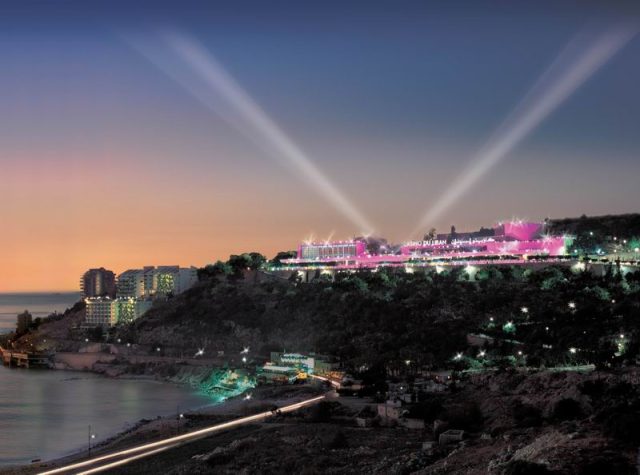
Saint George’s Church in Zouk al Khrab is one of those quiet places that don’t demand attention but leave a lasting impression. Perched on a hill overlooking Lebanon’s coastline, it stands apart from the usual tourist trails, offering something more subtle than grand cathedrals—a sense of history etched into stone and faded frescoes. The town itself is unassuming, a typical Lebanese settlement where life moves at its own pace, and the church feels like a natural part of that rhythm.
Built in the late 19th century, the church belongs to the Maronite tradition, one of the oldest Christian communities in the Middle East. For centuries, Maronite churches have been more than places of worship; they’ve served as anchors for local life, shaping both faith and culture. The architecture here reflects that duality—Byzantine influences blend with local craftsmanship in thick stone walls, rounded arches, and a facade that’s simple yet striking. Inside, low vaults rest on sturdy columns, and the frescoes, though aged, still hold their color, telling stories without words.
Saint George, or Mar Jorj as he’s known locally, occupies a special place in Lebanese devotion. Beyond his role as a warrior saint, he’s seen as a protector of farmers, a guardian against illness and misfortune. Local legends credit him with shielding villages from invasions and plagues, and the church’s icon of him—depicting the saint on horseback slaying a dragon—carries a distinctly Lebanese character. The figure is stern but fair, much like the land itself, and the image feels less like a distant religious symbol than a familiar presence in daily life.
Zouk al Khrab isn’t a place that draws crowds. Its narrow streets, small shops, and stone houses share the same quiet charm as the church, and there’s a sense of authenticity here that’s hard to find in more polished destinations. The church isn’t set apart from the town; it’s woven into it. People come not just for services but to sit under the trees outside, to climb the hill for the view of the sea, or simply to pause in a place where time feels slower. It’s the kind of spot where you might stop by on a whim, not because it’s famous, but because it feels right.
Inside, the atmosphere is one of quiet reverence. Light filters through narrow windows, casting a soft glow over the old icons and wooden pews worn smooth by generations. There’s no gilded opulence, no overwhelming grandeur—just a sense of continuity. The walls seem to hold the memories of countless prayers, weddings, and baptisms, of ordinary moments that together form the story of the town. In that way, the church isn’t just a building; it’s a living record of the people who’ve passed through its doors.
Like many places in Lebanon, the church has seen its share of hardship. It was restored after the civil war, when conflict left scars on the country’s religious sites. Locals recall how, during the worst years, the church became a refuge for those displaced by fighting, and its priests sometimes acted as mediators between divided communities. That history lingers in the air, adding to the sense of calm that visitors often notice. It’s as if the place itself remembers its role not just as a house of worship, but as a sanctuary in times of need.
Today, Saint George’s remains an active church, though it rarely sees tourists. Those who do visit often comment on its unassuming power—how it doesn’t try to impress, but simply exists, rooted in the landscape and the lives of those around it. That authenticity is its strength. If you find yourself in Zouk al Khrab, it’s worth the short climb up the hill. Step inside, even for a few minutes, and you’ll sense how life here moves at its own pace, measured not in hours but in the slow accumulation of years and stories. It’s the kind of place that doesn’t shout for attention but leaves you glad you stopped.