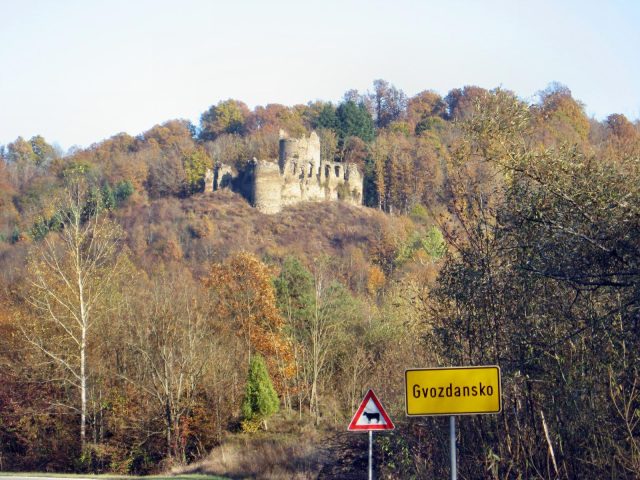
Nestled among the rolling hills and dense forests of inland Croatia, the village of Gvozdansko moves to the quiet rhythm of rural life. Far from the well-trodden tourist paths, it feels like a place where time has settled into a slower, gentler pace. At the heart of the village, perched on a low rise, stands the Church of Saints Philip and James—a modest but enduring presence that has served as a spiritual anchor for generations of locals.
Built in the late eighteenth century, when this region was part of the Habsburg Monarchy, the church reflects the unassuming architecture of rural places of worship from that era. Its whitewashed walls, simple lines, and a low bell tower with a single small bell give it a quiet dignity. Inside, wooden pews line the nave, leading to a restrained altar adorned with a few old icons, likely painted by local craftsmen. There is nothing grand about it, and that is precisely what makes it special. The church does not demand attention; instead, it offers a space for stillness and reflection.
The saints to whom the church is dedicated—Philip and James—hold a meaningful place in Catholic tradition. Philip was one of the twelve apostles, while James the Less, according to tradition, became the first bishop of Jerusalem. Their veneration here is no coincidence. In the eighteenth century, when the church was constructed, these saints were particularly revered in rural communities as protectors of farmers and guardians against hardship. For the people of Gvozdansko, the church was more than a place of worship; it was a sanctuary where they sought comfort in difficult times.
This part of Croatia has long been a crossroads of history, shaped by the ebb and flow of empires and conflicts. Over the centuries, the land changed hands countless times, caught between the ambitions of the Ottoman Empire, the Habsburgs, and local feudal lords. The Church of Saints Philip and James has stood through it all, surviving wars and upheavals that left surrounding villages in ruins. Though it has required repairs over the years, its endurance has made it a symbol of resilience for the community.
Today, the church looks much as it did two centuries ago. While it has undergone restoration, great care has been taken to preserve its original character. Inside, faint but still discernible frescoes cover the walls, and the ceiling is adorned with naive paintings typical of rural artists of the time. There is no academic precision in these works, but their sincerity is palpable, a quiet testament to the faith and craftsmanship of those who created them.
Surrounding the church is a small cemetery, where generations of Gvozdansko’s residents rest beneath simple headstones. Many of the graves date back to the nineteenth century, their inscriptions worn smooth by time. Some names are barely legible, yet the place does not feel melancholic. Instead, it serves as a reminder of the unbroken thread connecting past and present. For the villagers, the church and cemetery are not just landmarks; they are living parts of their own history, tended with quiet reverence.
Visiting the Church of Saints Philip and James is not about admiring grand architecture or ticking off a tourist checklist. It is about stepping into the rhythm of a place where life unfolds at its own pace, in harmony with the land. In summer, wildflowers bloom in the meadows around the church, while in winter, its white walls stand out against the snow-covered hills. If you time your visit right, you might witness a local festival or a service, where ancient Croatian hymns fill the air, accompanied by the soft notes of an organ.
Gvozdansko and its church are not the kind of places that draw crowds. There are no tour buses, no souvenir stalls, no bustling cafés. That is precisely why it feels so authentic—a corner of Croatia where history, culture, and way of life have remained largely unchanged for decades. If you ever find yourself in this part of the country, take a moment to pause. Step inside the church, wander through the cemetery, and listen to the silence. It may be here, far from the noise of cities, that you find something you didn’t even know you were looking for.