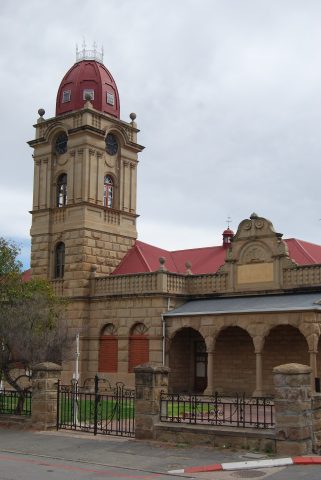
St. Boniface Church in Oudtshoorn sits quietly on the edge of town, surrounded by low houses and trees. At first glance, it might seem unremarkable—a modest building that could easily be overlooked. But those who pause for even a moment begin to notice something deeper than just an old structure. There’s a sense of stillness here, as if time itself has settled into the walls.
The church was built in 1880 by German settlers who had made their way to this part of South Africa. For them, faith was more than tradition; it was an anchor in an unfamiliar land. They chose St. Boniface as their patron—a figure who had carried Christianity to Germany centuries earlier—a name that connected them to the past even as they built a new life. The church became a gathering place, a small piece of home in a vast and often harsh landscape.
Unlike grand cathedrals with their towering spires and ornate interiors, St. Boniface is simple. The building is made of local stone, its golden hue deepening with age. The roof is tiled, the small bell tower unassuming. Inside, wooden pews line the floor, and a modest altar stands at the front. A few stained-glass windows cast soft light across the walls, their colors muted but warm. There’s nothing extravagant here, just a quiet dignity that invites reflection rather than awe.
Oudtshoorn itself has a history of contrasts. In the late 19th and early 20th centuries, the town boomed thanks to ostrich feathers, which were in high demand across Europe. Wealthy farmers built lavish mansions, and the streets buzzed with activity. But St. Boniface remained apart from that frenzy. It wasn’t a place for showing off or keeping up appearances. Instead, it was where people came to be themselves, to find comfort in shared faith and community.
Today, Oudtshoorn is a quiet town, its days marked by the slow rhythm of provincial life. The church still stands, much as it always has. On Sundays, the congregation gathers—many of them descendants of those early German settlers. Services are held in Afrikaans and English, sometimes in German, a nod to the past that still lingers in the present. The traditions haven’t faded; they’ve simply become part of the town’s fabric.
Around the church, a small garden offers shade in the summer and the scent of damp earth after winter rains. Locals come here to sit on the benches, to talk or simply to be still. The garden, like the church itself, feels lived-in, a natural extension of the town’s daily life.
Inside, the church is at its quietest on weekdays. The floorboards creak underfoot, and sunlight filters through the stained glass, painting the walls in soft blues and reds. Old photographs hang on the walls—faces of past parishioners watching over those who visit now. There’s no rush here, no sense of time pressing forward. It moves differently, as if the years have settled into the very air.
St. Boniface isn’t a place that draws crowds. There are no guided tours, no souvenir stands, no must-have photos. It doesn’t demand attention; it offers something quieter. For those who seek it out, it provides a connection to history, to a way of life that values simplicity and community. Perhaps that’s why some people return—not for spectacle, but for the quiet assurance that some things endure. The church doesn’t ask for much. It just stands there, waiting, as it has for well over a century.