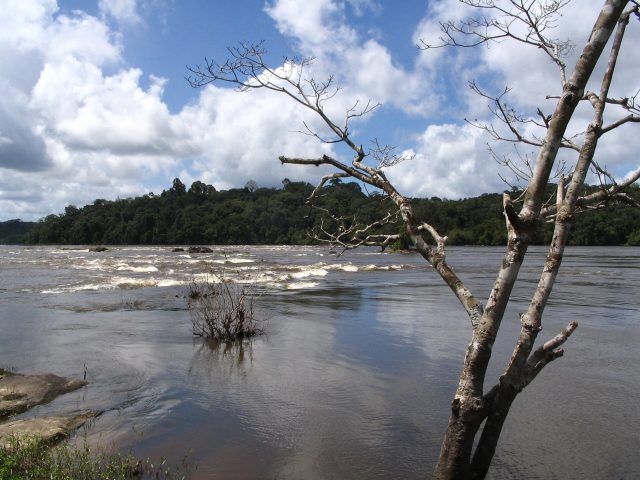
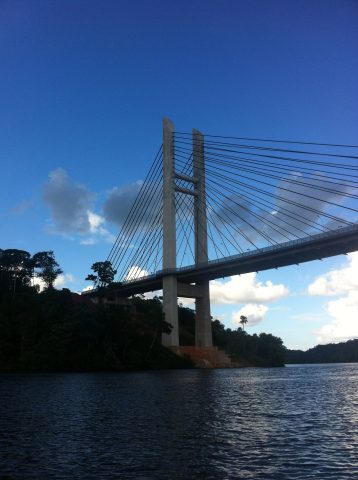
Saint Sebastian Church in Oiapoque is one of those quiet places that seem suspended outside of time. Built in the early 1700s, it stands on the banks of the Oiapoque River, where trade routes once connected Brazil with French Guiana. Back then, Oiapoque wasn’t just a border town—it was a crossroads where merchants, missionaries, adventurers, and Indigenous communities intersected, each leaving their mark on the land. The church became more than a place of worship; it was a symbol of how different worlds could coexist under one roof, shaped by the rhythms of river trade and the slow blending of cultures.
The architecture is simple but striking, a classic example of the colonial style found across northern Brazil. Whitewashed walls, heavy wooden doors, and a modest frontispiece with a cross give it the unassuming dignity of a building crafted by local hands and traveling artisans. Inside, there’s no grandeur—just the quiet beauty of wooden pews darkened by age, an altar bearing the image of Saint Sebastian, and a few old icons. The lack of ornamentation isn’t a flaw; it’s what makes the space feel real, a place where devotion matters more than decoration.
Over the centuries, the church has weathered its share of hardships. Fires have damaged its roof, floods have weakened its foundation, and time has worn away at its structure. Yet each time, the people of Oiapoque have come together to restore it. There’s something deeply human in that effort—the way the church isn’t just a building but a living part of the town’s memory. Even now, when Oiapoque is no longer the bustling trade hub it once was, Saint Sebastian remains a place where people come not only to pray but to sit in silence, to reflect on the past that still lingers in its walls.
Oiapoque itself is a town shaped by its borderland identity. Straddling the line between Brazil and French Guiana, it has always moved to its own rhythm, sometimes slow and steady, other times caught up in the ebb and flow of life on the frontier. In the 18th century, the river was a highway for smugglers, traders, and missionaries, and the church stood witness to it all. It heard the murmur of deals struck in back rooms, prayers spoken in different tongues, and the quiet moments when people set aside their differences. Today, the town is quieter, but the echoes of that history remain, especially in the early morning when mist rises from the river and sunlight spills across the church’s white facade.
A small square surrounds the church, a place where locals gather to rest and talk. There are no crowds here, no tourist traps—just the unhurried pace of life in a town that exists on its own terms. You might see elderly women in headscarves making their way to mass, children playing on the steps, or fishermen stopping to cross themselves on their way home from the river. It’s a scene that feels untouched by the rush of the modern world, as if time here moves differently, guided by the river’s current and the church’s steady presence.
The church plays a central role in the town’s cultural life, hosting not just religious services but local festivals tied to tradition. Every January, the feast day of Saint Sebastian brings the community together. The street in front of the church is decorated with flowers, music fills the air, and after mass, a small procession winds through the town. It’s not a spectacle like the carnivals of Rio or Salvador, but something more intimate—a celebration where everyone knows each other, where the past and present blend seamlessly. These moments remind you that the church isn’t just a relic; it’s a place where history is still being written.
Saint Sebastian isn’t the kind of church that demands attention. It doesn’t have the soaring arches of European cathedrals or the lavish interiors of Brazil’s colonial churches. But that’s part of its charm—it’s unpretentious, much like Oiapoque itself. There are no souvenir stalls, no pushy guides, no gimmicks. Just the river, the church, a handful of streets, and the people who live as their ancestors did, in a rhythm that feels both ancient and immediate.
If you ever find yourself in this corner of Brazil, don’t rush past. Oiapoque isn’t a place that reveals itself at first glance. You have to slow down—walk along the riverbank, step inside the church, sit on a bench in the square. Maybe then you’ll sense what the locals feel: a quiet attachment to this little world where history isn’t confined to museums but lives in the stones, the trees, the breath of the river. It’s the kind of place that stays with you long after you’ve left.