Copacabana sits quietly on the shores of Lake Titicaca, a town often overlooked by travelers rushing toward more famous destinations. Those who stay discover the Church of San Sebastián, a building that doesn’t announce itself but waits on a hillside just off the main square. From a distance, it looks like any other colonial-era structure, its stone walls blending into the landscape. Yet the worn steps leading to its doors invite you to climb—and once inside, you may find yourself lingering.
The church’s history is woven into Copacabana’s past. Long before the Spanish arrived, the Incas revered this spot where earth met water, dedicating it to Pachamama, the goddess of the land, and Yapuna, the god of water. When missionaries came in the 16th century, they layered Christianity over these beliefs. San Sebastián was built in the 17th century on the site of an ancient temple. Christian symbols now appear alongside indigenous motifs: saints whose features echo local deities, or patterns on the walls that mimic Andean textiles.
The architecture is simple. The church is a single-nave structure with thick stone-and-clay walls, typical of Bolivia’s highlands. The facade is modest—a rounded arch over the entrance, a small bell tower above. Inside, the space feels intimate. Low ceilings, wooden pews, and an altar with gilded details catch the flicker of candlelight. The murals are the most striking feature. Painted in a style unique to Andean artists, they merge European religious scenes with local traditions. In one, the Virgin Mary’s cloak bears patterns you’d find on an Inca textile.
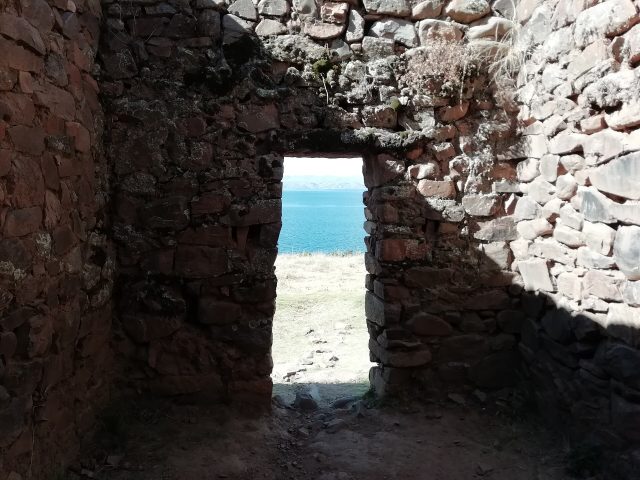
San Sebastián isn’t Copacabana’s main attraction. That honor goes to the Basilica of Our Lady of Candelaria, which draws pilgrims from across Latin America. But that’s why it feels special. No crowds, no souvenir vendors, no rush. People come for the stillness, the weight of history in the stones, the way light at this altitude sharpens everything. On clear days, the view from the windows stretches across Lake Titicaca, its surface so calm it looks like glass.
For locals, the church is alive. On Sundays, services bring people from nearby villages. The air fills with Quechua. Women in traditional dress—wide skirts, bowler hats—light candles or pray with small statues pressed to their chests. There’s no spectacle, just quiet faith that has endured for centuries. It’s not a museum.
The church has changed over time. Reconstructions in the 18th and 19th centuries added side chapels and Baroque touches to the altar, but it never lost its modesty. No grand flourishes, no gilded domes—just a sense of quiet devotion. That restraint suits the landscape. The church, the lake, and the mountains around it seem to belong together, as if they’ve shaped one another over time.
Copacabana rewards those who look beyond the obvious. San Sebastián is one of those quiet discoveries. It doesn’t demand attention, but it offers something deeper. The murals are beautiful, the craftsmanship precise. Yet what lingers are the echoes of the past—the voices of the Incas, the missionaries, the generations who came here seeking connection. The walls hold them all.