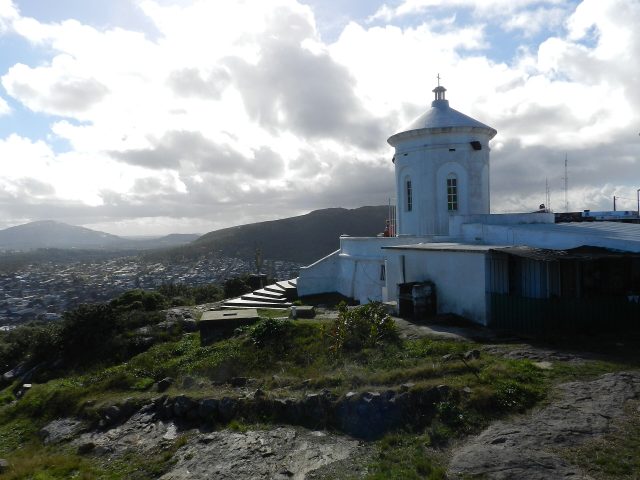
Piriápolis is a town that feels suspended in time, where the salt of the Atlantic breeze mingles with the scent of eucalyptus and the streets still whisper stories from the early 1900s. Perched on a gentle hill overlooking the ocean, the small Church of San Antonio stands as a quiet landmark in this coastal retreat. It doesn’t have the grandeur of European cathedrals or the ornate flourishes of Latin American basilicas, but that’s precisely what makes it special. Here, simplicity carries its own kind of beauty—a place where the weight of history feels light, and the rhythm of life slows just enough to let you breathe.
The church’s story is tied to the vision of Francisco Piria, the entrepreneur and dreamer who founded Piriápolis in the early 20th century. He imagined this stretch of empty coastline as an elegant escape for those seeking refuge from the noise of the world. Construction on San Antonio began in 1929, when the town was still taking shape, its streets unpaved and its future uncertain. Piria chose the hilltop location deliberately, framing the church as a bridge between the earth and the sea, a place where the horizon could inspire reflection. It was never meant to be a spectacle, but rather a sanctuary—one that would grow alongside the town itself.
The architecture reflects that understated purpose. Built in a neo-Romanesque style, the church has the sturdy, unpretentious lines of a building meant to last. Its light stone walls curve into rounded arches, and a modest rose window sits above the entrance, flanked by a single bell tower. Inside, the space is even more restrained: whitewashed walls, wooden pews, and a handful of stained-glass windows depicting saints. There are no gilded altars or elaborate frescoes, just the quiet dignity of craftsmanship done well. The effect is warm, almost domestic, as if the church were a home rather than a monument.
San Antonio hasn’t always looked the way it does today. By the mid-20th century, Piriápolis had fallen out of favor, and the church, like much of the town, was left to weather the years in neglect. But when the town began to revive in the 1980s, so did its little church. Restoration efforts were careful, preserving the original character without adding modern flourishes. Even the bell, which still rings on Sundays, is the same one installed nearly a century ago. The goal was never to transform it into something grander, but to let it remain what it always was—a place of quiet devotion.
Services are still held here, though not as frequently as in larger cities. On Sundays, a small congregation gathers, many of them descendants of the town’s first settlers. During the week, the doors stay open for anyone who wants to step inside, whether to pray, to sit in silence, or simply to take in the view from the hill. The best time to visit is at sunset, when the fading light turns the stone golden and the ocean below blurs into the sky. In those moments, the church feels like a threshold between the past and the present, a place where time seems to pause.
Beyond its religious role, San Antonio has become a cultural touchstone for Piriápolis. It’s a reminder of the people who built the town from nothing, who saw potential in a stretch of sand and scrub. Today, the church occasionally hosts small concerts, art exhibitions, and even weddings. For many couples, Piriápolis is a place of beginnings, and the church on the hill offers a setting that feels both timeless and deeply personal. There’s something fitting about exchanging vows here, where the ocean stretches endlessly beyond the windows, as if bearing witness to promises meant to last.
The church is surrounded by a small park, a green space where eucalyptus and pine trees sway in the coastal wind. It’s a favorite spot for locals, a place to walk, to think, or to escape the heat of the day. Unlike the busier parts of town, there are no crowds here, no souvenir stands or loud cafés—just the rustle of leaves, the distant crash of waves, and the occasional call of a bird. In summer, the air is thick with the scent of blooming trees; in winter, the park becomes a sheltered retreat from the wind. For many in Piriápolis, this is where daily life unfolds—whether it’s a morning coffee on a bench, a dog’s leash trailing through the grass, or an hour spent watching the sea.
San Antonio isn’t the kind of place that demands attention. Its charm reveals itself slowly, much like the town itself, which doesn’t rush to impress. There’s nothing staged about it—the walls still hold the memory of the hands that built them, the bell still rings with the same voice it had decades ago, and the view of the ocean remains unchanged. That authenticity is what makes the church feel alive, even when it’s empty. It’s a place where the past isn’t just remembered; it’s still present, in the quiet hum of the wind and the steady rhythm of the waves.
For visitors, the church offers something rare: a moment of stillness in a world that moves too fast. It’s not about spectacle or grandeur, but about the quiet things—the way the light falls through the windows, the sound of footsteps on the stone floor, the sense of being part of something older and larger than yourself. In Piriápolis, where the pace of life is measured in sunsets rather than hours, San Antonio stands as a gentle reminder of what matters. It’s a place to pause, to look out at the sea, and to remember that some things, like the horizon, are meant to endure.