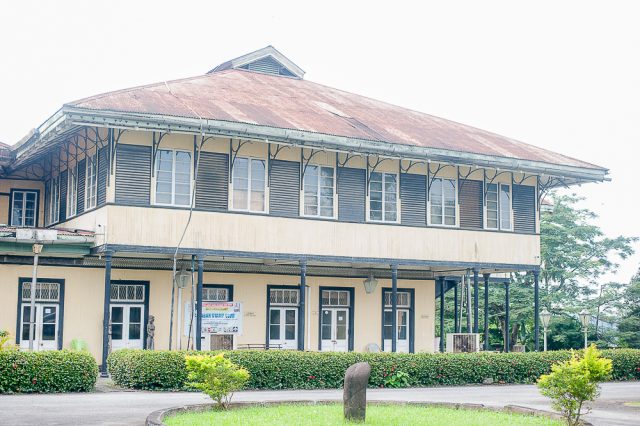
Perched on a gentle hill overlooking the Calabar River, the Church of Our Lady of Victory has watched over the city for more than a century. It stands quietly, as if part of the landscape rather than a focal point, yet its presence carries the weight of history in every stone. Built in the early 1900s, when Calabar connected West Africa to the wider world, the church arrived as Catholic missionaries had been active in the region since the mid-1800s. It became a tangible symbol of their presence—a place where faith took physical form amid colonial influence and local tradition.
The architecture blends European Gothic revival with local adaptations. Tall, pointed windows and sturdy buttresses give the building its silhouette, while the spire reaches toward the sky. The materials tell their own story: stone likely brought from distant quarries, wooden elements—pews, beams, and altar details—crafted by local hands. Inside, stained glass, worn wooden benches, and an altar adorned with images of saints create a quiet harmony. The space feels lived-in, softened by generations of prayers.
Calabar has always been a city of layers.
European traders, the Efik and Ibibio peoples, and freed slaves returning from Brazil and the Caribbean shaped its identity. The Church of Our Lady of Victory became more than a place of worship—it was a gathering point, a refuge, and a witness to change. Before Nigeria’s independence, such places helped shape community bonds, offering stability amid uncertainty.
Today, the church remains part of Calabar’s life. On Sundays, hymns spill into the streets. On weekdays, the doors stay open for those seeking quiet. The small garden around the building, with its palms and flowering shrubs, offers shade from the midday heat. In the evenings, locals sometimes gather to chat or enjoy the breeze.
Unlike many historic sites, this church isn’t a museum. There are no guided tours or gift shops. It exists as it always has: a place of worship, reflection, and community. Visitors often come not to tick off a landmark but to experience the light filtering through stained glass, the creak of floorboards, the sense of continuity where others have stood for generations.
Calabar has changed since the church was built. The port’s role has diminished, and modern buildings surround older neighborhoods. Yet the church remains, a quiet anchor. Its walls hold stories of those who passed through—some celebrated, others forgotten—but all part of Calabar’s past. If you listen, you might catch echoes in the rustle of leaves or the distant chime of a bell.
For visitors, the church offers a different kind of experience. No need to rush. Sit on a wooden bench, watch sunlight shift across the floor, or study old photographs of parishioners lining the walls. It doesn’t insist on being noticed, but those who linger often leave with a deeper understanding of the city—not just its history, but the way it moves through time.
In a world where so many places are polished for consumption, the Church of Our Lady of Victory feels unvarnished. It doesn’t try to impress or entertain; it simply is. And perhaps that’s why it endures—not as a relic, but as a living part of Calabar’s present, a reminder that some things are meant to be experienced, not just seen.