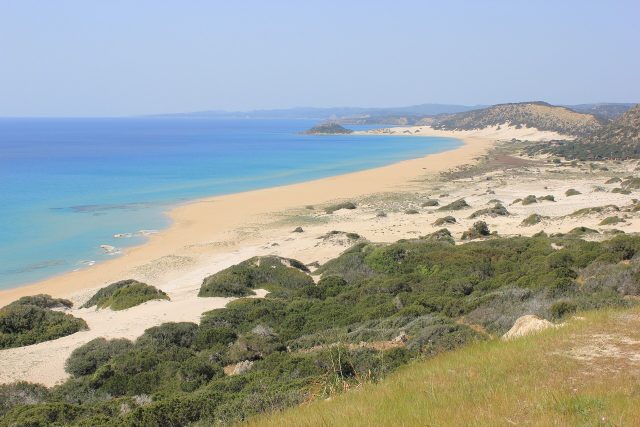
Perched on a gentle hill near the village of Lythragkomi, Panagia Kanakaria Church stands apart from the well-trodden paths of Cyprus. The countryside around it is a patchwork of olive groves and vineyards, where the Troodos Mountains slowly descend toward the Mesaoria plain. On clear days, the sea glimmers in the distance, but this place doesn’t call for crowds. It moves to its own rhythm, the kind you find in villages where the past isn’t just remembered—it’s still part of everyday life.
The church dates to the 6th century, making it one of Cyprus’s oldest Byzantine structures. Its stones are worn smooth, its design simple: a cross-in-square plan with three apses, a style that favored purpose over embellishment. The dome rests on four columns, and the walls, built from local limestone, have softened over time into a warm, golden tone. Inside, the space feels small, as if it was always meant for quiet reflection rather than grand gatherings.
The mosaics here are the reason visitors come. Created around the same time as the church, they’ve survived better than many others on the island. The central figure in the apse is Christ Pantocrator, rendered with a gentleness that’s unusual for the period. The saints and angels around him don’t stare down with severity; their expressions are calm, almost familiar. Below them, the Annunciation unfolds in a scene of quiet reverence. The mosaics are made from tiny cubes of smalto and stone, arranged to catch the light in a way that makes the figures seem to breathe, even in the dim interior.
The church’s history is as layered as the island’s. It endured the Arab raids of the 7th century, though not without scars. Later, the Franks and Venetians left their mark—gothic touches that stand out against the Byzantine simplicity. Under Ottoman rule, it became a mosque, only to be restored as an Orthodox church in the 19th century. Each era left something behind: bricked-up windows, fragments of frescoes peeking through plaster.
In the 20th century, the church faced its greatest loss. After the Turkish invasion in the 1970s, thieves cut the mosaics from the walls and smuggled them out of Cyprus. For years, their whereabouts were unknown until some resurfaced in the U.S. in the 1980s. After legal battles, they were returned, though not all pieces made it back. Today, the church displays both original mosaics and carefully recreated copies—a reminder of how easily history can be stolen and how hard it is to restore.
Panagia Kanakaria is still a place of worship. Locals and the occasional pilgrim visit, drawn by its quiet sanctity. The air inside is always cool, even in summer. In winter, the damp seeps into the stones, deepening their color. There’s no electric light; sunlight filters through narrow windows, casting a soft glow over the mosaics. On rare occasions, when a service is held, the space fills with Byzantine chant, its melodies echoing centuries of devotion.
Getting to Lythragkomi isn’t simple. The village sits far from tourist routes, and public transport doesn’t reach it. But that’s part of the appeal. The journey takes you through other small villages where life moves slowly—women sit outside their homes, old men play backgammon under olive trees. Lythragkomi itself has little in the way of cafes or shops. If you’re lucky, you might stumble upon a local festival or find a bench outside the church to sit and watch the hills stretch toward the sea.
Panagia Kanakaria doesn’t demand attention. There are no golden domes or marble columns here. Its beauty is in its modesty, in the way history isn’t just preserved but feels present—in the silence, in the way light plays on ancient mosaics, in the rustle of leaves outside. It’s a reminder that Cyprus holds more than beaches and resorts. Sometimes, all it takes is a moment of stillness to feel the weight of the past.