Ntarama Church sits on the edge of Gikongoro, a quiet town in southern Rwanda. It isn’t a place of worship anymore, nor is it a monument to architecture or faith. Instead, it stands as a memorial to the hundreds who sought refuge here in April 1994, during the genocide against the Tutsi. Their hope was met with violence, and nearly all who had gathered inside were killed. Today, the silence within its walls is heavy, carrying the weight of what happened.
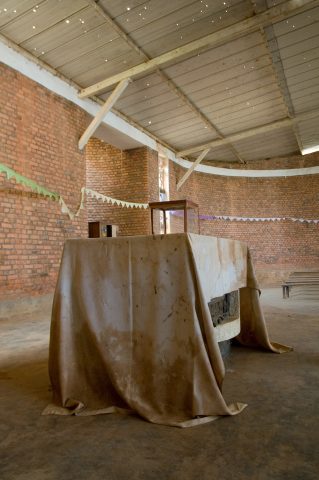
From the outside, the building looks unremarkable—a simple rural church with brick walls and a metal roof. Inside, the space is stripped bare: wooden benches, an altar, and walls left as they were after the attack. Bullet holes puncture the plaster, doors hang broken, and the floor bears the dark stains of rust. Nothing has been cleaned or repaired. The damage remains as evidence, a stark reminder of the past. In places, faint markings on the walls hint at the desperation of those who once hid here, their messages left behind in the chaos.
After the genocide, the decision was made not to restore the church. Instead, it was preserved exactly as it was found, a raw and unfiltered testament to the tragedy. The interior holds the personal belongings of the victims—clothing, shoes, identity papers, and children’s toys. Bibles, school notebooks, and framed photographs lie scattered, each item a silent story of a life cut short. There are no displays or explanations, just the objects themselves, left where they fell.
What sets Ntarama apart from other genocide memorials in Rwanda is its simplicity. There are no museum exhibits, no interactive maps, no documentaries playing on loop. The experience is direct and unfiltered. A local guide, often someone who survived the genocide or lost family members, walks visitors through the space. They point out where the attackers stood, where people tried to hide behind the altar, and how the church became a trap. Their words are measured, their tone quiet, which somehow makes the story harder to bear.
Outside, the landscape is peaceful. Fields stretch toward rolling green hills, birds sing, and the wind rustles through the grass. In the distance, villages dot the countryside, where life continues much as it always has. The contrast between the serene surroundings and the violence that unfolded here decades ago is jarring. It’s a reminder of how quickly ordinary places can become sites of unimaginable horror.
People come to Ntarama for different reasons. For some, it’s a pilgrimage—a way to honor the dead or to try to understand a history that still shapes Rwanda today. For others, it’s a moment of reflection, a chance to confront the darker chapters of human history. There are no souvenirs to buy, no cafes to visit afterward. Many leave in silence, unsure how to process what they’ve seen. Some stand for a long time outside, staring at the hills, while others weep quietly.
This is not a place that offers easy answers or comforting narratives. It doesn’t seek to entertain or inspire in the way most travel destinations do. Instead, Ntarama serves as a stark warning—a reminder of how fragile peace can be. There are no calls for vengeance here, only a quiet insistence that the past must not be forgotten. Rwanda has worked to heal and rebuild, but the memory of the genocide remains, preserved in places like this.
For Rwandans, Ntarama is sacred ground. Families who lost loved ones come here to pay their respects, sometimes holding memorial services, though more often simply standing in silence or laying flowers. For foreigners, it offers a glimpse of a side of Rwanda rarely mentioned in travel guides—a country that has faced its history with honesty and resilience.
If you find yourself in Gikongoro, Ntarama is worth visiting. But be prepared: this is not a place that leaves you untouched. It doesn’t offer solace or distraction. It simply exists, a quiet witness to a tragedy that must never be repeated.