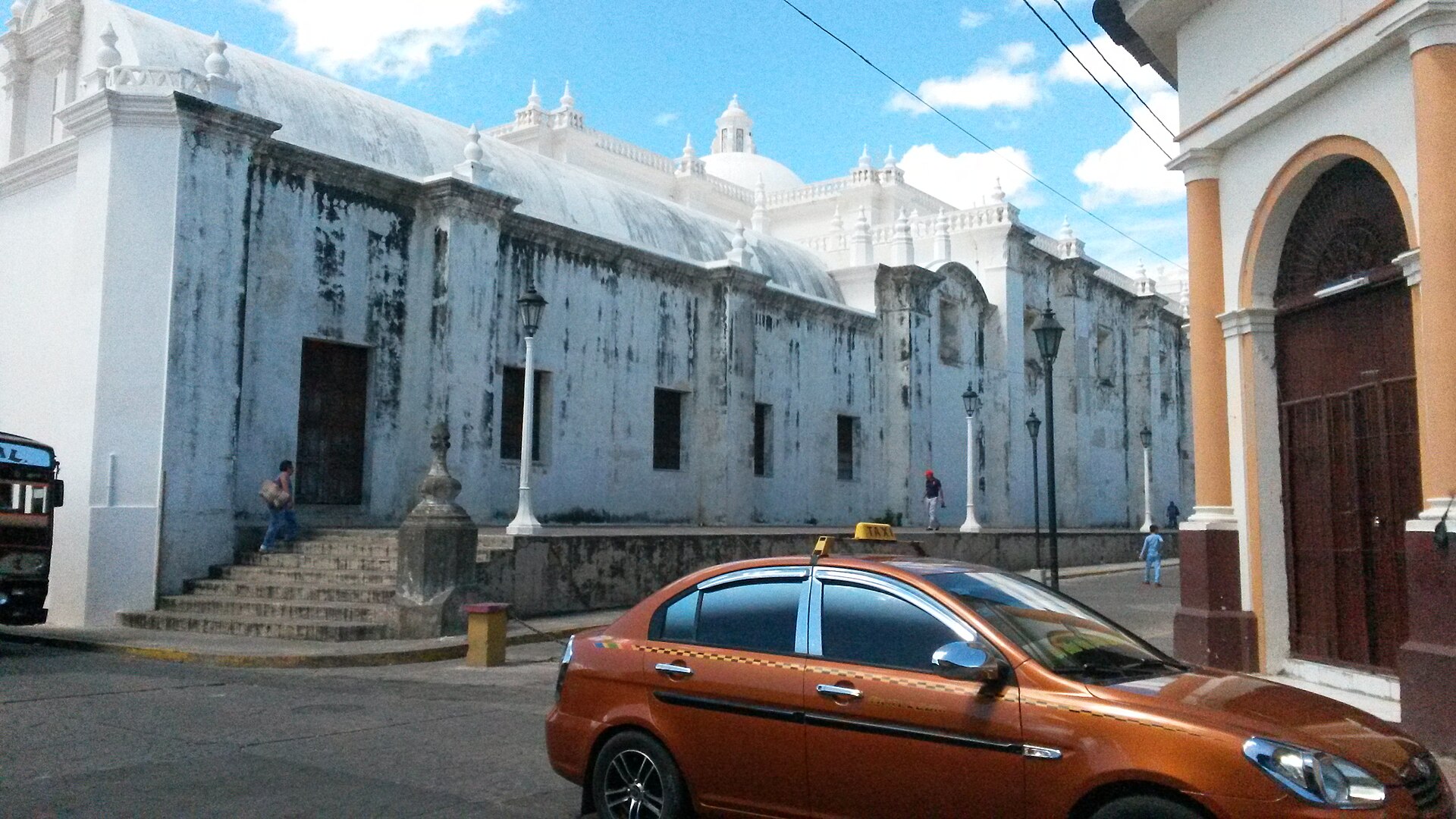
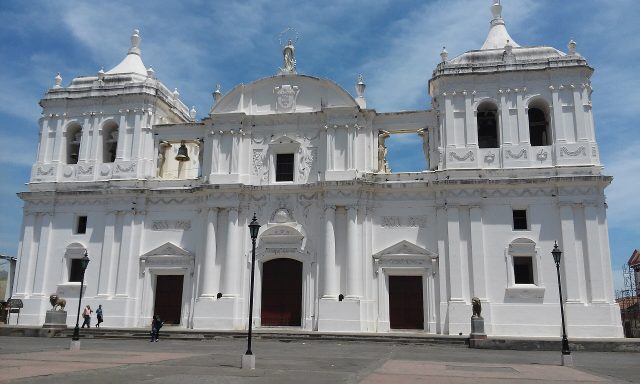
León’s La Recolección isn’t just another colonial church—it’s a quiet giant, one of those places that feels older than the city itself. Built in the late 18th century, it stands on the edge of what was once the outskirts of León, where the grid of streets gives way to a more open, dusty expanse. The church was founded by the Recollects, a branch of the Franciscan order known for their austerity, and that sense of restraint is still visible in the building’s unadorned façade. There’s no gilded excess here, no baroque flourishes competing for attention. Instead, the church presents a long, low wall of weathered stone, interrupted only by a single arched doorway and a few narrow windows. It’s the kind of architecture that doesn’t demand admiration but earns it slowly, the way a well-worn book earns its dog-eared pages.
Inside, the space opens up in a way that feels almost unexpected after the modest exterior. The ceiling soars, supported by thick wooden beams that have darkened with age, their grain still visible beneath layers of varnish. The nave is wide and uncluttered, with rows of simple wooden pews leading toward the altar. The walls are mostly bare, save for a few faded religious paintings and the occasional patch of exposed brick where the plaster has worn away. Light filters in through high, narrow windows, casting long, slanted rectangles across the floor. It’s a place that invites stillness, not because it’s grand, but because it feels honest—like a room that has seen centuries of quiet prayers, whispered confessions, and the slow passage of time.
What makes La Recolección unusual is how little it has changed over the years. Unlike many colonial churches in Nicaragua, which were either lavishly restored or repurposed during the 19th and 20th centuries, this one has remained stubbornly itself. The original retablo, a wooden altarpiece carved in the late 1700s, still stands behind the altar, its details softened by time but still recognizable. The pulpit, too, is original, a small wooden balcony perched near the front of the nave, where sermons were once delivered to a congregation that likely filled the space to capacity. There’s a sense of continuity here, as if the church has simply carried on, undisturbed by the revolutions, earthquakes, and political upheavals that have reshaped León over the centuries.
The church’s history is intertwined with that of the city in ways that aren’t always obvious. León was Nicaragua’s capital for much of the colonial period, a center of power and wealth, but La Recolección was never a church for the elite. It served the working-class neighborhoods that grew up around it, a place where farmers, artisans, and laborers would gather for mass or seek solace during times of hardship. During the 19th century, when León became a hotbed of liberal politics and intellectual ferment, the church remained a constant, a quiet counterpoint to the fiery rhetoric of the era. Even today, it’s not a tourist magnet like León’s cathedral or the ruins of nearby Subtiava. Most visitors who wander in do so by accident, drawn perhaps by the promise of shade or the curiosity of an open door.
One of the most striking things about La Recolección is how it sits in the landscape. León is a city of volcanoes—Momotombo looms to the east, its perfect cone often shrouded in mist, while Cerro Negro, the young and restless volcano, dominates the horizon to the north. The church doesn’t face any of them directly, but its orientation feels deliberate, as if it’s turned slightly away from the drama of the natural world, toward something more inward. The courtyard in front of the church is a dusty, sunbaked space, often empty except for a few stray dogs or a vendor selling fruit from a cart. There’s no grand plaza here, no fountain or statue to anchor the scene. Just the church, the sky, and the occasional gust of wind that kicks up the dry earth.
In the late afternoon, when the light slants low and the heat of the day begins to ease, the church takes on a different quality. The shadows lengthen, and the stone walls seem to glow with a warm, golden hue. The air inside is cooler than outside, carrying the faint scent of old wood and candle wax. If you’re lucky, you might hear the distant sound of a choir practicing in one of the side chapels, their voices rising and falling in a slow, mournful melody. It’s a moment that feels suspended in time, as if the church has paused to catch its breath before the evening mass.
La Recolección isn’t the kind of place that makes it onto postcards or into guidebooks with star ratings. It doesn’t have the dramatic ruins of León Viejo or the political weight of the cathedral, where Rubén Darío’s tomb lies. But that’s part of its charm. It’s a church for those who prefer their history unvarnished, their spaces uncluttered by the expectations of tourism. It doesn’t tell you how to feel or what to think. It simply stands there, a silent witness to the lives that have passed through its doors—some seeking faith, others refuge, and a few, perhaps, just a moment of quiet in a noisy world.
If you do visit, don’t rush. Sit for a while in one of the pews, let your eyes adjust to the dim light, and listen to the sounds of the city fading into the background. Outside, León will go on—motorbikes will buzz past, vendors will call out their wares, and the volcanoes will watch over it all, indifferent and eternal. But inside La Recolección, time moves differently. It’s slower, deeper, the kind of time that doesn’t measure itself in hours but in the weight of centuries. And that, more than anything, is what makes this place worth finding.