Candelária Church is one of those rare places in Rio de Janeiro where the city’s layered history feels almost tangible. Standing at the heart of downtown, on Praça Pio X, it seems to exist slightly apart from the rush of modern life, as if time moves differently within its walls. The church began as a modest chapel in the late 18th century, dedicated to Our Lady of Candelária, the patron saint of sailors. According to local lore, its origins trace back to a vow made by Portuguese merchants who survived a shipwreck, a story that ties the building to the city’s early days as a bustling port where fortunes were made and lost, and cultures collided.
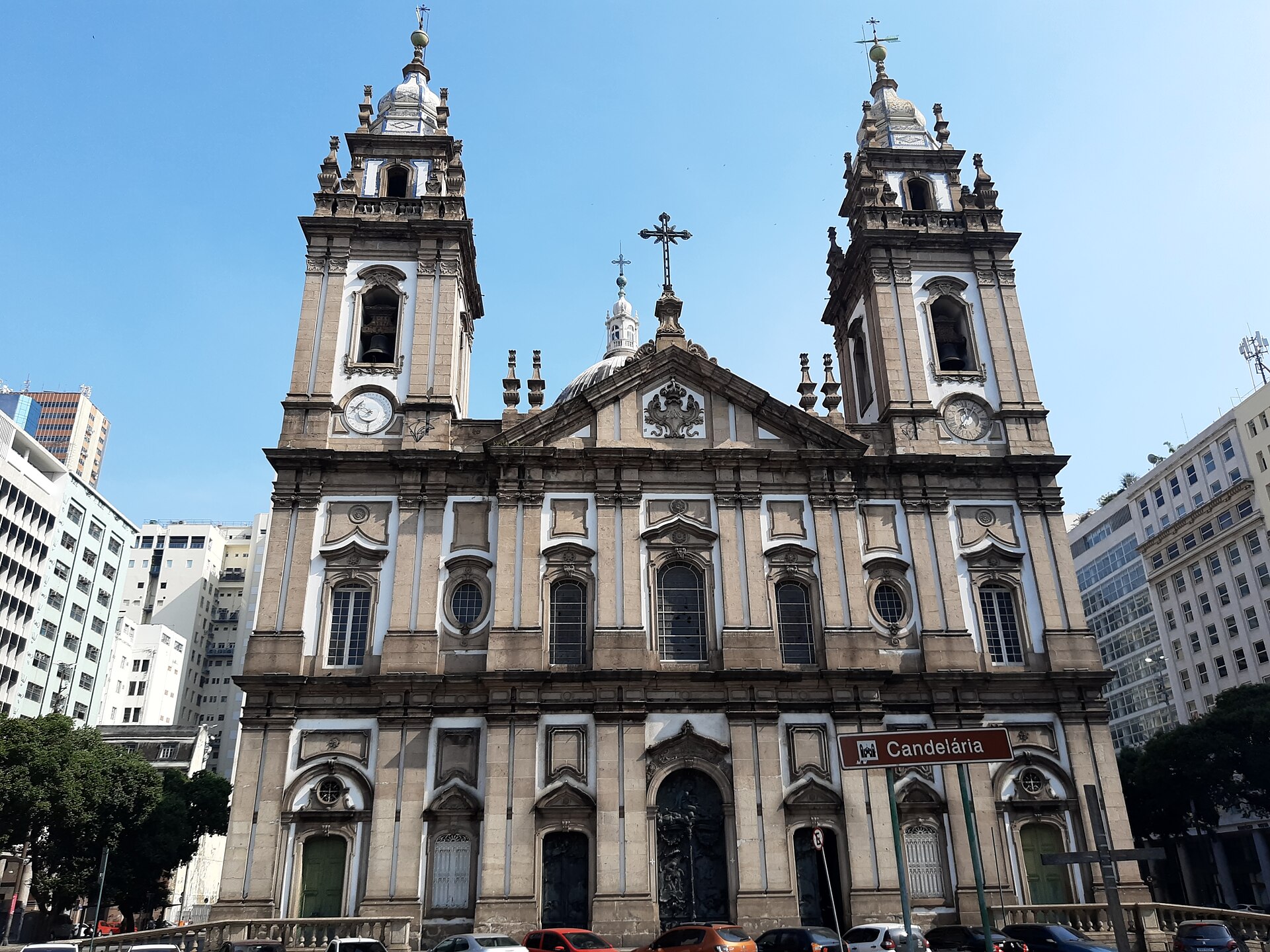
The architecture of Candelária tells its own story of Rio’s evolution. The original structure was simple, built to serve the needs of a growing but still provincial town. By the mid-19th century, however, it was clear that the city—now the capital of the Empire of Brazil—required something grander. What followed was a decades-long reconstruction that transformed the church into the imposing structure we see today. The neoclassical façade, with its tall columns and dome crowned by a statue of the Virgin Mary, reflects the ambitions of a young nation eager to assert its place in the world. Inside, the contrast is striking: the colonial influences remain, with intricate wood carvings, gilded altars, and frescoes that whisper of a time when Brazil was still a distant outpost of the Portuguese crown.
Stepping inside Candelária, you won’t find the overwhelming opulence of Europe’s great cathedrals. Instead, there’s a quiet dignity to the space, a sense of understated elegance. The main altar gleams with gold leaf, while the vaulted ceilings are adorned with scenes from the lives of Christ and the Virgin Mary. The stained glass windows, softer and more muted than those in Gothic churches, cast a gentle light that seems to slow time. Among the church’s treasures is the original statue of Our Lady of Candelária, brought from Portugal in the 18th century and still revered as miraculous. Every February, pilgrims gather here to honor her feast day, a tradition that has endured for centuries.
Candelária has witnessed some of Rio’s most pivotal moments. In the 19th century, it played host to the coronations of Brazilian emperors, their ceremonies blending imperial pomp with religious solemnity. After the fall of the monarchy and the birth of the republic, the church became a place of reflection for a nation in transition. In the 20th century, it served as a gathering point during times of political upheaval, its steps filled with people seeking solace or solidarity. Yet its history is not without tragedy. In 1993, the church became the backdrop to one of Rio’s darkest episodes when police opened fire on a group of homeless children sleeping near its entrance. Today, a memorial on the square stands as a stark reminder of that night, ensuring that Candelária remains not just a spiritual landmark but a symbol of the city’s unresolved struggles.
Unlike some of Rio’s more tourist-heavy churches, Candelária has managed to retain its authenticity. It’s still very much a place of worship, not just a historical site. On Sundays, the sound of the organ fills the nave, and the pews are filled with locals attending mass. On weekdays, you might find a handful of people praying in the side chapels or simply sitting in silence. There are no crowds jostling for photos, no vendors hawking souvenirs—just the quiet rhythm of a church that has served its community for over two centuries. It’s this sense of continuity that makes Candelária feel different from other landmarks in the city.
The area around the church offers a glimpse into Rio’s past. Praça Pio X is one of the few places in downtown where the old city still breathes. The square is surrounded by colonial-era buildings, their facades weathered by time, and narrow streets that lead down to the waterfront. Nearby, the Centro Cultural Banco do Brasil hosts exhibitions and performances, while the port area, once the lifeblood of the city, now stands as a reminder of Rio’s maritime heritage. Walking these streets, it’s easy to imagine the city as it once was—before the skyscrapers, before the traffic, when Rio was still a port town where sailors, merchants, and slaves shaped its destiny.
What makes Candelária special is its ability to exist in two worlds at once. It’s a monument to history, yes, but it’s also a living part of the city. It has survived revolutions, economic booms and busts, and the relentless march of progress, yet it remains a place of refuge. For visitors, it offers a chance to step back in time, to see Rio not just as a modern metropolis but as a city with deep roots. For locals, it’s a reminder of what endures—faith, tradition, and the quiet spaces where the noise of the world fades away.
In a city that never stops moving, Candelária stands still. It doesn’t demand attention like the Christ the Redeemer statue or the beaches of Copacabana, but for those who take the time to visit, it offers something far more meaningful: a connection to the past, a moment of peace, and a sense of the layers that make Rio what it is. Whether you come to pray, to admire the architecture, or simply to sit in silence, the church has a way of making you feel like you’ve touched something timeless.