Hólar is one of those places in Iceland where time seems to move differently. Tucked away in the northern part of the country, surrounded by rolling green hills and low mountains, it feels like a world apart from the bustle of Reykjavík. There’s no rush here, no crowds—just the quiet rhythm of nature and history woven together so naturally that it’s easy to imagine stepping back centuries. Once one of Iceland’s most important cultural and religious centers, Hólar still carries the weight of its past, and nowhere is that more evident than in the unassuming church of Grettistadir.
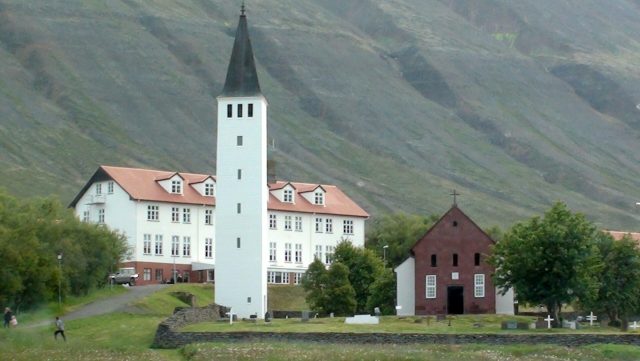
The church stands where the farmstead of Grettir the Strong once stood, a figure as complex as he was legendary. Grettir’s story is one of Iceland’s most famous sagas—a man both feared as an outlaw and respected as a protector of the weak. The church itself wasn’t built until the 19th century, long after Grettir’s time, but the connection to those old tales lingers in the air. Unlike most Icelandic churches, which were made of stone or turf, Grettistadir is built of wood, giving it a warmth and intimacy that feels almost out of place in this stark landscape. The low ceilings, small windows, and sturdy beams inside create a sense of shelter, as if the building itself is offering refuge from the wind and rain outside.
Inside, the church is simple, almost austere. There’s no grand decoration, just a few remnants of its 19th-century origins—a carved pulpit, old lamps, a modest altar. It’s not a place that demands attention, but one that invites quiet reflection. The space is small, barely large enough for a hundred people, and that intimacy makes it feel all the more personal. You won’t find tour groups here, just the occasional visitor or local stopping by, and the silence inside is almost tangible.
Hólar’s history goes beyond the sagas. In the 17th century, it became home to one of Iceland’s first schools, a place that helped spread literacy and education across the island. Later, in the 19th century, it played a role in the country’s religious revival, a time when Icelanders began reclaiming their cultural identity after centuries of Danish rule. Grettistadir wasn’t at the center of these movements, but it became part of them, a quiet symbol of continuity in a changing world.
Today, Hólar is a place for those who want to experience Iceland beyond the postcard images. There are no souvenir shops or guided tours here, just open fields where sheep graze, old farmhouses with weathered fences, and mountains that shift in color with the light. The church sits a little off the main road, accessible only by a narrow path that winds through the fields. Walking that path feels like stepping into the past, a reminder of all the people who have walked it before.
Around the church, a small cemetery stretches out, its gravestones worn smooth by time and weather. Some are so old they’ve been claimed by moss, their inscriptions barely legible. It’s not a sad place, though—more like a quiet acknowledgment of the lives that have come and gone here. Mostly, it’s locals who visit, especially during religious holidays, when the village comes alive with music and gatherings. On those days, the church is filled with voices, and the warmth inside feels like a counterpoint to the cold outside.
Grettistadir isn’t the kind of place that draws crowds. It doesn’t have the grandeur of Reykjavík’s cathedral or the dramatic appeal of Iceland’s famous waterfalls. But that’s precisely what makes it special. It exists not to impress, but to remind—to hold onto a piece of history in a way that feels real and unpolished. You can sit on one of the old wooden benches, listen to the wind outside, and think about how much has changed, and how much has stayed the same.
If you find yourself in this part of Iceland, take a moment to stop. Walk up to the church, step inside, and sit for a while. There’s nothing flashy here—just old wood, soft light filtering through the windows, and the quiet hum of the past. That’s the magic of Hólar and Grettistadir. It’s not a place for those seeking spectacle, but for those who want to feel the weight of history, to understand that sometimes the most meaningful things are the ones that don’t try to be anything at all.