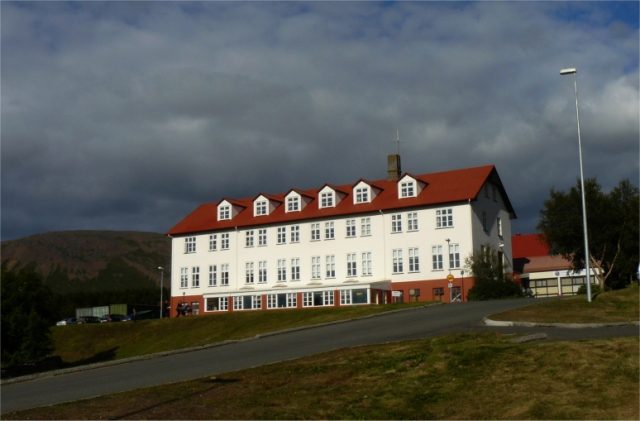
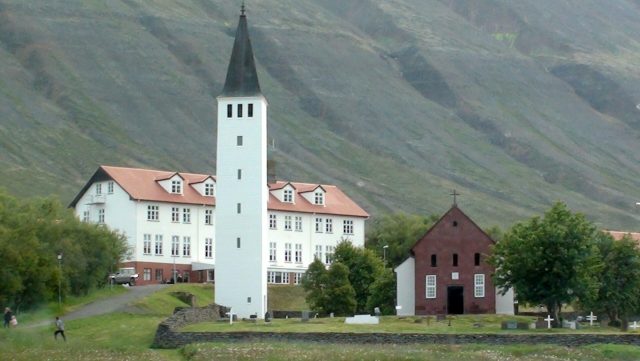
Hólar is one of those places in Iceland that most travelers overlook, tucked away in the quiet northern reaches of the country. There are no crowded streets or neon signs here, just a handful of buildings in a gentle valley, surrounded by low hills and open land. This settlement was once one of the most important places in Iceland, a center of power and learning when the country was still finding its footing. For centuries, Hólar served as the seat of one of Iceland’s two medieval bishoprics, shaping the religious and cultural life of the north. Today, its past is still visible in the few structures that remain, including Hóladómkirkja, a church that stands as a quiet witness to Iceland’s history.
Hóladómkirkja sits on a small rise. Its whitewashed walls and red roof contrast with the greens and browns of the surrounding landscape. The current structure dates to the early 19th century, but the site itself is far older. The first church was built here in the 11th century, not long after Iceland officially adopted Christianity. Hólar became the spiritual heart of northern Iceland, a role it held for nearly seven hundred years. The church we see today carries that history in its timber and stone.
The design is simple, built to withstand the climate. The wooden frame, clad in painted planks, and the steeply pitched roof are typical of Scandinavian church architecture. Inside, wooden pews face a modest altar. The carved altarpiece, a Baroque piece from the 18th century, came from Denmark. Its details stand out against the otherwise plain interior, showing the church’s connections beyond Iceland.
Hóladómkirkja is a link to Iceland’s medieval past. In the Middle Ages, Hólar was home to one of the country’s first schools. Students studied theology, Latin, law, and medicine. The old schoolhouse still stands nearby, now a small museum. Inside, you’ll find old books, religious artifacts, and faded photographs. It’s a place where history feels close.
Hólar has never been a busy place. Today, it’s a cluster of houses, a church, and a few outbuildings. The nearest town, Sauðárkrókur, is a half-hour drive away. That isolation makes Hólar special. Visiting feels like stepping back in time, to an Iceland where life moved at a slower pace.
Walk from the church to the old schoolhouse. Follow the dirt paths through the hills. The landscape here is rolling green slopes in summer, snow in winter, with sheep grazing in the distance. The air is crisp. The silence is broken only by the wind or a bird’s call. In winter, you might see the northern lights.
Hóladómkirkja is open year-round. Summer visits are easier, when roads are clear and days are long. There’s no entrance fee, but donations are welcome. The museum keeps irregular hours, so check ahead if you want to visit. Even if it’s closed, the church and the landscape are reason enough to come.
This isn’t a place for those seeking crowds. There are no souvenir shops or guided tours. Just a quiet church, a few houses, and open land. For those who like history, solitude, and Iceland’s countryside, it stays with you. The past isn’t just in museums here. It’s in the land, the light on the hills, the way the church has stood for centuries.