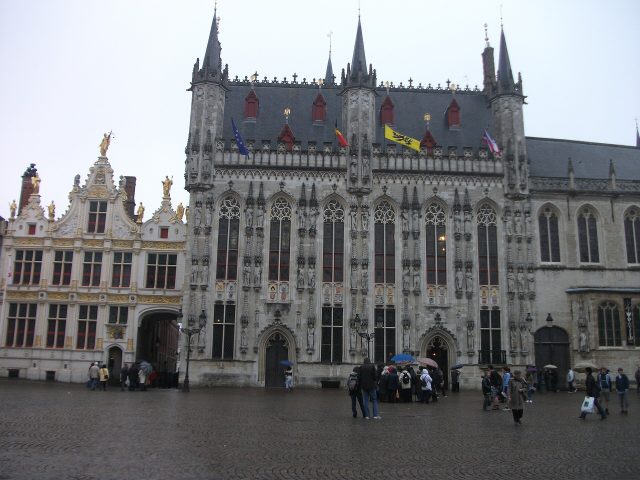
Saint Peter’s Church in Ghent is one of those places that doesn’t demand attention at first glance, but once you step inside, you begin to understand why it has stood here for centuries. Tucked away in the heart of the city, it offers a quiet contrast to the lively squares and bustling streets just beyond its walls. From the outside, the church appears unassuming—its grey stone, tall pointed windows, and sturdy buttresses are classic Gothic features, yet there’s something quietly compelling about its simplicity.
The history of Saint Peter’s stretches back to the 12th century, when a Romanesque basilica first occupied this site. Over time, it was rebuilt, expanded, and refined, gradually taking on the form we see today by the 15th century. Inside, traces of its earlier life remain. The crypt, for instance, still carries the weight of the Middle Ages, while old tombstones serve as silent reminders of those who once prayed here. The church has weathered wars, fires, and revolutions, yet it endures not just as a monument, but as a living place of worship.
The interior is striking in its harmony. Soaring vaults, supported by slender columns, create a sense of openness, while light filters through stained glass, casting soft hues across the stone. The high altar is particularly impressive—a masterpiece of Baroque craftsmanship, rich with gilded details. Nearby, works by local artists, including paintings and sculptures, once part of larger altarpieces, have been carefully restored after suffering damage during the 16th-century iconoclastic riots. They now occupy their rightful place in the church, their stories still visible in the brushstrokes and carvings.
Saint Peter’s has long been woven into the fabric of Ghent. In the Middle Ages, it was more than a spiritual center—it was a place where the city’s affairs were discussed, where relics were kept, and where the influential were laid to rest. The crypt still holds the tombs of old Ghent families, their names once well-known in these parts. The church also bore witness to the upheavals of the French Revolution, when it was looted before eventually being returned to the faithful. Since then, it has resumed its role as a place of quiet devotion.
Today, the church welcomes anyone seeking a moment of reflection or a connection to the past. The atmosphere inside is almost always calm, even when the city outside hums with activity. Visitors can climb to the choir loft for a sweeping view of the nave or descend into the crypt, where time seems to stand still. Occasionally, organ concerts fill the space with music—the instrument, installed in the 19th century, resonates through the stone, making the walls feel alive.
Ghent is a city where history lingers on every corner, but Saint Peter’s holds a special place in its story. It may not draw the same crowds as Saint Bavo’s Cathedral or the Castle of the Counts, yet that’s part of its charm. There are no tour groups rushing through, no hurried footsteps—just stillness and the sense that time moves differently here. Perhaps that’s why those who wander in often find themselves lingering longer than they intended. In a place like this, you don’t just observe; you feel the quiet pulse of a city that has endured for generations.