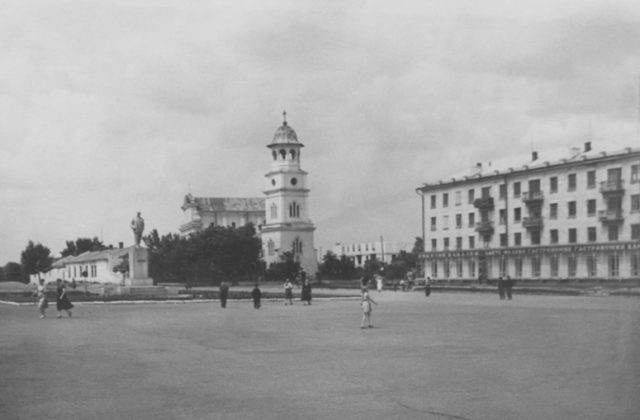
Rudy’s central square is the kind of place where the town’s pulse slows just enough to let you notice the details. There’s no rush here, no crowds of tourists snapping photos or vendors shouting over one another. Instead, the square feels like the heart of a small Moldovan town where life moves at its own unhurried pace. It’s compact, almost intimate, with just enough space for a few benches, a scattering of cafés, and the occasional group of locals catching up over coffee. The charm isn’t in grand gestures but in the quiet rhythm of everyday life—people strolling, children playing, the occasional stray cat weaving between parked cars.
Rudy itself is a typical Moldovan town, the kind where history isn’t preserved in museums but woven into the fabric of daily existence. The square, like the town, isn’t ancient, but it carries a sense of continuity. There are no medieval fortresses or Roman ruins here, just a handful of buildings that tell a story of simpler times. Many of the structures date back to the Soviet era, their low, functional facades softened by time and the occasional touch of traditional Moldovan design—pastel shutters, arched doorways, or a balcony draped in vines. The square doesn’t try to impress; it simply exists, a natural gathering place for the town’s residents.
At the center of the square stands a monument, a modest tribute to those who shaped the town’s past. Such memorials are common in Moldovan settlements, and while they may not draw crowds of visitors, they hold meaning for locals. On any given day, you might find a few people sitting on the benches nearby, chatting or simply enjoying the shade of the trees. Sometimes, fresh flowers are left at the base of the monument, a quiet reminder of the lives it honors. These small acts of remembrance are part of what makes the square feel lived-in, a place where history isn’t just remembered but actively kept alive.
The architecture around the square is unassuming, even plain, but there’s a certain harmony to it. Most of the buildings are two or three stories tall, their facades clad in light stone or plaster, giving the space an airy, open feel. The ground floors often house small shops, cafés, or offices, while the upper levels are residential. This mix of public and private spaces makes the square feel like an extension of the neighborhood rather than a separate, staged area. It’s the kind of place where you might run into a neighbor while buying bread or strike up a conversation with the owner of a tiny wine shop who’s happy to recommend a local vintage.
What makes Rudy’s central square special is its refusal to be anything other than itself. There are no grand fountains, no towering statues, no wide boulevards designed for parades. Instead, there’s an authenticity that’s increasingly rare in larger cities. This is a place where people know one another by name, where news travels through casual conversations at the market or over a glass of wine at a café. It’s the kind of square where you can sit for an hour and watch the town go about its business—students hurrying to school, elderly men playing dominoes at an outdoor table, a group of women setting up a small stall to sell homemade preserves.
In the summer, the square comes alive with small markets where locals sell fresh produce, cheese, and wine. Moldova is known for its winemaking, and even in a town as small as Rudy, you can find bottles from nearby vineyards. The markets here aren’t the polished, tourist-friendly affairs you’d find in Chișinău; they’re more like a village bazaar, where everything is sold straight from the farm. You might find a woman selling jars of pickled vegetables from her garden or a farmer offering bunches of herbs tied with twine. The prices are low, the bargaining is friendly, and the atmosphere is one of genuine exchange rather than commerce.
Winter transforms the square into a different kind of space. A Christmas tree is erected in the center, its lights twinkling against the snow, and the air fills with the scent of mandarins and mulled wine. Moldova’s winters are mild compared to those in northern Europe, but snow still falls regularly, dusting the rooftops and turning the square into a scene from a postcard. Children sled down gentle slopes, while adults take leisurely walks, their breath visible in the cold air. The pace slows even further during the holidays, as families gather to celebrate, their laughter and conversations blending with the soft crunch of snow underfoot.
Beyond its role as a marketplace or a meeting point, the square also serves as a cultural hub for the town. Small concerts, art exhibitions, and festivals often take place here, giving local musicians, artists, and craftspeople a chance to showcase their work. These events aren’t always widely advertised, so stumbling upon one feels like discovering a hidden gem. One evening, you might find a folk band playing traditional Moldovan music, their accordions and violins filling the square with lively melodies. Another day, there could be an impromptu display of handmade textiles or pottery, each piece telling a story of the town’s creative spirit.
For visitors staying in Rudy for more than a day, the square is a natural starting point for exploring the town. From here, you can wander down the surrounding streets, popping into small shops to browse handmade souvenirs or stopping at a café to try dishes like *mămăligă* (a cornmeal porridge often served with cheese and sour cream) or *sarmale* (cabbage rolls stuffed with meat and rice). The town’s other attractions are within easy walking distance, though they may not be as grand as those in larger cities. What they lack in scale, they make up for in character—a quiet church with a weathered bell tower, a small museum housed in a former merchant’s home, or a park where elderly men play chess under the shade of old trees.
Rudy’s central square won’t dazzle you with its grandeur or overwhelm you with its history. It doesn’t aspire to be a tourist destination or a must-see landmark. Instead, it offers something far more valuable: a glimpse into the real Moldova, the one that exists beyond guidebooks and curated experiences. This is a place where life unfolds at its own pace, where the past and present coexist without fanfare, and where the simple act of sitting on a bench can feel like a small revelation. If you find yourself in Rudy, don’t rush past the square. Take a moment to linger, to watch, to listen. It’s in these quiet, unscripted moments that the town reveals itself.