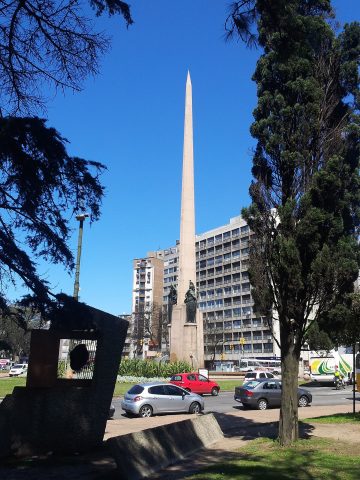
The Banco República headquarters in Montevideo is one of those buildings that quietly anchors the city, blending into the daily rhythm of the streets while carrying the weight of Uruguay’s history within its walls. Tucked away in the heart of the capital, it stands at a busy intersection where people rush past on their way to work or appointments. Yet if you pause and look up, the building reveals itself as more than just a financial institution—it’s a piece of the country’s identity, shaped by time and purpose.
Constructed in the early 20th century, the building reflects the optimism of an era when Uruguay was striving for economic stability and progress. Its architecture balances classical grandeur with the subtle influences of Latin American modernism. The imposing columns, heavy wooden doors, and intricate stonework convey a sense of permanence and trust—qualities essential for a national bank. Inside, the high ceilings, marble staircases, and antique chandeliers evoke an age when banking was as much about craftsmanship as it was about numbers. The design feels deliberate, almost ceremonial, as if every detail was meant to inspire confidence in those who walked through its doors.
The history of the Banco República is deeply intertwined with Uruguay’s journey as an independent nation. Founded in the 19th century, shortly after the country gained sovereignty, the bank played a central role in shaping Uruguay’s financial system. The headquarters wasn’t just an office; it was a hub where decisions were made that would ripple across the economy and touch the lives of ordinary citizens. For decades, it housed the country’s gold reserves and brokered deals that determined Uruguay’s economic future. In many ways, the building itself became a symbol of hope—a promise that stability and prosperity were within reach.
Today, the Banco República remains one of Uruguay’s most important financial institutions, but its headquarters has evolved into something more than a workplace. It’s now part of Montevideo’s cultural heritage, a place where people come not just to conduct business but to connect with the past. Some of its halls occasionally host exhibitions on the bank’s history or Uruguay’s economic development, while lectures and discussions on the country’s future are sometimes held within its walls. For visitors, the building offers more than just architectural beauty; it’s a chance to step into a living history, one that still resonates in the marble and stone.
Walking through downtown Montevideo, it’s easy to overlook this building if you don’t know what to look for. Unlike modern offices with their flashy signs and glass facades, the Banco República’s headquarters doesn’t demand attention. Instead, its strength lies in its understated confidence. The light stone facade, large windows, and symmetrical lines create a sense of order and reliability, a quiet counterpoint to the city’s bustling energy. There’s no need for extravagance here—the building’s presence speaks for itself.
Inside, the atmosphere feels frozen in time, a remnant of the early 1900s. The marble floors, dark wood paneling, and vintage clocks on the walls all hint at an era when banking was as much about relationships as it was about transactions. Even with modern technology integrated into the space, the old-world charm hasn’t been erased. Perhaps that’s why many Uruguayans still hold this building in such high regard—it’s not just a bank to them, but a tangible link to their country’s past.
For those interested in architecture, the Banco República headquarters is a fascinating study in how European styles were adapted to a Latin American context. The building shows clear influences of Italian neoclassicism, yet there’s something distinctly Uruguayan in its proportions and details. Local architects and craftsmen took the classical forms and made them their own, creating a structure that feels both timeless and rooted in its surroundings. It’s a reminder that even in a globalized world, architecture can still carry a sense of place.
Despite its formal purpose, the building doesn’t feel cold or impersonal. Maybe it’s because the people who work here understand its history and take pride in it. Or perhaps it’s the way the architecture itself, though grand, doesn’t overwhelm—it invites you in. Visitors often linger in the halls, not just to handle their banking needs but to admire the interiors or snap a few photos. In a city where the past and present often collide, this building manages to bridge the two effortlessly.
In an age where banks increasingly operate in glass towers or digital spaces, the Banco República’s headquarters stands as a reminder that finance is about more than just money. It’s about people, trust, and tradition. The building has weathered economic crises, political shifts, and generations of change, yet it remains firmly in place. In a world that moves too quickly, such places become anchors, grounding us in history while still serving a purpose in the present. And that, perhaps, is why it will likely stand for another hundred years.