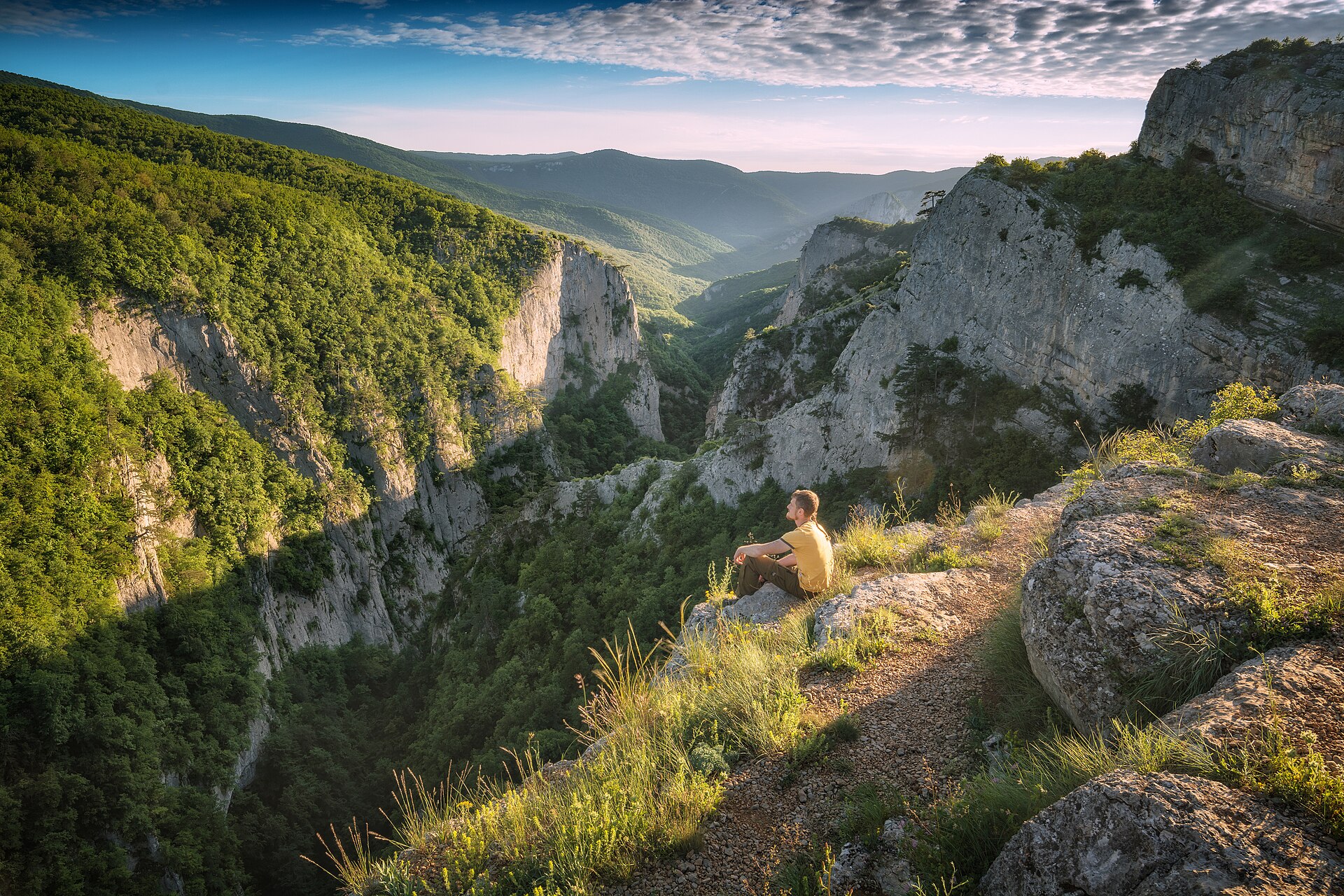
The Great Canyon of Crimea is one of those rare places where nature seems to have deliberately flexed its muscles, carving something both dramatic and delicate into the landscape. Tucked away in the heart of the Crimean Mountains near the village of Sokolinoye, this narrow gorge slices through the rock like a scar, its sheer walls rising so close in places that you feel as if you’ve stepped into another world entirely. The air here carries the weight of time—millions of years of water patiently wearing away at limestone, shaping the canyon into what it is today. In summer, the shade offers respite from the heat, while winter transforms the cliffs into a frost-laced wonderland, the ice clinging to the stone like spun sugar.
The canyon isn’t wide—at its narrowest, the walls press so close together that you have to turn sideways to squeeze through. It’s this intimacy that makes it feel special, as if the earth itself is drawing you deeper into its secrets. The stream running along the bottom is startlingly clear, its water tinged with blue, so pure it’s easy to imagine it holding echoes of a time when Crimea was nothing but the floor of an ancient sea. Local legends claim the canyon was born in an instant, split open by an earthquake that cleaved the mountain in two. Geologists, however, tell a quieter story: the slow, relentless work of water, dissolving the soft rock over centuries until the land gave way.
Walking through the canyon is less a hike and more an adventure. The trail begins at the mouth of the gorge, winding downward between boulders and gnarled roots, the path sometimes disappearing beneath your feet. You’ll scramble over rocks, hop across the stream, and at one point find yourself in a section so tight the walls loom overhead like the sides of a stone hallway. It’s easy to picture the people who once passed this way—ancient tribes seeking shelter, traders moving through the mountains, or soldiers navigating the terrain during wartime. The canyon has always been a place of passage, a corridor through the wild.
One of the most famous spots along the trail is the so-called Fountain of Youth, a small natural pool fed by a waterfall, its water so cold it takes your breath away. Locals swear by its restorative powers, though few can endure more than a minute in its icy depths. Even if you don’t take the plunge, sitting by the waterfall is reward enough—the sound of rushing water, the cool mist on your skin, the scent of damp moss and stone. It’s a place to pause, to let the quiet settle over you.
The canyon is steeped in history. Over the centuries, it has served as a trade route, a natural fortress, and a battleground. The cliffs above were once part of defensive structures, their remnants still clinging to the rock like stubborn memories. During World War II, the gorge saw fierce fighting, and in some corners, you can still find traces of trenches and foxholes, half-buried in the earth. The past here isn’t something you read about in books—it’s something you feel under your feet, in the way the light filters through the trees, in the silence that settles when the wind dies down.
The flora and fauna of the canyon are just as remarkable as its geology. The constant shade and moisture create a microclimate where rare plants thrive—ferns unfurl in the damp corners, moss carpets the rocks, and in spring, delicate orchids bloom in the crevices. Lizards dart across the stones, and if you’re lucky, you might spot a snake sunning itself on a warm boulder. Above, birds of prey circle on the thermals, their cries echoing off the cliffs. The stream is home to tiny crustaceans and fish, though they’re elusive, darting away before you can get a good look.
Visiting the Great Canyon of Crimea is more than just sightseeing—it’s a chance to step outside of time for a little while. The pace here is different, slower, as if the land itself sets the rhythm. There’s something humbling about standing in a place that has seen so much, that has been shaped by forces far greater than any of us. The canyon doesn’t ask for much—just respect for its quiet power—and in return, it offers an experience that lingers long after you’ve left.
The best time to visit is in spring or early autumn, when the crowds thin and the landscape is at its most vibrant. Summer is pleasant, but the trail can get busy, and the sense of solitude that makes the canyon so special can be harder to find. Winter turns the gorge into a frozen fairy tale, though the snow and ice make access more challenging. No matter when you go, the Great Canyon leaves you with the feeling of having touched something ancient, something that will endure long after you’re gone.