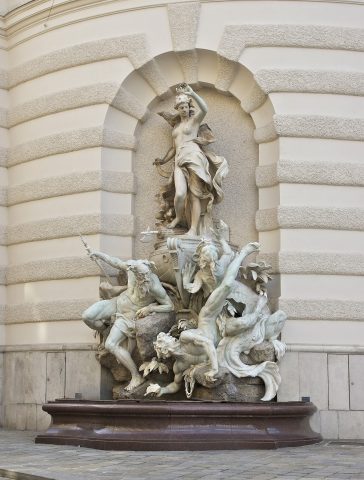
Belvedere isn’t just a museum—it’s one of Vienna’s most breathtaking palace complexes, a place where Baroque grandeur feels almost like a living fairy tale. Perched on a gentle hill, it overlooks the city with an air of quiet authority, its terraced gardens, fountains, and ornate facades designed not for everyday life but to leave visitors in awe. Commissioned in the early 18th century by Prince Eugene of Savoy, a military genius and diplomat whose victories over the Ottomans had made him one of Europe’s most powerful figures, the palace was meant to reflect his legacy. Though he didn’t live to see its completion, Belvedere became the perfect embodiment of his ambitions: lavish yet refined, imposing without being overwhelming.
The complex consists of two palaces—Upper and Lower Belvedere—connected by a sprawling park that cascades down the hillside in a series of terraces, sculptures, and water features. The Lower Belvedere, more modest in scale, was where Prince Eugene held receptions and conducted business, while the Upper Belvedere was conceived as a ceremonial residence. The facades are adorned with intricate stucco, columns, and statues, but it’s the interiors that truly dazzle. Marble halls, gilded ceilings, frescoes, and mirrors designed to catch the flicker of candlelight create an atmosphere of opulence. The most striking space is the Gold Cabinet, where walls and ceilings are covered in delicate gold leaf, giving the room an almost otherworldly glow.
The gardens are a masterpiece in their own right, laid out in the formal French style with geometric precision. Straight pathways, meticulously trimmed hedges, symmetrical flowerbeds, and fountains all contribute to the sense of order and harmony that defined the Baroque era. At the heart of the park, a grand water cascade tumbles down the terraces, flanked by statues of ancient gods and heroes who seem to watch over the visitors below. In summer, the gardens offer cool shade and quiet corners, while autumn turns the leaves to gold, making every stroll feel like a scene from a painting.
Today, Belvedere is best known as the home of one of Austria’s most important art collections, and its crown jewel is Gustav Klimt’s *The Kiss*. Painted in the early 20th century, the work is a defining piece of the Vienna Secession movement, its shimmering gold leaf and intricate patterns capturing the spirit of the era. The painting’s history is as fascinating as its technique—commissioned for the palace, it was later lost for decades before resurfacing in a private collection. Now, it hangs in a dedicated room, where visitors can lose themselves in its luminous details, discovering new nuances with every glance.
But Belvedere’s collection extends far beyond Klimt. The museum houses works from the Baroque period to the Biedermeier era, offering a journey through Austria’s artistic evolution. There are portraits of emperors and aristocrats, Alpine landscapes that seem to breathe with life, and intimate genre scenes depicting Vienna’s past. The medieval collection is particularly striking, featuring altarpieces and sculptures that reveal the deep religious traditions of the region. Each gallery has its own mood—some echo the grandeur of imperial receptions, while others feel like stepping into a 19th-century bourgeois home.
The palace’s history after Prince Eugene’s death was as turbulent as its construction. It passed through the hands of the Habsburgs, served as a royal residence, and was even used as military barracks in the 19th century. During World War II, the buildings suffered severe damage from bombing, but painstaking restoration in the postwar years brought them back to life. Today, Belvedere is more than just a museum; it’s a vibrant cultural space where exhibitions, concerts, and events breathe new energy into its historic walls. In summer, open-air film screenings transform the gardens into a gathering place, while winter brings Christmas markets that fill the courtyards with music and light.
Visiting Belvedere is like stepping into a layered story, where every stone, statue, and painting has something to say. You could easily spend hours wandering the galleries, then retreat to the gardens to sit on a bench and take in the view of Vienna spread out below. The palace doesn’t overpower—it invites. It’s a conversation between eras, between the people who built it, the artists who filled it with beauty, and the visitors who come to experience it. That’s why Belvedere isn’t just a place to see; it’s a place to return to, again and again.