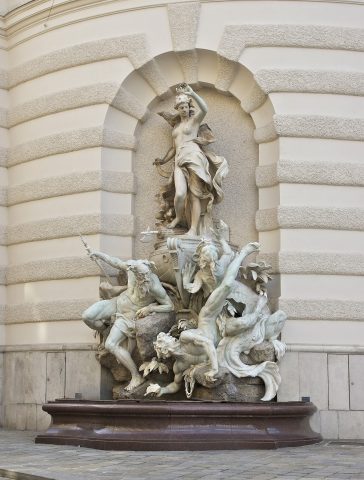
Schönbrunn is more than just a palace—it’s where Austria’s history unfolds in stone, gardens, and the quiet echoes of the past. Originally built in the late 17th century as a hunting lodge for Emperor Leopold I, it evolved over generations into the grand summer residence of the Habsburgs, a dynasty that shaped not only Austria but much of Europe. The palace grew alongside their ambitions, expanding from a modest retreat into a sprawling complex that reflected their power, taste, and even their contradictions. Here, emperors and empresses made decisions that redrew borders, hosted glittering courts, and left behind a legacy that still lingers in the air.
The architecture of Schönbrunn is a dialogue between grandeur and intimacy. The Baroque façade, with its ornate stucco and sweeping curves, was designed to impress, yet the proportions never feel overwhelming. Later additions in the neoclassical style softened the opulence, giving the palace a sense of lived-in elegance. The golden details, the grand staircases, and the carefully balanced symmetry were meant to convey authority, but there’s also something unexpectedly warm about the place. It doesn’t feel like a stage set for royalty; it feels like a home where real lives were lived—where children played, where lovers met in secret, and where the weight of empire was both celebrated and endured.
The gardens are where Schönbrunn truly breathes. Stretching out behind the palace, they were laid out in the 18th century as a masterpiece of formal landscaping, where nature was tamed into perfect geometry without losing its soul. Long avenues of manicured hedges lead the eye toward hidden groves, while fountains and statues punctuate the space like notes in a symphony. The Gloriette, a graceful pavilion perched on a hill, crowns the composition. Built to commemorate a Habsburg military victory, it also serves as a vantage point, offering one of the most iconic views of Vienna. In summer, the gardens hum with life—visitors strolling, musicians playing in the Gloriette, and the distant sound of laughter from the nearby zoo. In winter, the same paths take on a quieter magic, dusted with frost and lined with bare trees that stand like sentinels over the past.
Inside, the palace rooms tell stories of power, art, and everyday life. The Hall of Mirrors, where a young Mozart once performed for Empress Maria Theresa, still shimmers with gilded wood and crystal chandeliers. The Great Gallery, with its frescoed ceilings and towering windows, was the stage for imperial balls and diplomatic receptions, where alliances were forged and broken. Then there are the private chambers—the intimate spaces where the Habsburgs retreated from the public eye. The Chinese Cabinets, with their lacquered walls and delicate porcelain, reveal their fascination with the exotic, while the Blue Chinese Salon, where Maria Theresa received dignitaries, blends European craftsmanship with Eastern influences. Each room feels like a chapter in a novel, where history isn’t just recorded but lived.
Schönbrunn isn’t a relic frozen in time. It’s a place where the past and present coexist, sometimes uneasily, sometimes seamlessly. The palace still hosts state functions, and its gardens are a favorite spot for Viennese families, joggers, and tourists alike. In summer, open-air opera performances draw crowds to the gardens, while winter brings a Christmas market that transforms the grounds into a fairy-tale scene. The world’s oldest zoo, founded in 1752, remains a working institution, home to everything from giant pandas to penguins. Even the orangery, where the Habsburgs once cultivated rare plants, still blooms with exotic flowers, a quiet nod to their passion for botany.
What makes Schönbrunn special is how it balances its grandeur with approachability. You can wander through the same halls where emperors once strode, or sit on a bench by the Neptune Fountain and watch the world go by. The palace doesn’t intimidate; it invites. There’s no sense of a museum behind glass here—just layers of history that feel strangely alive. The gardens, in particular, have a way of making time feel elastic. One moment, you’re imagining the rustle of silk gowns and the murmur of courtly intrigue; the next, you’re simply enjoying the sunlight filtering through the trees.
Vienna has many landmarks, but Schönbrunn is the one that feels most deeply woven into the city’s identity. It’s been a backdrop for revolutions and romances, a source of inspiration for artists and writers, and a place where generations of Viennese have come to escape the city’s hustle. Today, it draws visitors from around the world, each finding something different in its walls. Some come for the architecture, others for the gardens, and some simply for the chance to step into a story much larger than their own. Schönbrunn doesn’t just preserve history—it lets you walk through it, breathe it in, and carry a piece of it with you when you leave.