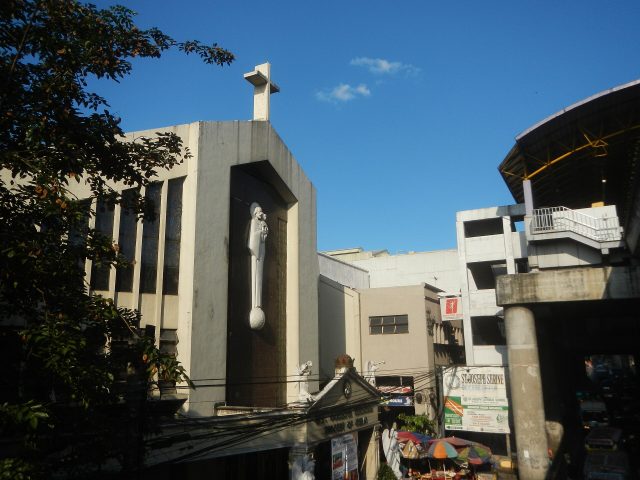
Quiapo is one of Manila’s most vibrant districts, a place where the city’s energy feels almost tangible. Narrow streets hum with the chatter of vendors, the scent of sizzling street food mixes with incense, and the occasional tricycle weaves through the crowd. Amid this lively chaos stands the Minor Basilica of San Lorenzo Ruiz, a church that has witnessed centuries of change yet remains a quiet anchor in the heart of the neighborhood. Named after the first Filipino saint, it is more than a place of worship—it is a living piece of the country’s history, where faith and daily life intersect in unexpected ways.
The basilica’s origins trace back to the early 1600s, when Spanish colonial rule was still taking root in the Philippines. What began as a modest chapel dedicated to Our Lady of the Rosary gradually expanded into a proper church, evolving alongside the city itself. Over the centuries, it underwent multiple renovations, each layer adding to its character. The most significant change came in 1981, when it was rededicated to San Lorenzo Ruiz following his canonization. Today, the building reflects this long history—a blend of Spanish colonial influences, local craftsmanship, and modern touches that tell a story of resilience and adaptation.
From the outside, the basilica presents a dignified facade, its neoclassical columns and pediment giving it an air of solemnity. But step inside, and the space opens up, filled with light and a sense of quiet grandeur. The main altar gleams with gold leaf and intricate carvings, while stained-glass windows cast soft hues across the walls. The most revered spot is the chapel of San Lorenzo Ruiz, where his relics and personal belongings are kept. Visitors often linger here, some in prayer, others simply absorbing the atmosphere. The church feels both intimate and vast, a place where individuals can find solitude even when surrounded by others.
Quiapo itself is a district of contrasts, where the old and new coexist in a way that feels uniquely Filipino. Just steps from the basilica, the streets pulse with activity—vendors selling everything from fresh flowers to religious trinkets, musicians playing folk tunes, and locals going about their day. The area has long been a commercial hub, and its character is shaped by this constant movement. Yet the basilica offers a counterpoint to the noise, a space where time seems to slow. Nearby, colonial-era buildings stand alongside modern storefronts, a reminder of how Manila has grown and changed while still holding onto its past.
For many Filipinos, the basilica is deeply tied to personal and collective memory. It is where families bring their children for baptisms, where people come in times of joy or sorrow, and where major religious festivals unfold with particular intensity. During Christmas and Easter, the church fills to capacity, the air thick with the scent of candles and the sound of hymns. Even on ordinary days, the basilica hums with quiet devotion—worshippers lighting candles, leaving handwritten prayers at the feet of saints, or sitting in silent reflection. For some, it is a place of pilgrimage; for others, simply a familiar presence in a city that never stops moving.
The story of San Lorenzo Ruiz, the man the basilica honors, is one of faith tested by hardship. Born in early 17th-century Manila to a Chinese father and a Filipino mother, he grew up in a time of upheaval. As a young man, he served as an altar boy in a Dominican monastery before being falsely accused of murder and forced to flee the country. He joined a group of missionaries bound for Japan, where Christians faced brutal persecution. There, he was martyred for refusing to renounce his beliefs. His canonization in 1987 was a moment of pride for the Philippines, where Catholicism has shaped culture and identity for centuries. His life, marked by both ordinary beginnings and extraordinary sacrifice, resonates with many who visit the basilica today.
Beyond its religious significance, the basilica is also a cultural landmark. It hosts concerts of sacred music, art exhibitions, and community gatherings, serving as a bridge between the spiritual and the everyday. The church’s role in Filipino life extends beyond its walls—it is a symbol of endurance, a place where history is not just remembered but actively lived. For tourists, it offers a glimpse into the soul of the Philippines, a country where faith is woven into the fabric of society. The basilica stands as a testament to how deeply religion has shaped the nation, from its colonial past to its modern identity.
Visiting the Minor Basilica of San Lorenzo Ruiz is not just about seeing a historic building; it is about experiencing the rhythm of Manila in a different way. The church exists in dialogue with the city around it—its quiet presence contrasting with the energy of Quiapo’s streets, its centuries-old stones holding stories that are still being written. For those who step inside, it offers a moment of pause, a chance to reflect on what it means to belong to a place with such a layered past. Whether you come for prayer, for history, or simply out of curiosity, the basilica leaves an impression that lingers long after you’ve walked back into the bustle of the city.