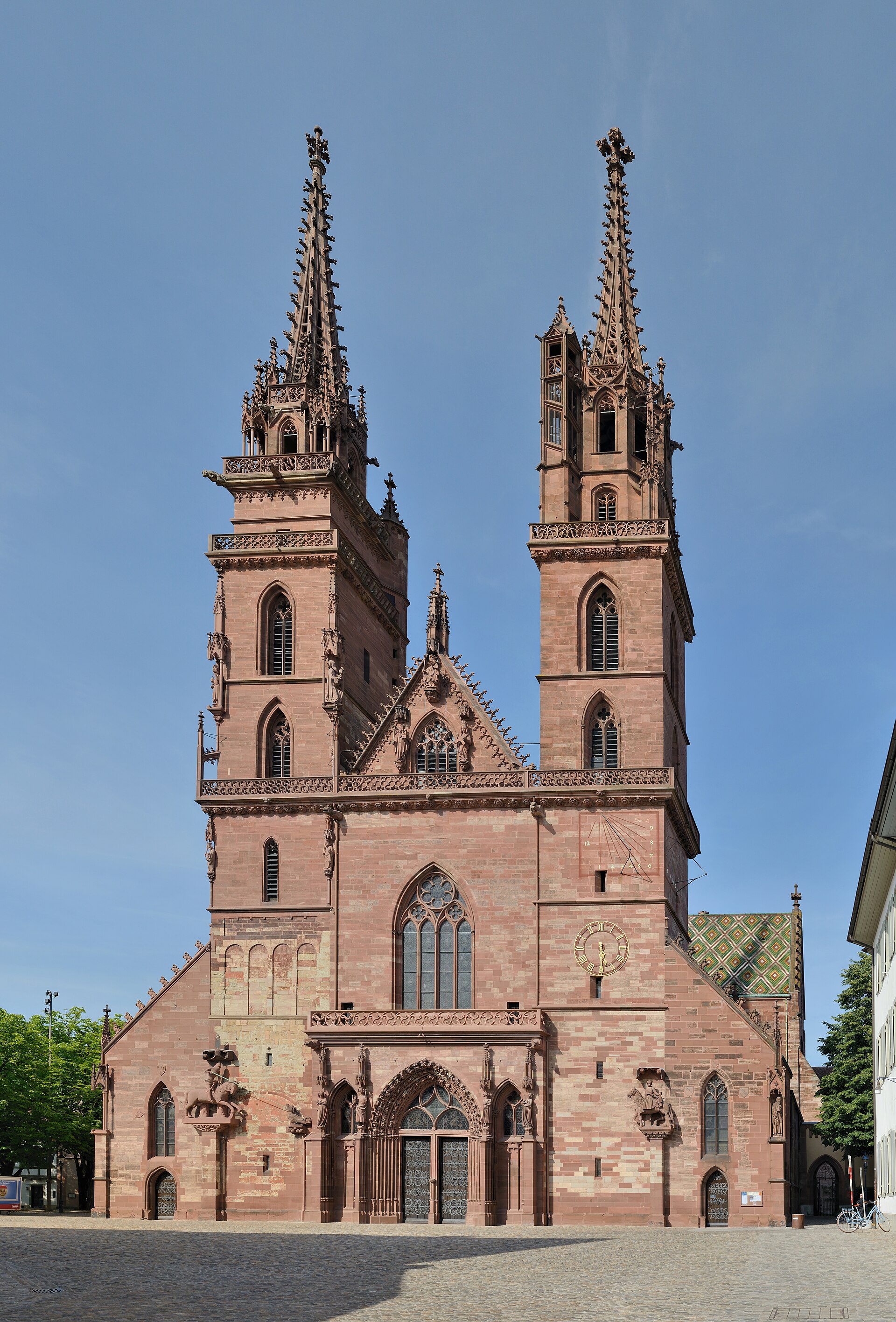
Basel’s cathedral, known locally as the Basler Münster, stands as one of the city’s most enduring landmarks, a quiet witness to centuries of history that have shaped this corner of Switzerland. Perched on a slight rise above the Rhine, its twin towers and red sandstone façade dominate the old town’s skyline, though not in the way grander European cathedrals might. There’s something understated about it—less about overwhelming scale and more about the way it fits into the city’s rhythm, as if it has always been there, steady and unassuming. The building itself is a blend of Romanesque and Gothic styles, a testament to the layers of time that have left their mark on its stones.
The origins of the cathedral trace back to the 9th century, when a Carolingian church first occupied this site. That early structure was destroyed by an earthquake in 1356, an event so violent it reshaped Basel’s landscape and left much of the city in ruins. What rose from the rubble was the cathedral we see today, rebuilt over the following decades with a resilience that mirrors the city’s own recovery. The red sandstone, quarried from the nearby Vosges mountains, gives the building its warm, earthy hue, a color that shifts subtly with the light—pale in the morning, deepening to russet as the sun sets. The twin towers, added later, were never quite symmetrical, a quirk that only adds to the building’s character.
Inside, the cathedral feels more intimate than its exterior might suggest. The nave is spacious but not cavernous, with slender columns rising to support ribbed vaults that draw the eye upward without overwhelming the senses. The stained glass, though not as extensive as in some other European cathedrals, casts a soft, diffused light that changes with the time of day. Some of the windows date back to the 14th century, their colors still vivid despite the centuries. The choir stalls, carved in the late Gothic period, are a marvel of craftsmanship, each seat adorned with intricate figures that tell stories of saints and biblical scenes. The pulpit, too, is a masterpiece of woodwork, its canopy a delicate lacework of tracery.
One of the cathedral’s most striking features is its cloister, a peaceful courtyard tucked away from the bustle of the city. The arcaded walkways, lined with gravestones of Basel’s medieval elite, offer a place to pause and reflect. The cloister was once part of a larger monastic complex, and though much of that has disappeared, the space retains a sense of quiet continuity. It’s easy to imagine monks walking these paths centuries ago, their footsteps echoing on the same stones. The courtyard itself is simple, with a central fountain and a few benches, but it’s the kind of place where time seems to slow down, a rare pocket of stillness in a city that’s otherwise always on the move.
The cathedral has played a central role in Basel’s history, not just as a place of worship but as a symbol of the city’s identity. In the 15th century, it hosted the Council of Basel, a major ecclesiastical gathering that drew theologians and dignitaries from across Europe. The council’s debates and decisions reverberated far beyond Switzerland, shaping the course of the Church during a turbulent period. Later, during the Reformation, the cathedral became a Protestant church, a shift that altered its role but not its significance. Today, it remains a place where people gather for services, concerts, and moments of quiet contemplation, a living part of the city’s cultural fabric.
The view from the cathedral’s terrace is one of the best in Basel. From here, the Rhine stretches out below, its waters glinting in the sunlight as boats drift past. The old town unfolds in a patchwork of red-tiled roofs, narrow streets, and hidden courtyards, with the distant hills of the Black Forest just visible on the horizon. On clear days, the Alps rise in the distance, their peaks dusted with snow even in summer. It’s a view that puts the cathedral’s place in the landscape into perspective—not as a looming monument, but as a natural part of the city’s geography, a high point from which to take in the world around it.
Over the centuries, the cathedral has seen its share of change. Wars, fires, and renovations have all left their mark, yet the building has endured, adapting without losing its essence. The most recent restoration work, completed in the early 21st century, was careful to preserve the cathedral’s character while ensuring its stability for future generations. The red sandstone, worn smooth by time and weather, was cleaned and repaired, but not polished to an unnatural shine. The goal was never to make it look new, but to let it age gracefully, as it always has.
For visitors, the cathedral offers more than just a glimpse into the past. It’s a place where history feels tangible, where the weight of centuries is present in the cool touch of the stone or the echo of footsteps in the nave. The atmosphere is one of quiet dignity, a sense that this is a building that has seen much but remains steadfast. Whether you come for the architecture, the history, or simply to sit in the cloister for a while, the Basler Münster has a way of making you feel connected to something larger than yourself—a thread in the long, unbroken story of Basel.