Jeddah’s skyline has always been a mix of tradition and ambition, but few buildings capture that contrast as sharply as the National Commercial Bank Tower. Rising near the Red Sea coast, this structure stands out not just for its height, but for its deliberate departure from the glass-and-steel uniformity of modern corporate architecture. Completed in the early 1980s, it was Saudi Arabia’s first skyscraper and, for a time, the tallest building in the country—a symbol of the kingdom’s rapid economic transformation during the oil boom.
The tower was designed by the American firm Skidmore, Owings & Merrill, though its most striking features came from the collaboration with local architects who understood the climate and cultural context. Unlike the sealed, air-conditioned towers common in the West, the NCB Tower was built to respond to Jeddah’s harsh environment. Its most unusual element is the way it turns inward, with a massive triangular void at its center. This isn’t just an aesthetic choice; it’s a practical solution to the region’s intense heat and sunlight. The open core allows natural ventilation, reducing the need for energy-intensive cooling while creating a shaded, almost secretive space at the heart of the building.
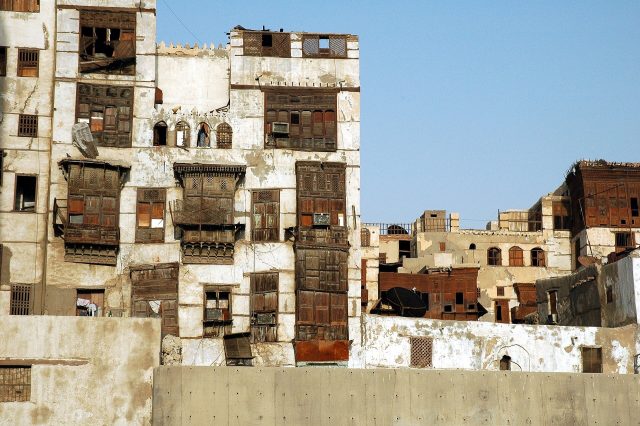
From the outside, the tower’s facade is a study in restraint. The exterior is clad in pale stone, a material that reflects the sun rather than absorbing it, and the windows are small, recessed, and arranged in a pattern that minimizes direct exposure. The overall effect is one of solidity and permanence, as if the building has always been part of the city’s fabric. Yet the design also carries a subtle modernity, with clean lines and geometric precision that set it apart from the ornate coral houses and traditional mosques nearby. It’s a building that doesn’t shout for attention, but once you notice it, it’s hard to look away.
Inside, the tower’s layout is just as unconventional. The central atrium, which spans the full height of the building, is a quiet, almost meditative space. Sunlight filters down through the open core, casting shifting patterns on the walls and floors throughout the day. The offices are arranged around this void, with balconies overlooking the atrium, creating a sense of connection between the different levels. It’s a design that encourages interaction, though in practice, the bank’s corporate culture likely kept things more formal than the architecture might suggest.
The NCB Tower wasn’t just a feat of engineering; it was a statement. At a time when Saudi Arabia was asserting its economic independence, the building represented the kingdom’s ability to commission world-class architecture on its own terms. It was also one of the first major projects to incorporate local environmental considerations into its design, long before sustainability became a global buzzword. That foresight has helped the tower age gracefully, even as newer, flashier skyscrapers have risen around it.
Today, the building remains a functional part of Jeddah’s financial district, though its role has evolved. The National Commercial Bank, once the kingdom’s largest financial institution, has since merged with other entities, and the tower now houses offices for various businesses. Yet it still feels like a place apart from the rest of the city. The surrounding area is a mix of high-rises and older neighborhoods, where the scent of the sea mixes with the hum of traffic. The tower itself is set back from the street, surrounded by a low wall and landscaped grounds that offer a buffer from the bustle outside.
Visitors can’t simply walk into the tower—it’s a working office building, not a public space—but its presence is felt throughout the area. From the corniche along the Red Sea, it stands as a landmark, a reminder of Jeddah’s dual identity as both a gateway to Mecca and a city of commerce. At night, when the lights of the offices glow softly through the small windows, the building takes on a different character, less imposing and more intimate, as if it’s keeping watch over the city.
The NCB Tower may not be as famous as Dubai’s Burj Khalifa or as visually dramatic as some of the newer developments in Riyadh, but that’s part of its charm. It’s a building that was designed to serve a purpose, not just to impress. In a region where architecture often leans toward the extravagant, the tower’s understated elegance feels almost radical. It’s a quiet testament to the idea that good design doesn’t have to be loud to leave a lasting impression.