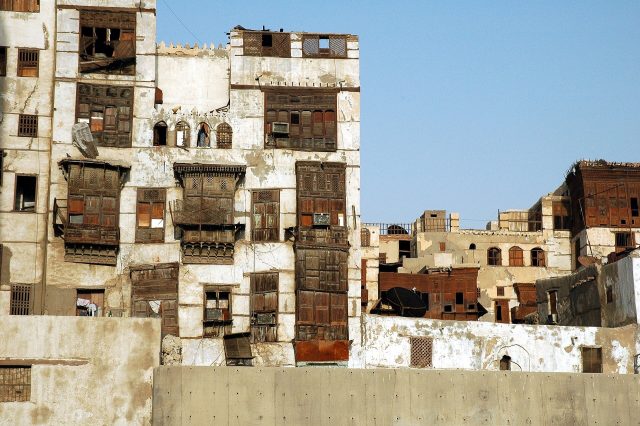
The Qishla of Jeddah is one of those rare places where time seems to stand still, a silent witness to the city’s transformation from a modest port town into the bustling metropolis it is today. Built in the mid-19th century, this imposing fortress once served as both a military stronghold and an administrative hub, a symbol of Ottoman authority in the Hijaz region. Its thick coral-stone walls, reinforced with corner towers, were designed to withstand sieges and protect the city’s strategic interests. Though much of its interior has crumbled over the decades, the structure still commands attention, its weathered facade telling stories of a bygone era when Jeddah was a vital gateway for pilgrims and traders.
The architecture of the Qishla reflects the military engineering of the Ottoman Empire, which dominated the Hijaz during that period. The use of coral stone, a material abundant along the Red Sea coast, was practical yet enduring, though the harsh climate has gradually worn it down. Inside the fortress, the remains of barracks, storage rooms, and an arsenal hint at its former purpose, while the main gate and sections of the walls bear the scars of cannon fire—a reminder of the conflicts that once raged here. The fortress was more than just a defensive structure; it was a statement of power, a physical manifestation of control over a city that thrived on commerce and pilgrimage.
Over the years, the Qishla’s role evolved with the changing fortunes of Jeddah. After its military significance waned, it was repurposed as a prison, then a police station, and later even housed a courthouse. Each new function left its mark, from faded Arabic inscriptions on the walls to the remnants of cells and administrative offices. These layers of history are still visible today, adding to the fortress’s character. The passage of time has softened its edges, giving it a sense of age and resilience that modern restorations can’t replicate. It’s a place where the past feels tangible, where every crack in the stone seems to whisper about the people who once walked these grounds.
Today, the Qishla is not just a relic of the past but a living part of Jeddah’s historic Al-Balad district. The fortress sits at the heart of this vibrant neighborhood, where narrow alleyways wind past traditional coral houses adorned with intricate wooden balconies, and the air is filled with the scent of spices and the hum of daily life. Unlike many historical sites that feel frozen in time, the Qishla is surrounded by the energy of the present. Children play in nearby squares, merchants haggle over goods in the souks, and locals gather in the shade of palm trees. The fortress blends seamlessly into this landscape, a quiet anchor in a neighborhood that refuses to forget its roots.
For those interested in Saudi Arabia’s history, the Qishla offers a glimpse into a pivotal era. In the 19th century, Jeddah was a critical stop on the pilgrimage route to Mecca, and the Ottomans, who controlled the Hijaz, recognized its importance. The fortress was built not only for defense but also to project authority over a city that was both a commercial hub and a spiritual crossroads. Standing within its walls, it’s easy to imagine the bustle of the old port, the arrival of pilgrims from distant lands, and the constant flow of goods and ideas that shaped Jeddah’s identity. The Qishla was a symbol of order in a city that was anything but orderly—a place where power was both enforced and challenged.
Despite its historical significance, the Qishla remains a place where locals and visitors alike come to connect with the past. Some wander its grounds to escape the heat, others to photograph its weathered beauty, and a few simply to reflect on the city’s evolution. In recent years, efforts to preserve Al-Balad’s heritage have brought renewed attention to the fortress, with careful restorations aimed at maintaining its authenticity. The goal isn’t to erase the passage of time but to ensure that the Qishla continues to tell its story for generations to come. It’s a delicate balance—one that respects the fortress’s age while allowing it to remain a part of the city’s living history.
Visiting the Qishla is less about ticking off a tourist attraction and more about experiencing the soul of old Jeddah. Unlike the crowded sites that draw international visitors, this fortress offers a quieter, more intimate encounter with the city’s past. There are no grand exhibits or guided tours, just the raw, unfiltered presence of history. Walking along its walls, you can almost hear the echoes of soldiers’ boots, the creak of the gates opening to yet another caravan, or the distant roar of cannons. These moments are long gone, but the Qishla preserves them in its stones, just as Al-Balad itself preserves the spirit of a city that has always been a meeting point of cultures, faiths, and stories.