Jakarta Tower stands unfinished on the skyline of Indonesia’s capital, a silent giant that has watched the city grow around it for decades. Begun in the 1990s as an ambitious project to create a landmark for Jakarta, the tower was meant to symbolize the country’s economic rise and modern aspirations. At over 550 meters tall, it would have been one of the tallest structures in Southeast Asia, housing offices, a luxury hotel, and observation decks with panoramic views of the sprawling metropolis. But construction halted in 1997 during the Asian financial crisis, leaving behind a skeletal frame of steel and concrete that has since become one of the city’s most unusual sights.
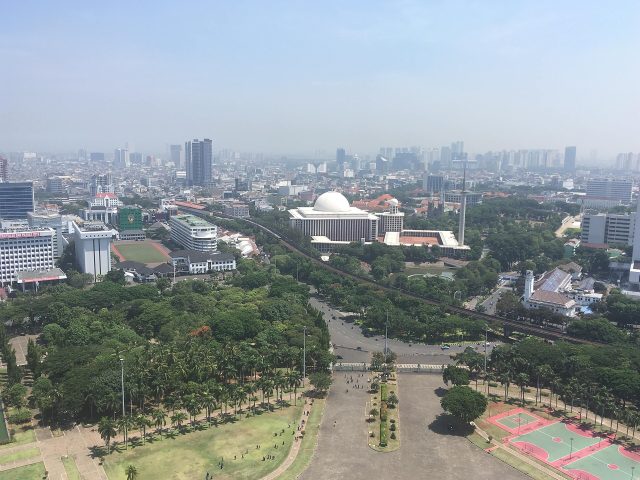
The tower’s location in the Kuningan district places it in the heart of Jakarta’s business and diplomatic hub. Surrounded by glass-fronted skyscrapers and embassies, it feels like a relic from a different era, a reminder of how quickly fortunes can shift in a rapidly developing city. The area itself is a mix of old and new—luxury malls and high-end restaurants sit alongside traditional markets and street food stalls, where the scent of satay and fried tempeh lingers in the humid air. The contrast between the tower’s abandoned grandeur and the bustling life around it makes it all the more striking.
What happened to Jakarta Tower is a story of overreach and economic reality. The project was conceived during a time of optimism, when Indonesia’s economy was booming and Jakarta was positioning itself as a global city. The original plans included not just the tower but an entire complex with shopping centers, entertainment venues, and even a monorail connection. But when the financial crisis hit, funding dried up, and the developers struggled to secure new investors. Over the years, various attempts were made to revive the project, but none gained enough traction to restart construction. Today, the tower remains a half-built monument to what might have been.
For locals, the tower has taken on a kind of mythic status. Some see it as a cautionary tale about unchecked ambition, while others view it as a symbol of resilience—a structure that refused to be torn down despite years of neglect. It’s a popular spot for urban explorers and photographers, drawn to its eerie, post-apocalyptic aesthetic. The skeletal framework, rusting in places, stands in stark contrast to the polished facades of the buildings around it. On certain days, when the city’s infamous pollution clears, the tower’s silhouette can be seen from miles away, a ghostly presence on the horizon.
The architecture of Jakarta Tower was designed to be both futuristic and functional. The original plans called for a sleek, tapered structure with a distinctive spire, inspired by both modern skyscrapers and traditional Indonesian motifs. The lower levels were intended to house commercial spaces, while the upper floors would have featured a rotating restaurant and observation decks. The design reflected the optimism of the era, blending cutting-edge engineering with a nod to local culture. Even in its unfinished state, the tower’s scale is impressive, a testament to the vision of its creators.
Over the years, the tower has become a canvas for the city’s creativity. Graffiti artists have left their mark on its lower levels, turning the concrete into a patchwork of colors and messages. Some of the tags are political, others purely artistic, but all of them add to the tower’s sense of being a living part of Jakarta’s urban landscape. There’s something almost poetic about the way the city has reclaimed this abandoned structure, turning it into a space for expression rather than just a failed development.
Despite its unfinished state, Jakarta Tower remains a point of curiosity for visitors. It’s not a place you can enter—security fences and guards keep people at a distance—but its sheer size and presence make it impossible to ignore. For those who remember the tower’s early days, it’s a reminder of how much Jakarta has changed. The city has grown outward and upward, with new skyscrapers and infrastructure projects reshaping its skyline. Yet the tower endures, a quiet witness to the city’s evolution.
There’s a certain melancholy to Jakarta Tower, a sense of potential unfulfilled. But in a city as dynamic as Jakarta, where change is constant, it also feels strangely fitting. The tower is a reminder that not every grand plan comes to fruition, and that sometimes, the most interesting stories are the ones left unfinished. Whether it will ever be completed remains an open question, but for now, it stands as one of Jakarta’s most intriguing landmarks—a monument to ambition, resilience, and the unpredictable nature of urban development.