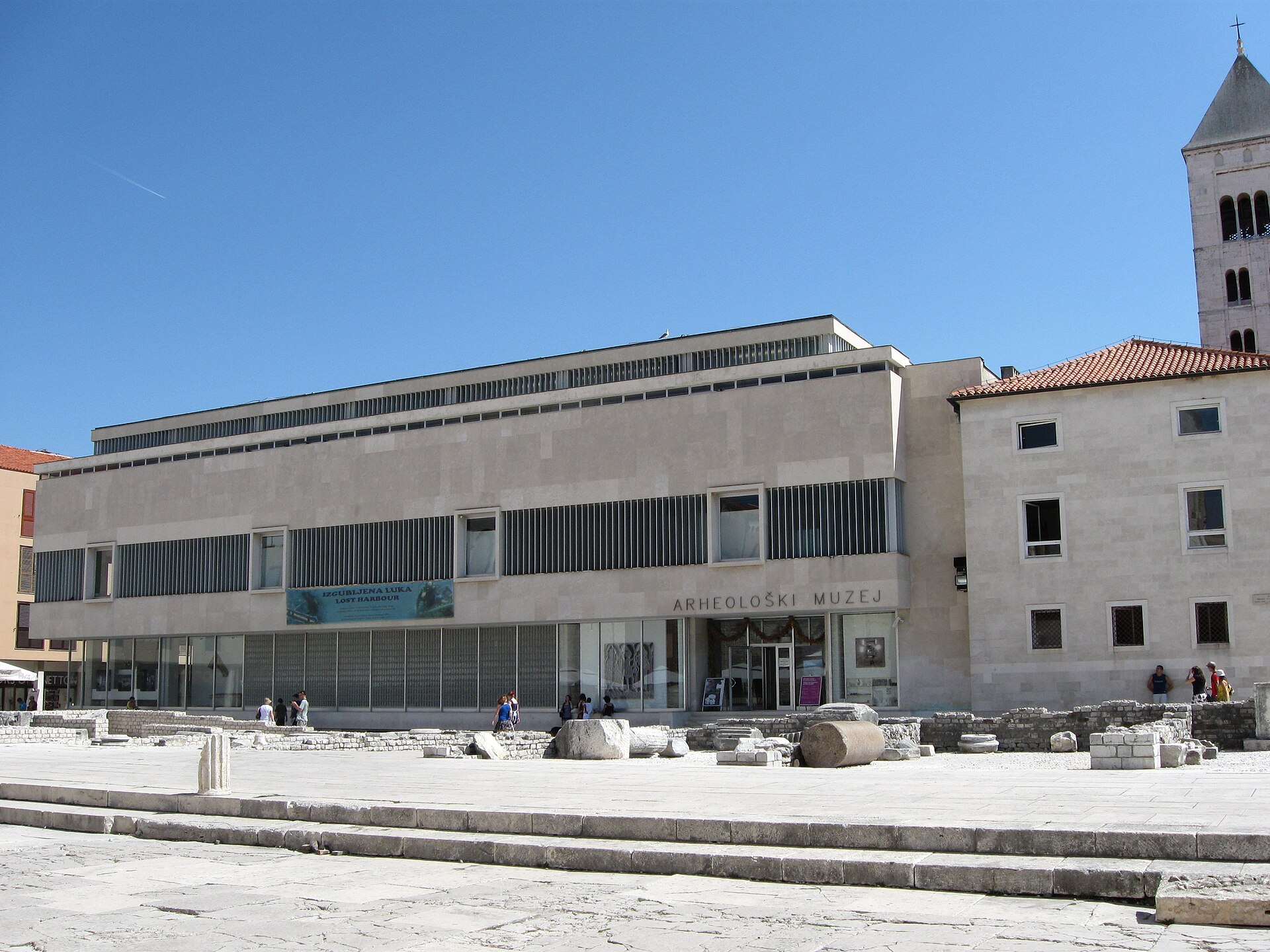
Zadar’s Archaeological Museum is one of those rare places where history doesn’t just sit behind glass—it lingers in the air, woven into the very walls that hold it. The city itself is ancient, with roots stretching back over three thousand years, and for much of that time, it has been a crossroads of civilizations. Illyrians, Romans, Byzantines, Venetians, and Austrians all left their mark here, layering the past like sediment in stone. The museum stands in the heart of the old town, steps away from the ruins of a Roman forum, in a building that once housed the Church of St. Donatus, founded in the 9th century. Today, it spans several structures, its exhibits unfolding from prehistoric times to the early Middle Ages, though it’s the classical and medieval eras that truly anchor its collection.
The earliest artifacts on display—stone tools and Neolithic pottery unearthed from nearby caves—offer a quiet glimpse into the lives of the region’s first inhabitants. But it’s the antiquities that command attention. Here, Latin inscriptions on weathered tombstones, fragments of intricate mosaics, and statues of gods and emperors tell the story of Iadera, as Zadar was known in Roman times. The city was no provincial backwater; it was an administrative hub, a place where trade and power converged. Marble busts of Roman rulers, remarkably preserved, stare back at visitors with an almost unsettling immediacy. Alongside them, everyday objects—clay lamps, glass vials for perfumes, simple jewelry—paint a picture of ordinary life two millennia ago, grounding the grandeur of empire in the tangible details of human existence.
The museum’s collection of early Christian art is particularly striking, reflecting Zadar’s role as a center of religious transformation. The city is dotted with basilicas and churches from this period, and the museum preserves their remnants: carved capitals, altar pieces, and sarcophagi adorned with biblical scenes. One of the most evocative pieces is a mosaic of a peacock, a symbol of immortality, recovered from the ruins of an ancient church. These artifacts trace the shift from paganism to Christianity, capturing the moment when old beliefs gave way to new ones. The transition isn’t presented as a clean break but as a gradual evolution, and that nuance makes the exhibits feel alive, as if the past is still unfolding.
Medieval Zadar comes into focus through weapons, armor, and jewelry, but it’s the maritime artifacts that truly stand out. The city has always been a port, its people skilled sailors and traders, and the museum’s collection of anchors, navigational tools, and ship models speaks to that legacy. These objects also hint at the city’s turbulent history—its struggles for dominance between Venice, Hungary, and the Ottoman Empire. The exhibits don’t just showcase relics; they reveal the ebb and flow of power, the rise and fall of fortunes, and the resilience of a place that has been rebuilt time and again.
One of the museum’s most fascinating sections is devoted to underwater archaeology. Zadar’s coastline has claimed countless ships over the centuries, from ancient trading vessels to medieval galleys, and the artifacts recovered from the seabed are a testament to the city’s maritime past. Amphorae, pottery, and household items are displayed alongside surprisingly well-preserved glassware, their transparency intact despite centuries submerged. This part of the museum offers a glimpse into a lesser-known field of archaeology, one that requires patience, precision, and a deep understanding of the sea’s caprices.
The museum isn’t just a repository of static objects; it’s a living institution. Temporary exhibitions, lectures, and workshops keep the space dynamic, and visitors might even catch conservators at work, carefully cleaning artifacts or restoring faded frescoes. The museum’s library, with its rare books on Dalmatian history and archaeology, is a quiet corner for those who want to dive deeper. This sense of ongoing discovery makes the past feel immediate, as if the stories behind the exhibits are still being uncovered.
A visit here is more than a walk through galleries—it’s an immersion in the layers of Zadar’s identity. Unlike other Croatian coastal towns, where tourism often overshadows history, Zadar retains a sense of authenticity. The museum helps explain why. The city’s narrow streets, its blend of architectural styles, its unhurried pace—all of it makes more sense after seeing the artifacts that have shaped it. You can spend hours examining the exhibits, then step outside and find yourself standing on the same stones that once formed a Roman forum or a medieval fortress.
What makes the Archaeological Museum special isn’t just its collection but its approach. There’s no pretension here, no attempt to dazzle with grandeur. Instead, there’s a quiet commitment to telling the city’s story in a way that feels personal, as if the past isn’t something distant but something that still resonates in the present. History isn’t just what happened long ago; it’s what lingers in the names of streets, in the worn steps of old buildings, in the faces of the people who walk the same paths as their ancestors did centuries before. The museum doesn’t just preserve that history—it invites you to be part of it.