The Armenian Church of Saint Hripsime in Yalta stands quietly on a hillside, its pale stone walls catching the light in a way that makes it seem both ancient and timeless. Built between 1909 and 1917, it was commissioned by Pavel Ter-Gukasyan, an oil magnate who wanted to honor his daughter’s memory. The design was entrusted to Gabriel Ter-Mikelov, an architect who drew inspiration from the seventh-century Saint Hripsime Church in Echmiadzin, one of the oldest surviving examples of Armenian ecclesiastical architecture. The result is a structure that feels rooted in tradition—simple, solid, and unadorned, with a central dome resting on a drum and walls made of volcanic tuff, a material said to have been brought from the Caucasus.
The approach to the church is part of its quiet power. A broad staircase, lined with cypress trees, ascends the hill in measured steps, slowing visitors down before they even reach the entrance. The climb is deliberate, meant to prepare the mind for what lies ahead. In summer, the heat can make the ascent feel longer, but the reward is worth it—a cool, dim interior where the air carries the scent of aged stone and candle wax. The walls inside are adorned with frescoes by Vardges Sureniants, a painter who spent his final years working here. His grave lies in the churchyard, a quiet reminder of the hands that shaped this place.
Sureniants was more than just a painter; he was a storyteller in color and light. His murals depict scenes from Armenian history and Christian lore, their muted tones blending with the soft glow of the stained-glass windows. The mosaic floors, also designed by him, add another layer of texture to the space, their patterns shifting underfoot as you move through the nave. The church has a way of making time feel still, as if the outside world—with its noise and rush—doesn’t quite reach here.
Though it remains an active place of worship for Yalta’s Armenian Apostolic community, the church welcomes visitors during daylight hours. Services are held on Sundays and religious holidays, but on other days, the doors stay open for those who come to look, to sit, or simply to escape the heat. The rules are few but clear: silence is expected, and photography is allowed only without flash. It’s a small ask for a place that feels like a sanctuary in more ways than one.
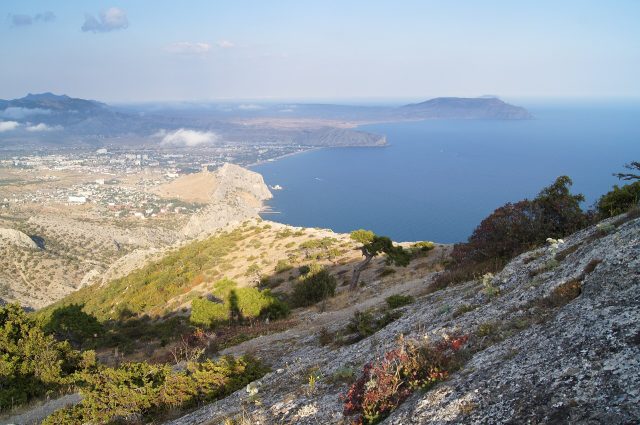
Outside, the churchyard offers a different kind of respite. Benches are scattered beneath the trees, and the view over Yalta and the Black Sea is one of the best in the city. In the evening, when the light turns golden, the water shimmers and the rooftops below glow softly, as if the whole town is holding its breath. The perspective from here makes the city feel distant, even though it’s just a short walk downhill. From the church steps, you can see Massandra Beach to the east, its curve of sand and pebbles stretching toward the horizon.
The church has also found its way into cinema, serving as a backdrop for Soviet-era films like *The Gadfly*. There’s something about its austere beauty that lends itself to storytelling—its walls have witnessed quiet prayers, whispered conversations, and the occasional hum of a film crew setting up equipment. Yet it never feels like a stage set; it’s too lived-in for that, too much a part of the fabric of Yalta.
Getting here is straightforward, though the climb can be a challenge in the midday sun. From the seafront, it’s about a twenty-minute walk uphill, or a quick taxi ride if you’d rather save your energy. The path winds through residential streets, past houses with gardens spilling over fences, before narrowing into the final ascent. There’s no grand entrance, no fanfare—just the slow reveal of the church as you round the last bend.
Inside, the thick walls and narrow windows keep the heat at bay, even on the hottest days. The air is cool and still, the kind of quiet that makes you lower your voice without thinking. It’s a place that invites reflection, whether you’re here for faith, for history, or just for the view. And while the church itself is modest in scale, its presence in Yalta is anything but. It stands as a reminder of the city’s layered past, of the communities that have shaped it, and of the quiet moments that often go unnoticed in the rush of travel.