Sligo Abbey feels like a place where history lingers in the air, not as something distant or abstract, but as a presence you can almost touch. These ruins of a 13th-century Dominican monastery stand on the edge of town, surrounded by the quiet green hills that define Ireland’s northwest. There are no crowds here, no tourist chatter—just the wind rustling through the grass and the stones that have witnessed centuries of change. The abbey was founded in 1252 by Maurice FitzGerald, a Norman lord who sought to extend his influence in the region. The Dominicans, known as the Order of Preachers, settled here to spread their faith in a land where Christianity had long taken root but still coexisted with older Celtic traditions.
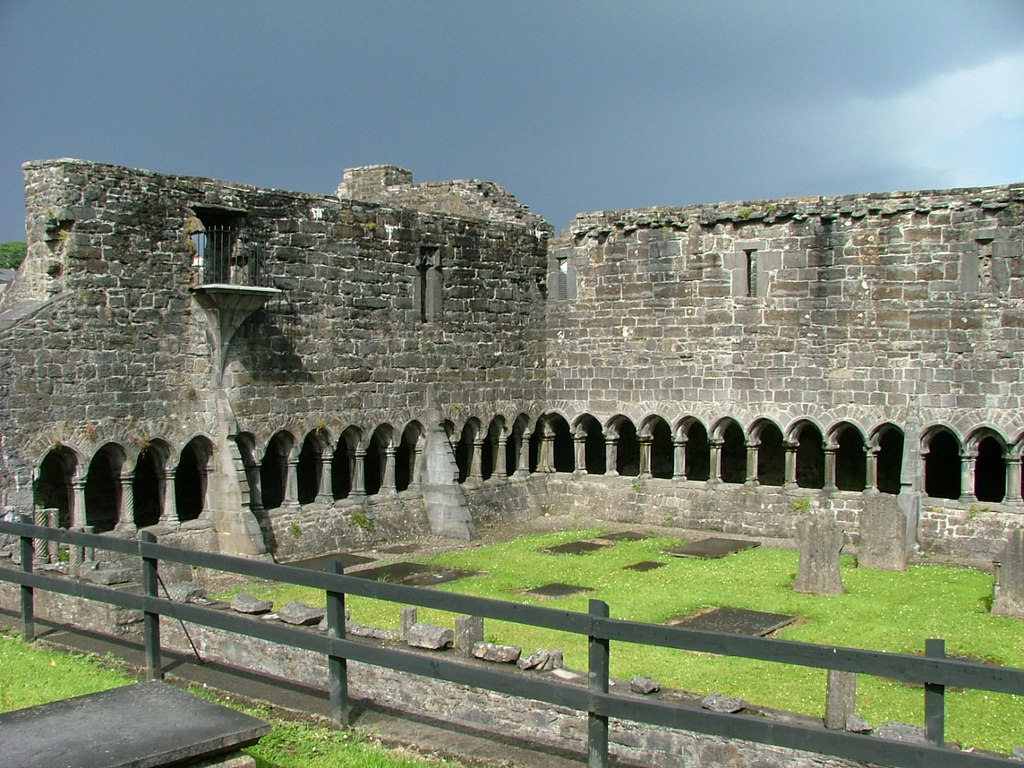
The architecture of the abbey blends the austerity and elegance typical of Gothic design. The main church, with its tall, pointed windows and sturdy buttresses, was once the heart of spiritual life. Now, only the walls remain, yet even in their ruined state, they convey a sense of enduring strength. The east window, remarkably intact, is particularly striking—its delicate stone tracery seems frozen in time. Inside, you can still make out the remnants of the altar, tombs, and fragments of frescoes that once adorned the walls. The cloister, framed by arched walkways, hints at the daily life that once filled this space: monks praying, copying manuscripts, and teaching the local community.
The abbey has witnessed some of Ireland’s most turbulent moments. In the 14th century, it was sacked by English forces during the wars for independence, only to be rebuilt later. By the 16th century, the Reformation brought its closure, and the monastery’s lands passed into secular hands. Yet the local people never abandoned the site. Even after services were officially banned, secret masses were held here. By the 19th century, the ruins had become a source of fascination for antiquarians and artists drawn to the romantic ideal of the Middle Ages. Restoration efforts began then, ensuring the abbey would endure for future generations.
Today, Sligo Abbey is more than just an architectural relic—it’s a place where different eras overlap. Among the ruins, you’ll find 17th- and 18th-century gravestones, long after the monastery ceased to function. Some are marked with Celtic crosses, a reminder of the ancient traditions that never fully faded. The abbey is set within a small park, a peaceful spot for a walk, especially on clear days when the sunlight warms the old stones, turning them a soft gold.
There’s a quiet melancholy to this place, but it’s also deeply calming. Time seems to move differently here, slower and more gently than in the modern world. That might be why the abbey draws not just visitors but locals, too—people who come to reflect, to escape, or simply to appreciate the beauty of the ruins. In Sligo, a town rich with history, this site holds a special place in the hearts of those who know it. It’s a reminder that even in decay, the past doesn’t vanish; it lives on in the stones, in the stories, and in the memories of those who walk among them.
For anyone curious about Ireland’s history, the abbey offers a starting point for exploring the region. Nearby, you’ll find other traces of the past, like the megalithic tombs at Carrowmore or the early Christian monastery on Inishmurray. But even if you’re not on a historical pilgrimage, a visit to Sligo Abbey leaves a lasting impression. There’s no need for guides or exhibits—just the stones, the wind, and the chance to imagine the prayers and chants that once filled this space.
It’s worth noting that the abbey isn’t a museum in the usual sense. There are no displays, no detailed plaques, no interactive exhibits. This is a place for those who value authenticity, who prefer to experience history directly—through the touch of stone and the silence that surrounds it. That’s perhaps its greatest appeal. Sligo Abbey doesn’t try to impress; it simply exists, as the hills do, as the sea does a few miles away, as Ireland itself does, with all its layered and remarkable history.