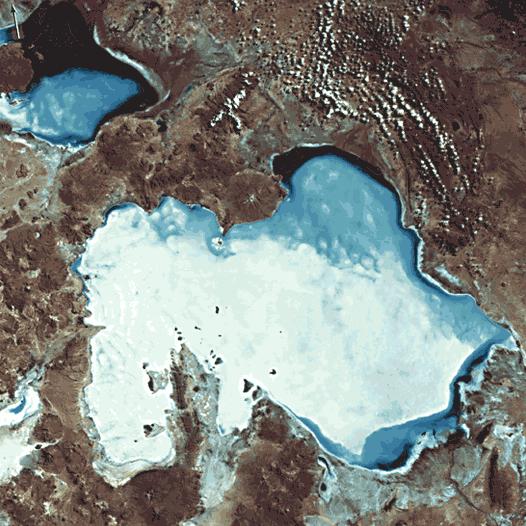
Salar de Uyuni
Bolivia · 4 places
Photo: Wikimedia Commons, Public domain
Uyuni
Uyuni is the last outpost before the world ends—or the first place where it begins anew. The town sits on the edge of the largest salt flat on earth. Its streets are narrow, unpaved, lined with adobe houses that have stood for generations. The walls blend into the vast, shimmering horizon. There’s no rush here, no traffic, no crowds. The air carries the weight of altitude, the clatter of a bicycle, the bark of a dog. The sky stretches endlessly, so bright it presses down on the rooftops, as if earth and heavens might meet if you walked far enough.
The salt flat draws most visitors. Few understand it until they stand on its surface. In the rainy season, a thin layer of water turns the expanse into a mirror, reflecting the sky until the horizon vanishes. You could swear you’re walking on clouds. When the dry winds return, the salt crust cracks into geometric patterns, hexagons stretching to infinity. Beneath it lies the remains of an ancient lake, evaporated, leaving lithium and a landscape so strange it defies belief.
Tourists come for photographs that play with perspective—tiny figures balancing on a coin or floating in midair. The real magic is the light, the silence, the sense of standing on another planet.
Life in Uyuni moves slowly. Mornings begin with vendors setting up stalls in the main square. Their tables hold salt sculptures: llamas, cacti, chairs carved from the same white mineral that surrounds the town. In cafés, stews simmer—quinoa soup, llama meat, peppers stuffed with rice. By evening, the streets empty. A guitar strums from an open doorway. Laughter drifts from a courtyard.
There are no neon signs, no nightclubs. Just the quiet certainty that the day has been lived without hurry.
Uyuni is a crossroads. From here, jeeps leave for expeditions into the Altiplano. They pass flamingo-studded lagoons, geysers, volcanoes. Local guides share stories of Inca trails, Spanish conquistadors, and modern adventurers. The town thrives on tourism but hasn’t been polished into a theme park. Hotels are modest, family-run lodgings where travelers warm up by a wood stove after hours in the cold.
What makes Uyuni unforgettable isn’t what it has. There are no skyscrapers, no traffic lights, no noise beyond the wind and conversation. The stars at night are vivid, the Milky Way a ribbon of light. The town doesn’t try to impress. It simply exists, a witness to the vastness of the world.
In a place of salt, sky, and silence, you remember what it means to feel small.
See & Do
3 places
Places on the map
Marker colour follows the categoryClimate and weather
Detailed weather: Salar de Uyuni- Average temperature
- 11 °C
- Precipitation per year
- 413 mm
Average air temperature
°C
13
13
13
11
9
6
8
8
10
12
13
13
Jan
Feb
Mar
Apr
May
Jun
Jul
Aug
Sep
Oct
Nov
Dec