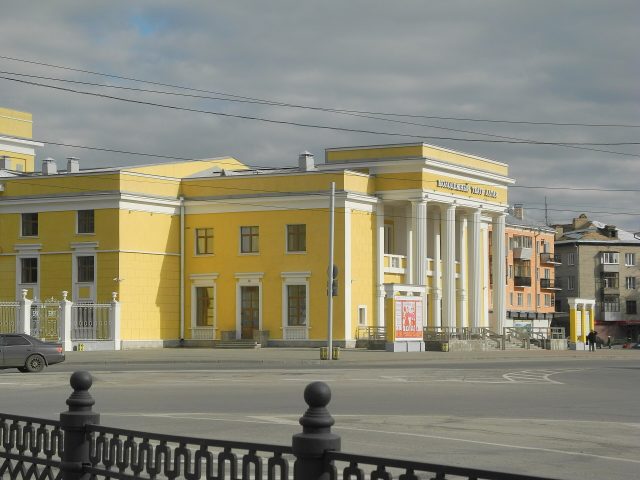
The main building of Altai State University is one of those places in Barnaul that doesn’t immediately catch the eye, but slowly reveals its significance the longer you spend in the city. Standing on Lenin Prospekt, right in the heart of Barnaul, its architecture isn’t grand or imposing, yet there’s a quiet solidity to it. The long, gray structure with its columns at the entrance is a classic example of Soviet neoclassicism—unassuming on the outside, but with a story deeply tied to the development of education and science in the Altai region.
The university’s construction began in the mid-20th century, a time when the country was rebuilding after the war and needed skilled professionals. Barnaul, already a major industrial and cultural hub in Siberia, was granted its own university in 1973, and this building became its main campus. It was here that academic schools took shape, later gaining recognition far beyond the region. Today, thousands of students pass through its halls, and the lecture rooms and laboratories still carry the echoes of generations who came here in search of knowledge.
The building’s architecture is typical of its era—clean lines, minimal decoration, and functionality above all else. The facade is marked only by pilasters and a modest portico with columns, but inside, the space is designed to accommodate as many classrooms as possible. Long corridors, high ceilings, and large windows create an environment that feels both practical and conducive to study. Soviet-era buildings like this were often constructed from standardized designs, but it’s precisely this simplicity that allowed them to blend seamlessly into the urban landscape without pretension.
For Barnaul, the university isn’t just an educational institution; it’s an important public space. Conferences, exhibitions, and meetings with scientists and cultural figures are regularly held here. The area around the building has developed its own distinct atmosphere, with student cafes, bookshops, and small parks where young people gather in warmer months. Even those who have no direct connection to the university often find themselves here—whether attending a lecture or simply strolling along Lenin Prospekt.
The building is also closely tied to the history of the city itself. During the Soviet period, Barnaul was growing as a center of science and education, and the university’s establishment was a natural progression. Today, its faculties cover a wide range of disciplines, from the natural sciences to the humanities. It’s a place where theory meets practice, where students don’t just learn but also contribute to research that has real significance for the region.
Inside, some details still hint at the building’s past. The foyer features memorial plaques honoring distinguished alumni and faculty, and there’s a small museum dedicated to the university’s history, filled with documents, photographs, and personal items from those who helped shape the institution. These elements give the place a sense of continuity, where the past feels alive rather than preserved behind glass.
From the outside, the building might seem austere, but the surrounding space softens that impression. A small park with trees and benches stretches out in front, where students take breaks between classes. In winter, a Christmas tree is set up here, while in summer, the area hosts impromptu concerts and gatherings. When the facade is adorned with flowers in warmer months, even the building’s strict lines seem to relax a little.
Altai State University is more than just an educational institution—it’s a part of Barnaul’s cultural life. Open lectures, workshops, and science festivals are held here, drawing not only students but also locals. The university has its own theater, creative studios, and even a small observatory that occasionally opens to the public. It’s a place where learning extends beyond textbooks and becomes part of everyday life.
Today, the university building is far more than an architectural landmark—it’s a living, evolving space. New faculties emerge, modern laboratories open, and students and faculty participate in international projects. All of this makes it an integral part of Barnaul, a place where the future of the region is being shaped. While it may not be a tourist attraction in the traditional sense, for those interested in the city’s history and culture, it’s a meaningful stop on any visit.