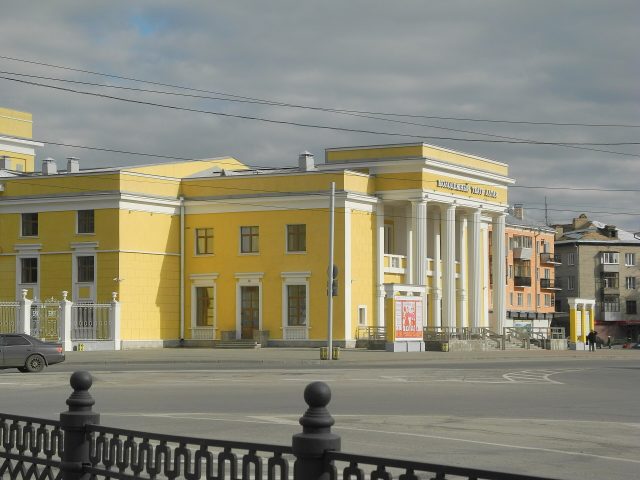
Barnaul’s Museum of Altai Literature, Art, and Culture feels like a quiet pause in the rush of time—a place where the spirit of the region lingers in the air. Housed in a 19th-century merchant’s mansion in the heart of the city, the building itself is part of the story. Its high ceilings, intricate plasterwork, and tall windows with stained glass cast a soft glow over the rooms, while the creak of wooden floors underfoot adds to the sense that history isn’t just displayed here—it’s lived.
The museum opened in the 1980s, born from the realization that Altai was more than just a dot on the map. For centuries, this land has been a crossroads of cultures: nomadic tribes, settlers, writers, and artists drawn to its rugged beauty. The museum weaves these threads together, from ancient petroglyphs to modern novels, from folk crafts to fine art. It’s an attempt to capture the essence of a place where the steppe meets the mountains, where traditions have been shaped by both isolation and exchange.
Walking through the exhibits, you don’t just observe—you step into different eras. A peasant’s hut with a loom stands beside a writer’s study, its desk scattered with yellowed manuscripts. An artist’s studio holds an easel and half-finished sketches, as if the painter just stepped out for a moment. Some displays are tied to names that have become synonymous with Altai. There’s a case with personal items belonging to Vasily Shukshin, the filmmaker and writer whose work captured the soul of rural Russia. Nearby, you might find the notes of Georgy Grebenshchikov, an early 20th-century author who saw Altai not just as a land of resources, but as a source of inspiration.
The museum isn’t stuck in the past. Contemporary artists and photographers often exhibit here, their work reflecting Altai’s landscapes and people. Some shows are documentary, like projects on the lives of remote villagers; others are abstract, translating the colors of the mountains into paint. Themes vary—one exhibit might explore Altai’s role in World War II, when factories and institutions were evacuated here, while another could focus on the traditions of the region’s indigenous peoples, with rare photographs and artifacts.
A highlight is the collection of folk art. Altai has long been home to skilled craftspeople—woodcarvers, potters, weavers—whose work is celebrated here. You’ll see painted chests, clay toys, and embroidered towels adorned with intricate patterns. Some pieces are so old their origins are lost to time; others are new but made using ancient techniques. The exhibits also explain the symbolism behind the designs, which often tell stories or carry meanings beyond mere decoration.
The museum’s reach extends beyond its walls. Staff occasionally travel to schools and libraries across the region, giving talks and workshops on Altai’s culture. Expeditions to remote villages help document fading traditions, with new findings added to the museum’s archives. It’s a living institution, shaped by the people it represents.
There’s no rigid path through the museum. You can wander at your own pace, lingering where something catches your eye. Audio guides offer deeper dives into specific exhibits, or you might just settle into a quiet corner with a book from the museum’s library—a collection of rare volumes on Altai’s history and art.
In recent years, the museum has become a gathering place for locals as well as visitors. Poetry readings, concerts of traditional music, and author talks fill the halls. Sometimes, the space transforms into an impromptu stage, with musicians playing folk instruments or actors reciting verse. The atmosphere is warm, almost familial, as if everyone present is part of the same ongoing story.
This isn’t a museum where you simply look at objects behind glass. It’s a place where Altai speaks for itself—where the rhythm of folk songs echoes in the galleries, where the colors of the steppe appear in paintings, where the words of local writers seem to carry the sound of mountain streams. Past and present blur here, and every visitor leaves with their own piece of the region’s soul.