Chambord is a place where the Renaissance dream of beauty and power takes physical form, standing as a testament to an era that valued grandeur over defense, pleasure over war. Commissioned by King Francis I in the early 16th century, the château was never meant to be a fortress. Instead, it was conceived as a retreat—a hunting lodge where the king could escape the burdens of rule and indulge in the pursuits he loved most. The story goes that Francis, inspired by Italian architects, took a personal hand in its design, though historians still debate how much of the vision was truly his. What remains undeniable is that Chambord became a symbol of a new France, one where art and nature existed in harmony, and where the rigid structures of the past gave way to something lighter, more refined.
The architecture of Chambord is deceptive in its magnificence. At first glance, its central keep, flanked by four round towers, resembles a medieval stronghold. But look closer, and the illusion of defense dissolves. There are no arrow slits, no battlements—only vast halls, soaring windows, and the famous double helix staircase, a marvel of engineering that allowed two people to ascend and descend without ever crossing paths. The staircase spirals upward to a terrace, where the view stretches across the surrounding forest and parkland, a reminder that this was a place designed for contemplation as much as for display.
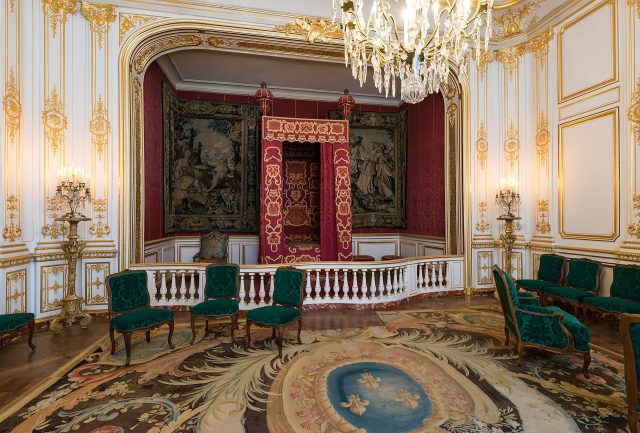
Inside, Chambord is less opulent than Versailles or Fontainebleau, but its restraint only adds to its charm. The rooms are adorned with heraldic emblems, Renaissance fireplaces, and tapestries that whisper stories of royal hunts and courtly life. The royal chapel, with its faded frescoes and intricately carved wooden pews, offers a quiet glimpse into the spiritual life of the château’s inhabitants. In one chamber, hunting trophies and antique weapons serve as a reminder of Chambord’s origins—a country retreat where kings came to escape, not to reign. Yet even here, the grandeur is palpable: the high ceilings, the long corridors, the light streaming through the tall windows all conspire to create a sense of boundless space.
The park surrounding the château is a world unto itself, a vast expanse of forest and meadows that once served as the king’s private hunting grounds. Today, it remains a place of wild beauty, where deer and wild boar roam freely, and rare birds nest in the ancient trees. Trails wind through the woods, leading to viewpoints that offer sweeping vistas of the château and the Loire Valley beyond. Scattered throughout the park are the remnants of its royal past—old stables, pavilions where guests once stayed, and clearings where hunts would begin and end. In summer, the park comes alive with open-air concerts and performances, while in winter, it transforms into a quiet, snow-dusted landscape, as if plucked from a fairy tale.
Chambord’s history is woven into the fabric of France itself. It hosted kings and courtiers, including Louis XIV, who favored it for its hunting and its seclusion. By the 18th century, the château had fallen into disrepair, but the Revolution spared it, recognizing its value as a national treasure. Restoration began in the 19th century, and today, it stands as one of the Loire Valley’s most visited landmarks. Yet unlike other historic sites, Chambord retains a sense of solitude. Even in peak season, it’s possible to find a quiet corner on the terrace or beneath the trees, where the only sounds are the rustling of leaves and the distant call of birds.
A visit to Chambord is more than a tour—it’s a step back in time. There are no crowds like those at the Louvre or Notre-Dame, no jostling for space or hurried footsteps. Instead, there’s a sense of stillness, a chance to wander at your own pace and let the château reveal itself slowly. In the late afternoon, when the sun casts long shadows across the stone and the forest glows golden, Chambord feels almost unreal, as if it exists outside of time. The air is filled with the scent of earth and old wood, and the wind carries the echoes of centuries past. It’s a place where history isn’t just remembered—it’s felt, in the quiet moments between footsteps, in the way the light falls across the walls, in the way the past lingers just beneath the surface.