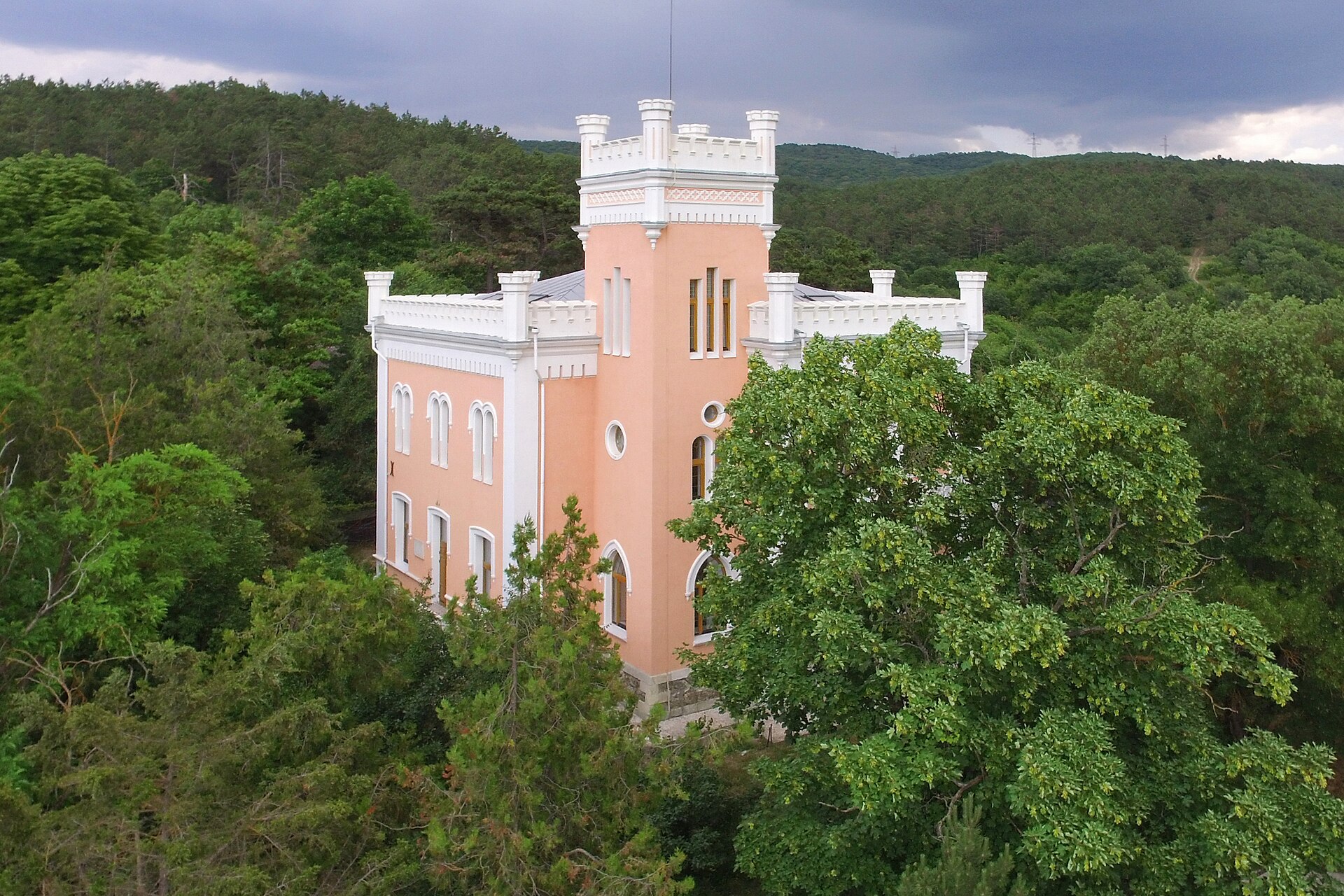
Nestled on the edge of Lozovoye, a quiet village lost in the Russian countryside, the Kessler-Fersman Castle feels like a fragment of another era. The building stands apart from the scattered houses, surrounded by fields and dense forest, as if time itself has forgotten to move forward here. Built in the early 20th century, it reflects a moment when Russia still clung to the elegance of European estate traditions, even as the winds of change began to stir. Though modest in size, the castle carries a striking presence—its pointed towers, tall arched windows with faded stained glass, and weathered stone walls, now softened by moss and ivy, suggest a place where its owners once sought more than just shelter. This was a home built not out of necessity, but out of a desire to create something enduring, something that would outlast its makers.
The castle’s story is tied to two remarkable figures in Russian science: Alexander Kessler, a chemist and mineralogist, and his student and close friend, Alexander Fersman, one of the most influential geochemists of his time. Kessler acquired the land in the late 19th century, and later, Fersman spent summers here, turning the estate into a retreat for work and reflection. It was in Lozovoye that Fersman is said to have written parts of his groundbreaking studies on the mineral wealth of the Kola Peninsula, research that would later become foundational in the field. The castle wasn’t just a private residence—it was a gathering place for intellectuals, artists, and scientists who shaped the cultural and scientific landscape of their time. The walls, if they could speak, would tell of long evenings spent debating theories, sharing discoveries, or simply enjoying the quiet companionship of like-minded souls.
Architecturally, the castle blends Neo-Gothic and Art Nouveau elements, a bold choice for its time. Constructed from local stone and brick, its facades feature decorative details that echo medieval European castles—turrets, intricate carvings, and heavy wooden doors that seem to guard secrets of the past. Inside, the original layout remains largely intact, with high ceilings, grand fireplaces, and wooden paneling that once gleamed under the light of chandeliers. The staircase, with its wrought-iron railings, spirals upward like something from a fairy tale, while the stained-glass windows in the main hall cast colored patterns across the floors when the sun is right. The interiors aren’t always open to visitors, but even the exterior, with its mix of grandeur and decay, tells a story of ambition and resilience.
The castle’s fate mirrored the turbulent history of the country. After the Revolution, it was repurposed—first as a school, then as a rest home, and later as an administrative building. Each new use left its mark, altering rooms and layouts, but the core of the structure survived. By the 1990s, it had fallen into disrepair, its walls crumbling, its gardens overgrown. Restoration efforts began in recent decades, though progress has been slow. Today, it belongs to a local museum, which is gradually piecing back together its original character. The work is painstaking, but the goal isn’t to erase the layers of history—rather, to preserve them, letting the castle’s many lives remain visible.
Lozovoye itself is the kind of place where life moves at its own unhurried pace. There are no crowds, no traffic, no rush—just the quiet rhythm of a village where people still know their neighbors. The castle fits seamlessly into this landscape, not as a grand statement of wealth or power, but as a personal refuge, a place where someone once sought inspiration away from the noise of the city. It lacks the opulence of the aristocratic estates that dot the Russian countryside, but that only makes it more intriguing. This was a home built by scholars, not nobles, and it carries the warmth of a place where ideas mattered more than titles.
Visiting the castle today is a low-key affair. It’s not always open, and when it is, the experience is more about atmosphere than spectacle. Occasionally, there are guided tours, small exhibitions, or local events, but more often than not, the grounds are quiet. The villagers treat it with quiet pride, but without the reverence reserved for more famous landmarks. For them, it’s simply part of their history, a place that has always been there, as familiar as the old oak trees in the park. You can wander the overgrown paths of what was once a formal garden, sit on a bench by the entrance, or just watch how the light shifts across the stone as the day fades. There are no souvenir stands, no flashy signs—just the building itself, standing as it has for over a century.
What makes the Kessler-Fersman Castle special is its unassuming authenticity. It wasn’t built to impress; it was built to inspire. There were no lavish balls or political intrigues here, just the quiet hum of intellectual life—long conversations over tea, the rustle of papers as Fersman worked on his manuscripts, the crackle of fire in the hearth on cool summer evenings. The castle was a backdrop to a different kind of wealth, one measured in ideas rather than gold. Today, it’s easy to imagine Fersman returning from a walk in the woods, a rare mineral specimen in hand, or Kessler poring over a new discovery with colleagues. The details of those moments are lost, but the feeling lingers, as if the walls still hold the echoes of those conversations.
If you find yourself in Lozovoye, the castle is worth a visit—not for the sake of ticking off another tourist attraction, but for the chance to step into a slower, more contemplative world. This isn’t a place for those seeking excitement or spectacle. It’s for those who appreciate the quiet beauty of old buildings, the stories they carry, and the way history can feel alive in the right setting. There are no crowds here, no pressure to perform the role of a tourist. Just a building, standing in the middle of a Russian village, waiting to share its story with anyone willing to listen.