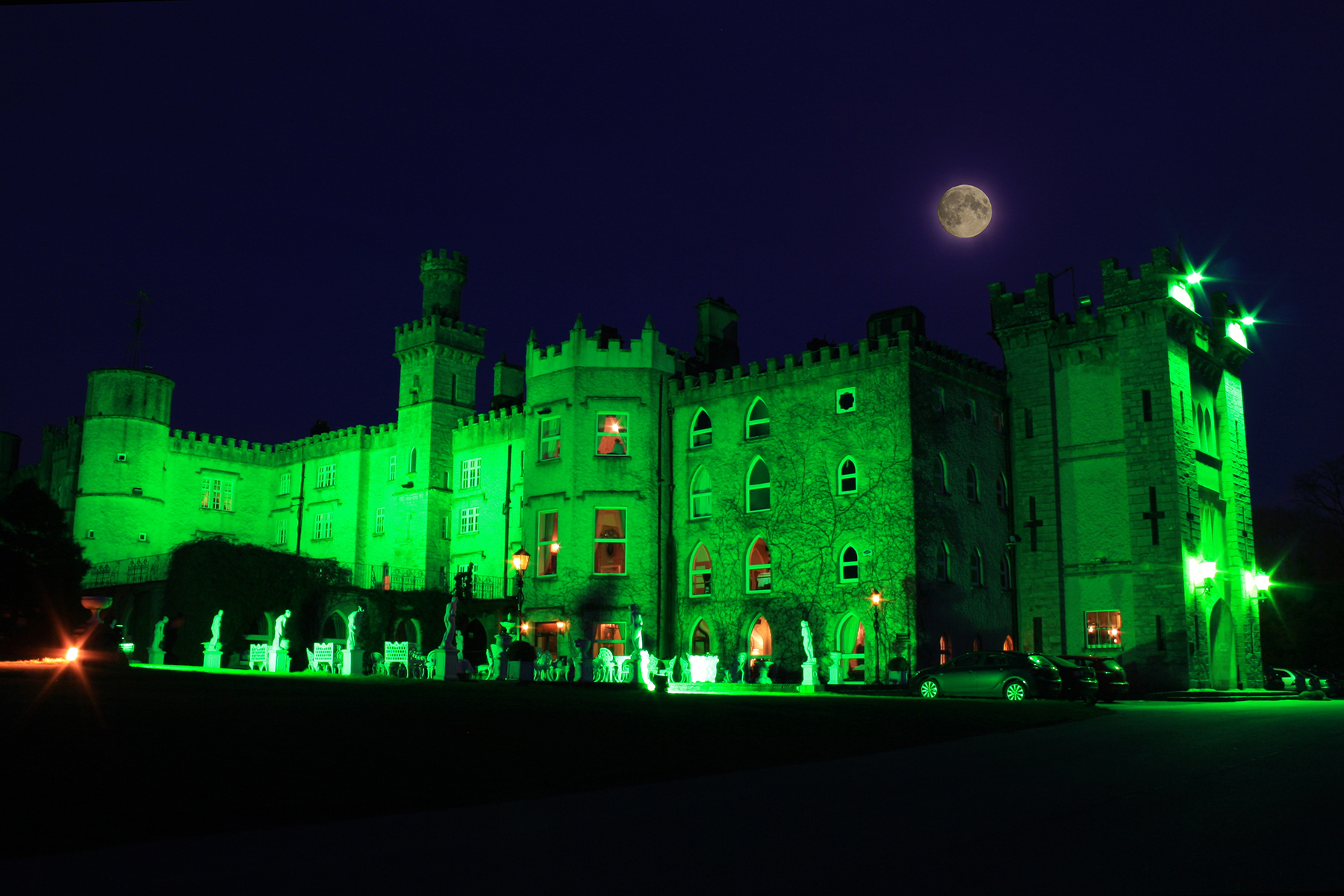
Cabra Castle rises from a gentle hill above the quiet Irish countryside, where once dense forests stretched across the land and now only scattered groves remain among the neat fields. Its walls have stood for generations, bearing the marks of time yet still commanding attention—a silent witness to the slow, steady rhythm of life in this corner of Ireland. The castle doesn’t demand admiration; it simply exists, as it has for over a century, offering a glimpse into a past that feels both distant and strangely familiar.
Built in the mid-1800s by William Young, a local landowner, Cabra was never meant to be a fortress. Instead, it was conceived as a grand country residence, designed in the neo-Gothic style that was fashionable among Ireland’s Anglo-Irish elite at the time. This was an era of transformation for the country, still recovering from the devastation of the Great Famine, and landowners like Young sought to assert their status through architecture that blended medieval grandeur with modern comfort. The result was a building that looked as though it had been plucked from a romantic novel—turrets, pointed arches, and battlements all carefully crafted to evoke the past while serving the needs of the present.
Inside, the castle retains much of its original character, though time has softened some of its finer details. The grand hall, with its soaring ceilings and tall windows, was once the heart of social life, where guests gathered for balls and dinners. The staircases twist and narrow as they rise, a deliberate nod to medieval design, though here they were built more for atmosphere than defense. Some rooms still hold traces of their former opulence—massive four-poster beds draped in heavy fabrics, ornate fireplaces, and the occasional stained-glass window casting colored light across the stone floors. The kitchens below, with their vast hearths, hint at the feasts once prepared here, though now they stand quiet, their purpose long since faded.
Like many Irish estates, Cabra’s history is one of shifting fortunes. After Young’s death, the castle passed through several owners, serving as a private home, a hotel, and even a girls’ school. By the mid-20th century, it had fallen into disrepair—roofs leaked, walls cracked, and the once-manicured grounds grew wild. For a time, it seemed destined to join the ranks of Ireland’s abandoned great houses, another casualty of changing times. But in the 1980s, new owners took on the challenge of restoration, painstakingly bringing the castle back to life. Today, it stands as a testament to resilience, though not without scars—some walls bear the faint marks of repairs, and the furnishings, while elegant, are not all original.
The land around Cabra is as much a part of its story as the building itself. The park that once surrounded the castle was designed with care, featuring winding paths, ornamental gardens, and rare trees. Now, only a few of those trees remain—ancient oaks and beeches that have stood for centuries, their branches swaying in the same winds that once carried the sounds of carriages and laughter. Beyond the park, the countryside unfolds in gentle waves of green, dotted with sheep and hedgerows. On clear days, the view stretches for miles, offering a quiet panorama of the Cavan landscape, a place that has inspired poets and painters for generations.
What makes Cabra special is not just its architecture or history, but the way it feels. There are no crowds here, no guided tours rushing visitors from one room to the next. Instead, the castle invites you to linger, to notice the small details—the way light filters through a narrow window, the texture of the stone beneath your fingers, the faint creak of a floorboard underfoot. In recent years, it has become a popular venue for weddings and photographs, drawn by its romantic atmosphere. But even without an occasion, the castle has a way of making time feel different, as if the past and present exist side by side, separated only by the thickness of a wall.
For those with an interest in Irish history, Cabra offers a quiet reflection on the country’s complex past. It stands as a reminder of the Anglo-Irish landlords who once shaped the landscape, of the families who lived and worked here, and of the decline that followed Ireland’s independence. The castle doesn’t tell the whole story—no single place could—but it offers a fragment, a piece of the puzzle that is Ireland’s layered history. In its stones and halls, you can sense the lives that unfolded here, the ambitions, the struggles, and the quiet moments that make up the fabric of any place.
If you find yourself in County Cavan, Cabra is worth a visit, not for any grand spectacle, but for the chance to step away from the noise of modern life. There’s no rush here, no agenda, just the slow unraveling of time. You might come for an afternoon and leave with the feeling that you’ve touched something enduring. The castle doesn’t promise excitement, but it offers something rarer—a sense of connection, a moment of stillness in a world that moves too quickly. And perhaps that’s enough.