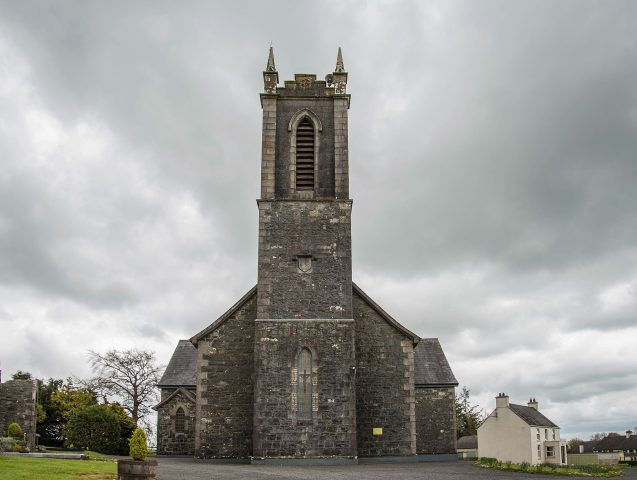
St. Patrick’s and St. Felim’s Cathedral in Cavan is the kind of place that lingers in the mind long after you’ve left. Perched on a gentle rise in the heart of the town, it’s surrounded by old trees and low-slung houses, as if holding onto a time when Cavan was a place of spiritual significance. The building itself is unassuming, a modest structure of grey stone with a neat bell tower and narrow pointed windows. There’s no grand flourish, just a sense of harmony.
The cathedral’s story is woven into the broader history of Ireland. The first church on this site dates back to the 16th century, when Cavan was part of the territory controlled by the O’Reilly clan. That earlier church was a wooden structure dedicated to St. Felim, the patron saint of the Kilmore diocese. Felim was a 7th-century monk and hermit whose devotion never faded in these parts. The old church didn’t survive the upheavals of the Reformation and the religious conflicts that followed. It was destroyed, leaving only the memory of its presence.
The cathedral we see today was built in the mid-19th century, during a Catholic revival in Ireland. The architect, William Hague, designed the building in the neo-Gothic style. Construction took nearly two decades, and in 1862, the cathedral was consecrated in honour of two saints: Patrick and Felim. In that dual dedication, the cathedral became a symbol of Ireland’s national identity and its local traditions.
Inside, the cathedral is striking for its simplicity. The high vaulted ceilings are supported by slender columns, and the light filtering through the narrow windows casts a soft glow. The altar is made of white marble, and behind it stands a carved wooden reredos depicting scenes from the lives of the saints. The stained glass here shows St. Patrick blessing Ireland and St. Felim in prayer. These windows tell a story of a faith that endured despite hardship.
This isn’t a cathedral that draws crowds of tourists. It’s a place of stillness, where the only sounds are the rustle of prayer books or the murmur of hymns during Mass. The people who come here sit in silence, think, or pray. That’s the essence of St. Patrick’s and St. Felim’s: it doesn’t exist to impress. It’s a steady presence in the life of the town.
The small park surrounding the cathedral is a quiet space. In summer, children play on the grass while older residents sit on benches with newspapers or cups of tea. In winter, the trees stand bare, the ground dusted with frost, but the cathedral never feels unwelcoming. Occasionally, the park hosts small festivals or markets, but more often, it’s just a peaceful spot.
Cavan isn’t a town on the typical tourist trail. There are no grand castles or dramatic coastal cliffs. But that’s why St. Patrick’s and St. Felim’s feels authentic. It’s a living part of the town, shaped by the people who have worshipped here for generations. It tells the story of ordinary lives, of faith passed down, of memories made.
If you ever find yourself in Cavan, step inside. Sit on one of the wooden pews, listen to the silence, and let the space settle around you. You won’t find anything flashy, but that’s the point. The cathedral’s beauty lies in its quiet presence, in the way it doesn’t demand anything from you. It’s a place for connection—for those seeking reflection or a moment of peace.