The Mahamuni Pagoda in Mandalay is more than just a landmark—it’s a living center of devotion, where faith and history intertwine in ways that feel both ancient and immediate. At its heart stands the revered Mahamuni Buddha image, a statue so deeply embedded in Myanmar’s spiritual life that it transcends the role of a mere relic. Over centuries, worshippers have pressed sheets of gold leaf onto its surface, layering devotion upon devotion until the figure gleams with the collective prayers of generations. For many, the statue isn’t just a representation of the Buddha; it’s a tangible connection to something sacred, a presence that feels almost alive. The exact origins of the image are debated among historians, but for those who come here, its age and authenticity matter less than the weight of its presence.
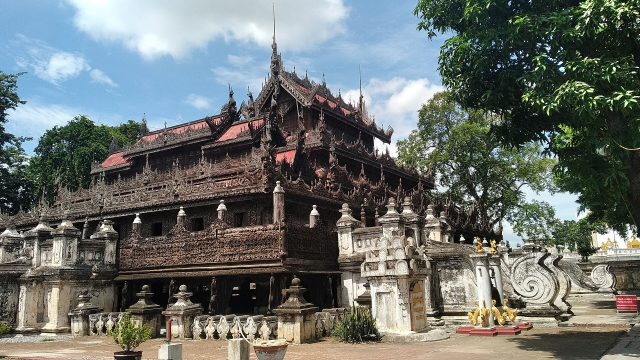
The temple itself is unassuming in its design, yet its simplicity carries a quiet power. The main structure, with its steep, tiered roof adorned with traditional Burmese motifs, rises above a spacious courtyard that hums with activity at all hours. Inside, the air is thick with the scent of incense, and the dim light filters through the haze, catching the edges of the gold-covered statue. There are no grand murals or intricate carvings here—just the raw, unadorned focus of devotion. The lack of ostentation only amplifies the sense of reverence, as if the space itself is designed to direct all attention toward the figure at its center.
The history of the Mahamuni image is as much a story of politics as it is of faith. It was brought to Mandalay in the 19th century from the ancient kingdom of Arakan, a region along Myanmar’s western coast. According to legend, the statue was cast during the Buddha’s lifetime, making it one of the few likenesses created with his direct blessing. When King Bodawpaya conquered Arakan, he ordered the image to be transported to his capital, not just as a spoil of war but as a symbol of his divine right to rule. The move was calculated—by housing the statue in Mandalay, he tied his reign to the spiritual authority of the Buddha himself. Over time, the temple became a cornerstone of the city’s identity, a place where the past is never far from the present.
One of the most striking rituals at Mahamuni takes place each morning, when monks perform the face-washing ceremony. With careful, deliberate movements, they cleanse the statue’s visage with a damp cloth, a ritual that draws crowds of onlookers. For many, this moment is the highlight of their visit—a fleeting but profound connection to the sacred. The gold leaf that covers the statue isn’t just decoration; it’s a physical manifestation of faith, each sheet a testament to someone’s hope, gratitude, or plea. Over the years, the layers have grown so thick that the statue’s original form is nearly obscured, yet that only adds to its mystique.
The temple grounds are a microcosm of Myanmar’s spiritual life. Vendors line the streets selling lotus flowers, candles, and bundles of incense, their stalls forming a colorful border around the sacred space. Pilgrims arrive from all corners of the country, some having traveled for days on foot, others by bus or train, their faces weary but determined. Among them are monks in saffron robes, women in traditional longyi, and the occasional traveler, all drawn by the same pull. The atmosphere is one of quiet intensity—there’s no need for grand gestures or loud declarations here. The devotion is in the details: the way hands press gold leaf onto the statue, the murmured prayers, the flicker of candlelight against the dark wood.
Mahamuni isn’t a place that caters to tourists. It operates on its own rhythm, governed by centuries-old traditions that may feel unfamiliar to outsiders. Women, for instance, are restricted from certain areas of the temple, not as a slight but as an observance of long-held customs. Visitors are expected to dress modestly, speak softly, and ask before taking photographs. These aren’t rules designed for comfort; they’re part of what makes the temple what it is. For those willing to adapt, the experience is all the more rewarding. There’s a sense of stepping into a world where time moves differently, where the boundaries between the sacred and the everyday blur.
The temple’s mood shifts with the hours. Mornings are lively, with the courtyard filled with the sounds of footsteps and whispered prayers. By evening, as the light fades and candles are lit, the space takes on a more contemplative air. The glow of the flames reflects off the gold leaf, casting a warm, almost otherworldly light. Even for those who don’t share the Buddhist faith, it’s hard not to feel the weight of the place—the sense that something profound is happening here, even if it’s not entirely understood. Mahamuni doesn’t try to impress; it simply exists, and in doing so, it leaves an impression that lingers long after you’ve left.
Mandalay is a city of contrasts, where the rush of modern life collides with the steadfast rhythms of tradition. Nowhere is this more evident than at the Mahamuni Pagoda. It’s not a place of silence, nor is it a place of chaos. Instead, it’s a space where history and faith coexist, where the past isn’t just remembered but actively lived. The temple isn’t just a stop on a tourist itinerary; it’s a glimpse into the soul of the city, a reminder of what endures when so much else changes. If you find yourself in Mandalay, visiting Mahamuni isn’t about checking a box or taking a photo. It’s about standing in a place where the sacred feels tangible, where the air hums with the weight of centuries, and where, for a moment, you might catch a glimpse of something greater than yourself.