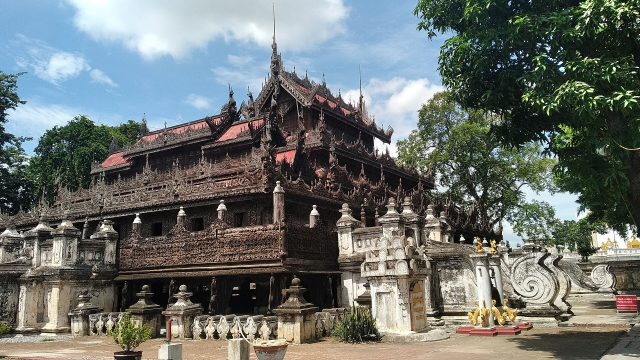
Mandalay’s Royal Palace isn’t just a relic of stone and timber—it’s a quiet witness to the final chapter of Burma’s monarchy, a place where the past lingers in the details. Built in the mid-19th century under King Mindon’s rule, the palace was the heart of a kingdom that flourished briefly before collapsing under British colonial pressure. The complex was designed as both a fortress and a symbol, raised on an artificial platform and encircled by a wide moat and high walls topped with battlements. Every element, from the defensive towers to the intricate woodwork, carried meaning, blending practicality with the spiritual ideals of Burmese statecraft. What stands today is largely a reconstruction from the mid-20th century; the original structures were devastated during World War II, when Allied bombings reduced much of the palace to rubble. Yet even in its restored form, the site retains a sense of authenticity, a careful attempt to preserve the essence of what was once the political and cultural nucleus of a sovereign Burma.
Stepping through the palace gates feels like entering a different era. The throne hall, with its gilded roof and elaborate carvings, dominates the central courtyard—not because of its size, but because of the craftsmanship that went into every beam and panel. This was where kings held court, received foreign dignitaries, and made decisions that shaped the fate of the kingdom. Nearby, the royal living quarters offer a more intimate glimpse into the private lives of the monarchy. Though modest compared to the grand halls, these rooms still carry the weight of history, their wooden floors and simple furnishings hinting at the daily rhythms of a family that once ruled an empire. One of the most intriguing spaces is the palace library, where sacred Buddhist texts inscribed on palm leaves were kept. These manuscripts weren’t just religious artifacts; they represented the spiritual authority that underpinned the king’s earthly power, a reminder that in Burma, governance and faith were never truly separate.
The palace complex is a maze of tradition, each building serving a specific purpose within the rigid hierarchy of royal life. The audience halls, pavilions, and treasuries were arranged according to ancient architectural principles, their tiered roofs and mythological carvings designed to evoke the heavens. The roofs, in particular, seem to float above the ground, their curved eaves adorned with figures from Buddhist lore—dragons, celestial beings, and scenes from the Jataka tales, which recount the Buddha’s past lives. Even the layout of the buildings followed a cosmic order, with the king at the center, acting as a bridge between the divine and the mortal. This wasn’t just a residence; it was a microcosm of the universe, a physical manifestation of the belief that the monarch’s rule was ordained by higher forces.
Today, the palace functions as an open-air museum, but it doesn’t feel like one. Locals visit not just to learn about history, but to connect with it. In the early mornings, monks in saffron robes walk the grounds, their prayer beads clicking softly as they circumambulate the buildings. By evening, families gather on the grassy areas, chatting and enjoying the cooler air. During festivals, the palace comes alive with traditional dance performances, the twang of saung gauk harps, and reenactments of royal ceremonies. These moments make the past feel tangible, as if the walls themselves are whispering stories of a time when Mandalay was the beating heart of an independent nation.
What makes the palace especially striking is its contrast with the city around it. Though it sits at the center of Mandalay, the high walls and moat create a sense of seclusion, shielding the complex from the noise and bustle beyond. Inside, the only sounds are the rustling of tamarind leaves and the occasional murmur of visitors. From the watchtowers along the fortress walls, the view stretches in every direction: to the north, the hazy outlines of the Shan Hills; to the south, the broad ribbon of the Irrawaddy River; and below, the grid of streets that make up old Mandalay. As the sun sets, the palace is bathed in a golden glow, and for a moment, it’s easy to forget that the world outside has moved on.
The palace’s history is inseparable from the tragedy of Burma’s monarchy. After the British seized Mandalay in 1885, the last king, Thibaw, and his queen, Supayalat, were exiled, and the palace was repurposed as a colonial military barracks. During World War II, it became a battleground, caught between Japanese and British forces, and much of its original splendor was lost. The reconstruction that began in the 1980s restored some of its former grandeur, but many details—carvings, frescoes, and even entire structures—were irretrievably damaged. Still, what remains is a powerful symbol of a bygone era, a time when Mandalay wasn’t just a city, but the capital of a kingdom that refused to bow to foreign rule.
For those trying to understand Myanmar’s soul, the Royal Palace is essential. It lacks the ostentation of European castles or the opulence of Middle Eastern palaces, but that’s part of its charm. There’s a quiet dignity here, a sense of harmony between human ambition and the natural world, between power and spirituality. The palace doesn’t just showcase wealth; it reflects a philosophy where even the most powerful ruler was subject to forces greater than himself. That’s why it resonates so deeply with both locals and visitors—it’s a place where the past isn’t just remembered, but felt.
The best time to visit is early morning or late afternoon, when the heat is less intense and the light is soft. The dry season, from November to February, is particularly pleasant, with cooler temperatures and clear skies. While the throne hall and main buildings are the obvious highlights, the palace’s outer areas are worth exploring too. Hidden among the trees are small ponds and quiet corners where time seems to stand still. Climbing one of the watchtowers offers a different perspective, not just of the palace, but of Mandalay itself. If you’re lucky, you might encounter a local guide who can share stories about the palace’s secrets or show you old photographs of how it looked in its prime.
The Royal Palace isn’t just a tourist attraction—it’s a place where history breathes. You could spend an hour here or an entire day, wandering through the courtyards, studying the carvings, or simply watching how the space is used by those who call Mandalay home. In the end, it’s these moments—when the past and present overlap—that offer the deepest understanding of a place. The palace may no longer be the same as it was in King Mindon’s time, but it still carries the echoes of his vision: a city built not just of bricks and mortar, but of dreams.