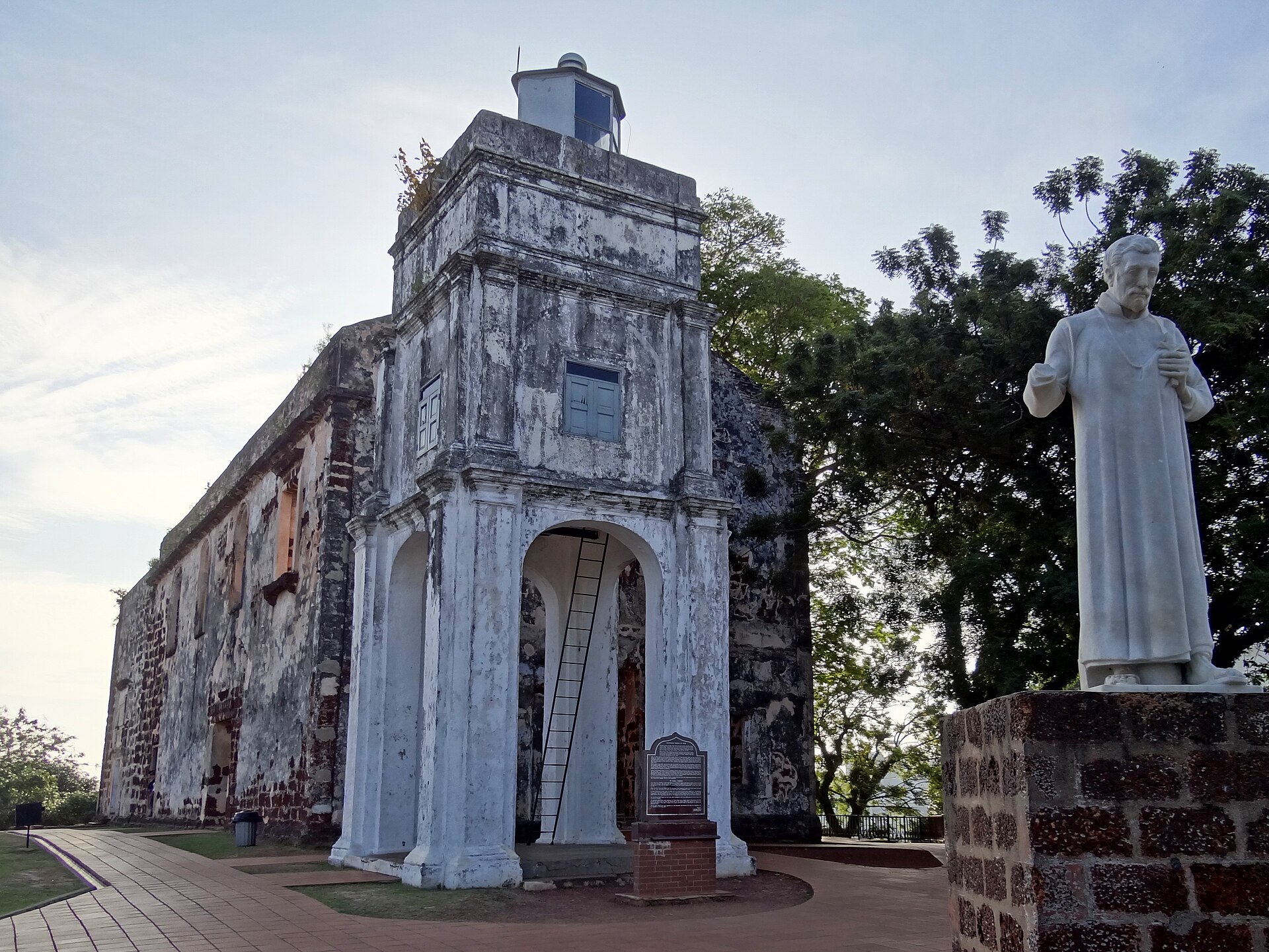
St. Paul’s Hill has seen centuries of change, standing quietly above the streets of Malacca as one of the city’s oldest landmarks. The hill rises gently near the mouth of the Malacca River, offering a vantage point over the rooftops and the straits beyond. At its summit, the ruins of St. Paul’s Church are all that remain of what was once a bustling center of faith and colonial power. The structure itself is simple—a roofless shell of weathered stone, its walls still bearing the marks of time and the hands of those who once gathered here.
The story of this place begins in the early 16th century, when Portuguese explorers arrived on the shores of Malacca. They built a small chapel on the hill in 1521, dedicating it to the Virgin Mary under the name Nossa Senhora da Annunciada. The chapel was modest, reflecting the early days of Portuguese influence in the region, but it quickly became a focal point for the growing Catholic community. When the Dutch took control of Malacca in 1641, they repurposed the building, renaming it St. Paul’s Church and expanding it into a more substantial structure. The Dutch used it as their primary place of worship for over a century, until they completed Christ Church at the foot of the hill in 1753.
The church’s decline began after the Dutch left, and by the time the British arrived in the late 18th century, it had already fallen into disuse. The roof was removed to provide materials for a nearby lighthouse, and the building was left exposed to the elements. Over time, the interior was stripped of its furnishings, and the gravestones that once lined the floor were either moved or worn away by the tropical climate. Today, the open-air ruins give visitors a sense of the passage of time, with sunlight streaming through the empty windows and the sound of wind rustling through the trees.
One of the most striking features of St. Paul’s Hill is the collection of tombstones that still stand against the walls. Many of them belong to Dutch settlers and officials who lived in Malacca during the 17th and 18th centuries. The inscriptions, though faded, offer a glimpse into the lives of those who shaped the city’s history. Some stones bear the names of entire families, while others mark the resting places of soldiers, merchants, and clergy. The tombstones are a reminder that this hill was not just a place of worship but also a burial ground, where the living and the dead coexisted for generations.
The hill itself is more than just a historical site—it’s a place where layers of history overlap. Before the Portuguese arrived, the hill was likely used by the local Malay community, though little remains from that era. The Dutch fortifications that once surrounded the church are now mostly gone, but traces of their presence can still be seen in the cannons that dot the hillside. These cannons, some of which date back to the 17th century, were part of the defenses that protected Malacca from attacks by sea. Today, they serve as silent witnesses to the city’s turbulent past.
Climbing St. Paul’s Hill is a short but rewarding walk. The path winds upward through lush greenery, with glimpses of the city unfolding below. At the top, the ruins open up to a panoramic view of Malacca, from the historic Dutch Square to the modern buildings along the coast. The breeze carries the scent of the sea, and the sound of distant traffic fades into the background. It’s a place where visitors can pause and reflect, not just on the history of the hill, but on the broader story of Malacca itself—a city shaped by trade, conquest, and cultural exchange.
The atmosphere at St. Paul’s Hill is one of quiet contemplation. Unlike the bustling streets of Jonker Walk or the lively markets along the river, this place feels removed from the present, as if time moves at a different pace here. The ruins are not restored in the way that some historical sites are; instead, they are left as they are, allowing visitors to imagine what the church might have looked like in its prime. There are no guided tours or interpretive signs to dictate the experience—just the stones, the wind, and the weight of history.
For those interested in Malacca’s colonial past, St. Paul’s Hill is an essential stop. It connects the Portuguese, Dutch, and British periods in a way that few other sites in the city can. The hill has seen empires rise and fall, and its ruins tell a story of adaptation and resilience. Whether you’re drawn by the history, the architecture, or simply the chance to stand in a place that has witnessed so much, St. Paul’s Hill offers a moment of stillness in a city that is otherwise full of life. It’s a reminder that history is not just something we read about—it’s something we can touch, see, and feel.