Treblinka is a place that resists easy description, where the weight of history presses down on every step. Tucked away in a quiet, wooded area near the small Polish town of Kosów Lacki, it stands as one of the most harrowing symbols of the Holocaust. During World War II, the Nazis established an extermination camp here, where hundreds of thousands of people were systematically murdered. Today, Treblinka is a memorial—a stark reminder of a tragedy that must never be forgotten.
The camp’s history began in 1942, when Nazi Germany implemented the Final Solution, a plan to annihilate Europe’s Jewish population. Treblinka was built as part of Operation Reinhard, a campaign aimed at the mass murder of Jews in occupied Poland. Unlike Auschwitz, where prisoners endured forced labor before execution, Treblinka was designed solely for extermination. There were no barracks for long-term detention, no pretense of work—only a streamlined process of death. Trains arrived packed with people, and within hours, most were gone.
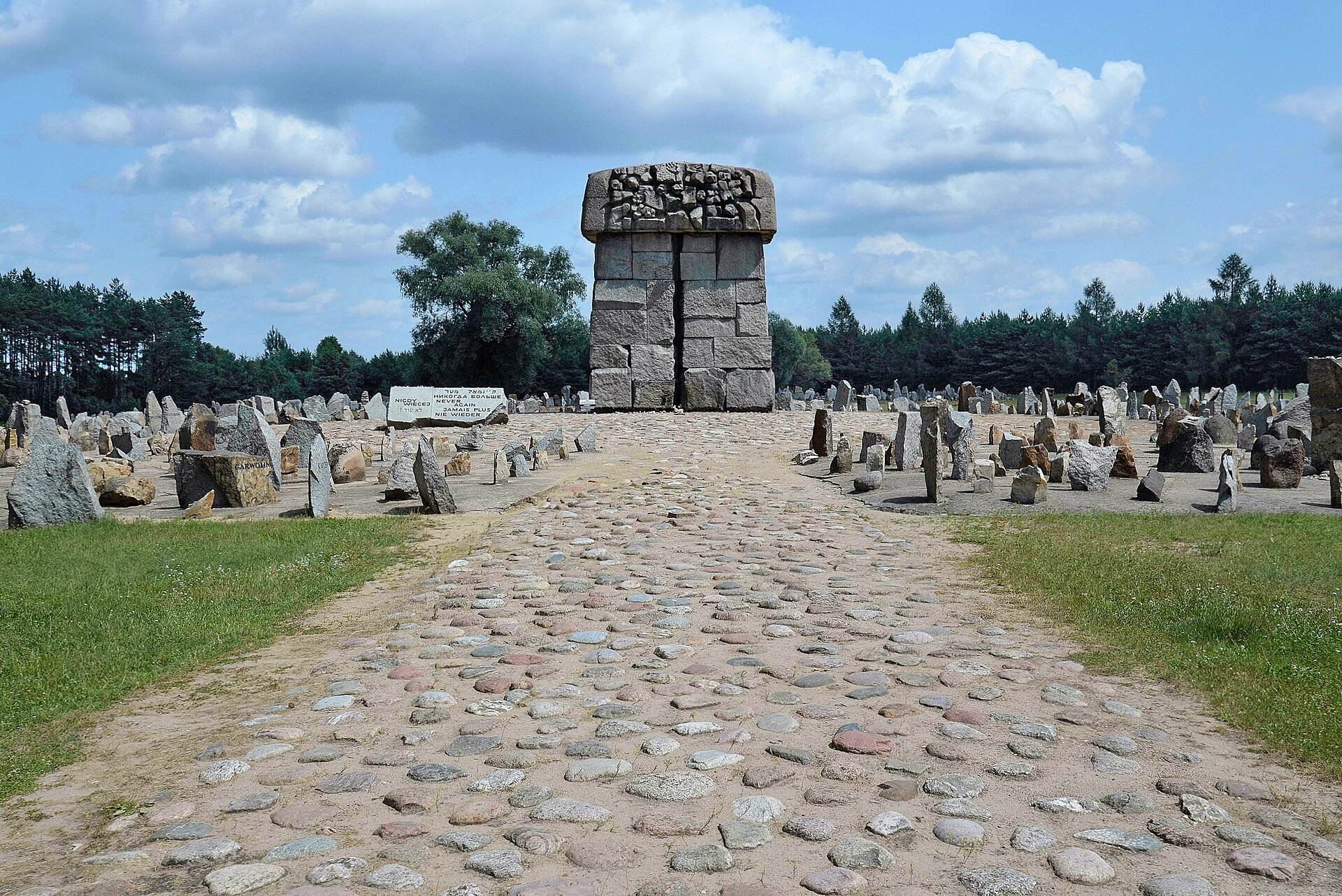
The architecture of Treblinka was built for efficiency in killing. The camp was divided into two sections: Treblinka I, which housed administrative buildings and living quarters for guards, and Treblinka II, the extermination zone. Gas chambers, disguised as showers, stood at the center of the operation, while open-air cremation pits burned the bodies. The Nazis destroyed most of the structures before abandoning the site, leaving little physical trace. What remains today is a memorial that reconstructs the camp’s layout through symbolic elements—paths, stones, and markers that hint at the scale of what happened here.
Over 900,000 people were murdered in Treblinka in just 13 months, from July 1942 to October 1943. The majority were Jews deported from the Warsaw Ghetto, but victims also came from across Poland, Greece, Bulgaria, and Yugoslavia. Roma people and Polish political prisoners were among those killed. The camp’s brief existence was marked by unimaginable suffering, culminating in a prisoner uprising in August 1943. Though the revolt was crushed, it remains one of the few acts of resistance in a place designed to erase all hope.
For decades after the war, Treblinka was a forgotten site. It wasn’t until the 1960s that a monument was erected, and the memorial gradually took shape over the following years. Today, the former camp is a vast, open field dotted with thousands of stones, each representing a community wiped out here. A towering black granite obelisk stands at the center, near a mass grave where the ashes of victims rest. The landscape is quiet, almost serene, but the silence feels heavy with what once took place.
Visiting Treblinka is not like visiting other historical sites. There are no guided tours with cheerful anecdotes, no exhibits designed for casual interest. Instead, there is only the land itself—a place where the past lingers in the rustling leaves and the distant sound of footsteps. Many come to pay their respects, leaving flowers or standing in silence. Others arrive seeking understanding, though the full weight of what happened here is impossible to grasp.
Treblinka serves as a warning, a reminder of how quickly civilization can unravel when hatred takes hold. It forces visitors to confront uncomfortable questions: How could this have happened? What allows such cruelty to flourish? There are no easy answers, only the knowledge that this place existed, and that its victims deserve to be remembered. The memorial is not just about the past—it’s a call to ensure such horrors are never repeated.
The experience of being here is deeply personal. Some leave feeling numb, others overwhelmed. But few walk away unchanged. Treblinka doesn’t offer closure or resolution; it demands reflection. It asks visitors to carry its memory forward, to recognize the fragility of peace, and to remain vigilant against the forces that once made this place possible. In a world where such atrocities can seem distant, Treblinka stands as a stark reminder of what humanity is capable of—and what it must never allow again.