Kosów Lacki doesn’t appear on most tourist maps. There are no grand squares or famous museums, no crowds or guided tours. The town moves at its own pace, where history lingers in the details—the weathered facades of old houses, the cobblestone streets worn smooth, and the churches that have stood in the same spot for centuries. The Church of the Holy Spirit is one of them.
The church first appeared in the early 16th century, when the region was part of the Duchy of Masovia. The earliest written mention is from 1521, though like most churches here at the time, it was built of wood. These structures were the heart of community life—places of worship, gathering spots where disputes were settled, festivals celebrated, and the dead laid to rest. Wooden churches in Masovia were vulnerable to fire, and Kosów Lacki’s burned down in the 17th century. A new stone church rose in its place.
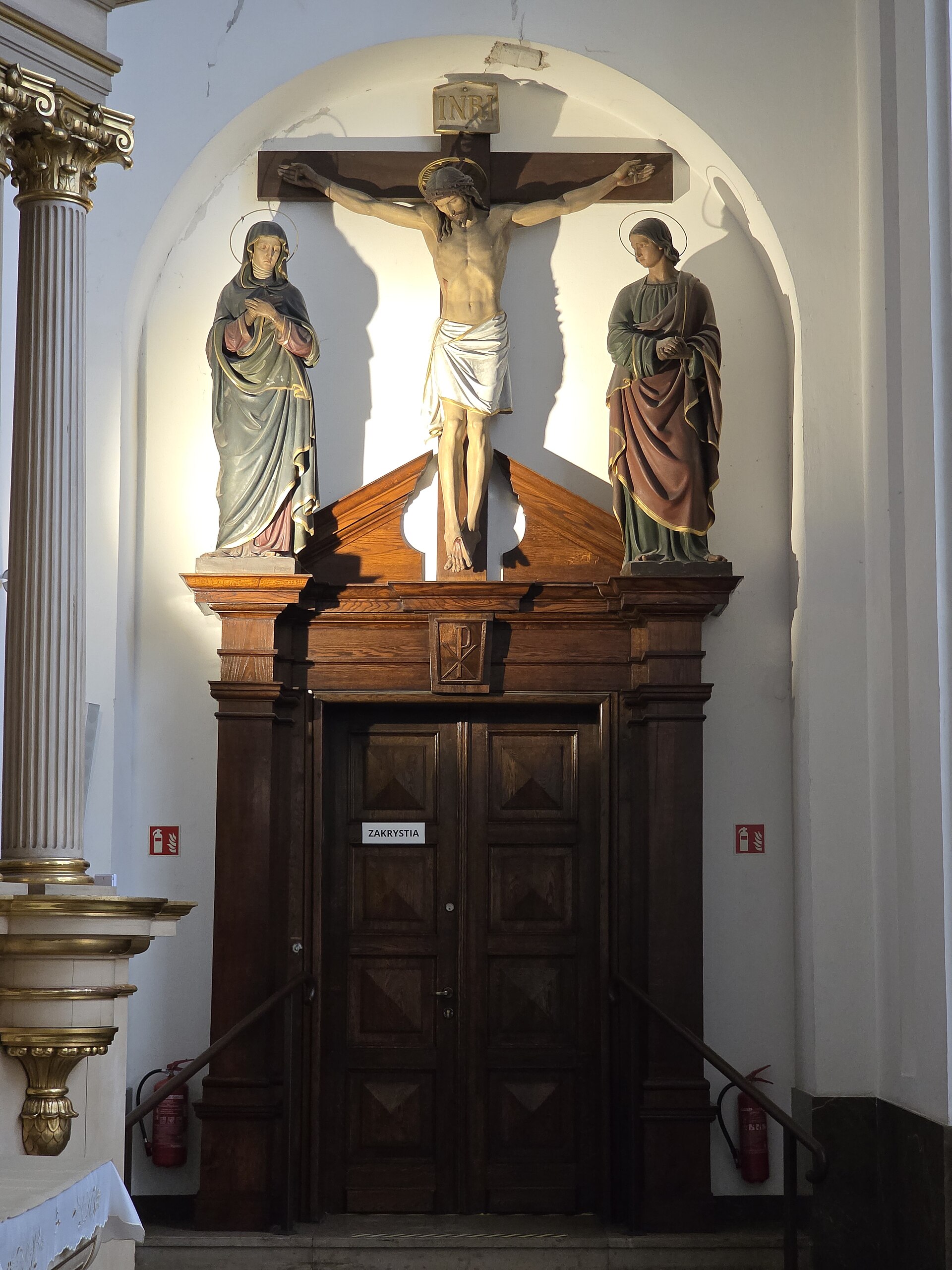
The church as it stands today took shape in the 18th century, rebuilt in the late Baroque style. By then, Masovia had been absorbed into the Polish-Lithuanian Commonwealth and later the Russian Empire. The exterior is unassuming—a low structure with a gabled roof, a simple facade framed by pilasters, and a small pediment above the entrance. Inside, high windows let in just enough light to reveal the details: faded frescoes on the vaulted ceilings, wooden pews with carved armrests, and the main altar, where the Holy Spirit is depicted as a dove descending upon the apostles.
The main altar, crafted in the 18th century, centers on the scene of Pentecost. The apostles are rendered in a style that feels almost folk-like, their rough quality giving them immediacy. Nearby, a 17th-century icon of the Virgin and Child stands out. Icons like these were passed down through generations, with families praying before them for centuries. The wood beneath the paint is darkened with age, the colors softened, yet the faces remain vivid.
The church has always been a keeper of memory. In the 19th century, under Russian rule, it became a quiet stronghold of Polish identity. Services were held in Polish despite official bans, and priests often led the community, preserving language and traditions. Wars brought looting and damage, but the church was always restored. Even under communist rule, when religious practice was restricted, it remained open.
Today, the Church of the Holy Spirit is still an active parish. On Sundays, locals gather for mass. On weekdays, the church is often empty, offering a chance to explore without hurry. The air inside carries the weight of old churches—damp stone, aged wood, the faint sweetness of beeswax. Sometimes, the silence is broken by the sound of an organ.
Kosów Lacki isn’t a place you visit for a single landmark. The appeal lies in the rhythm of everyday life, in the way the past and present coexist. The Church of the Holy Spirit is part of that rhythm, a building that has seen generations come and go, wars and occupations. It doesn’t demand attention, but if you find yourself in this part of Masovia, step inside. Stand in the quiet and listen to the echoes of history that aren’t written in textbooks. Here, time moves differently, and the stories are told in whispers.