Tartu’s Vanemuine Theatre is one of those places where the past and present coexist without effort, a building that has witnessed the city’s transformations while remaining a constant in its cultural life. Founded in 1870, it holds the distinction of being Estonia’s oldest theatre, a title that carries weight in a country where the arts have long been a cornerstone of national identity. The name itself—Vanemuine—pays homage to an ancient Estonian deity of music and poetry, a nod to the theatre’s roots in a time when cultural revival was intertwined with the struggle for self-expression.
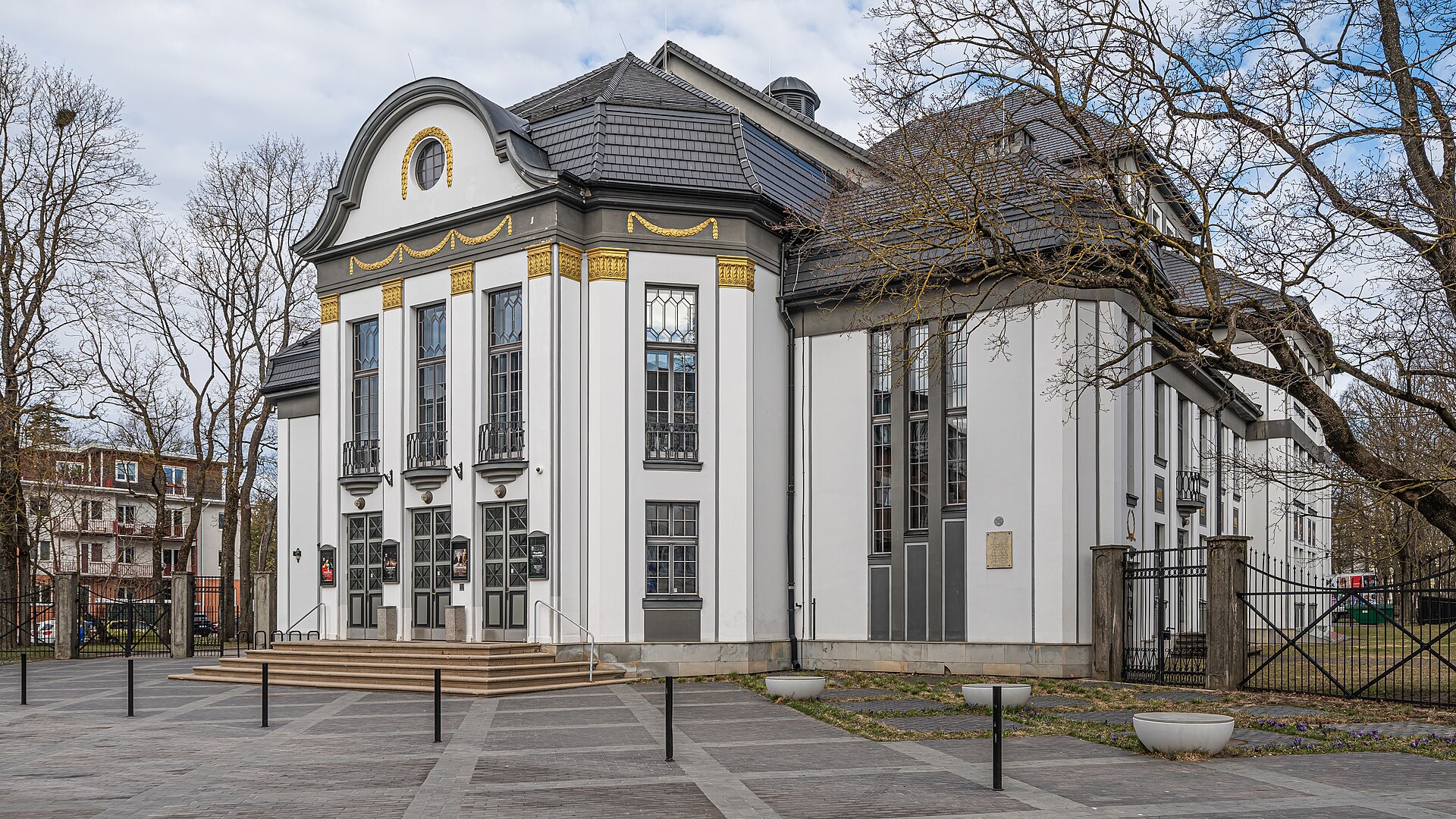
The current building, however, is not the original. The first theatre was a modest wooden structure, destroyed by fire in 1903. What stands today is the result of several reconstructions, the most significant of which took place in the 1960s, when the theatre was expanded into a modern complex. The architecture reflects this layered history: the façade is a blend of neoclassical and Soviet-era functionalism, with clean lines and a certain austerity that feels very much of its time. Inside, the main auditorium is a study in mid-century design, with warm wood paneling and a proscenium arch that frames the stage like a living painting. It’s not the grandest theatre in the Baltics, but there’s a quiet dignity to it, a sense that the space was built for the art rather than the spectacle.
Vanemuine has always been more than just a venue. In the late 19th century, it became a hub for the Estonian national awakening, a place where plays in the native language were performed at a time when German and Russian dominated public life. The theatre’s repertoire has evolved alongside the country’s history—from patriotic dramas in the early years to Soviet-era productions that often walked a fine line between artistic expression and state-approved narratives. After Estonia regained independence in 1991, Vanemuine entered a new phase, one marked by experimentation and a renewed focus on Estonian works. Today, it’s a repertory theatre with a broad program, staging everything from classical operas to contemporary dance, though it remains best known for its ballet and drama productions.
The theatre’s ballet company, in particular, has earned a reputation beyond Estonia’s borders. Founded in the 1940s, it was one of the few in the Soviet Union to develop its own distinct style, blending classical technique with a more lyrical, almost Nordic sensibility. The company’s productions of Tchaikovsky and Prokofiev are still performed here, but so are works by Estonian choreographers, which often draw on local folklore and landscapes. The drama troupe, meanwhile, has a more eclectic approach, alternating between Shakespeare, Chekhov, and modern Estonian playwrights. There’s no single "Vanemuine style," but rather a willingness to take risks, whether that means reimagining a classic or premiering a new work that challenges audiences.
What makes Vanemuine special, though, isn’t just its history or its productions—it’s the way it feels like a living part of Tartu. The city itself is often called Estonia’s intellectual capital, home to the country’s oldest university and a vibrant student culture. The theatre sits on the edge of the old town, near the Emajõgi River, in an area that’s lively but not touristy. On performance nights, the streets around it fill with people—locals mostly, but also visitors who’ve come to see what the fuss is about. There’s no grand marquee or neon signs; the theatre’s presence is understated, almost modest, as if it’s confident that those who seek it out will find it.
The atmosphere inside is similarly unpretentious. The main auditorium seats around 700, but it rarely feels cavernous, even when it’s full. The acoustics are warm, the sightlines good from almost anywhere in the house. The smaller chamber theatre, added during the 1960s renovation, is an intimate space, ideal for experimental works or smaller ensembles. Then there’s the Vanemuine Concert Hall, which hosts everything from symphony orchestras to jazz nights, its programming as diverse as the theatre’s own. The building also houses a café, a quiet spot where patrons can linger before or after a show, sipping coffee beneath high ceilings and large windows that let in the soft Estonian light.
For all its significance, Vanemuine isn’t a museum piece. It’s a working theatre, with all the imperfections and surprises that come with that. Productions can be hit or miss—some are revelatory, others forgettable—but that’s part of the experience. The theatre doesn’t shy away from controversy, either. In recent years, it has staged works that tackle Estonia’s complex relationship with its Soviet past, as well as productions that explore contemporary social issues. These aren’t always comfortable conversations, but they’re necessary ones, and Vanemuine has become a place where they can happen.
If you visit Tartu, the theatre is worth seeing even if you don’t catch a performance. The building itself tells a story—of resilience, adaptation, and the enduring power of art. Walk past it during the day, and you might see rehearsals through the windows, dancers in the studio or actors running lines in the courtyard. In the evening, the lights come on, and the place takes on a different energy, one that’s been building for over a century. It’s not the kind of theatre that dazzles with opulence, but it has something rarer: a sense of authenticity, of being exactly what it needs to be. For a city that prides itself on its intellectual and artistic life, Vanemuine is more than a landmark—it’s a reflection of Tartu itself.