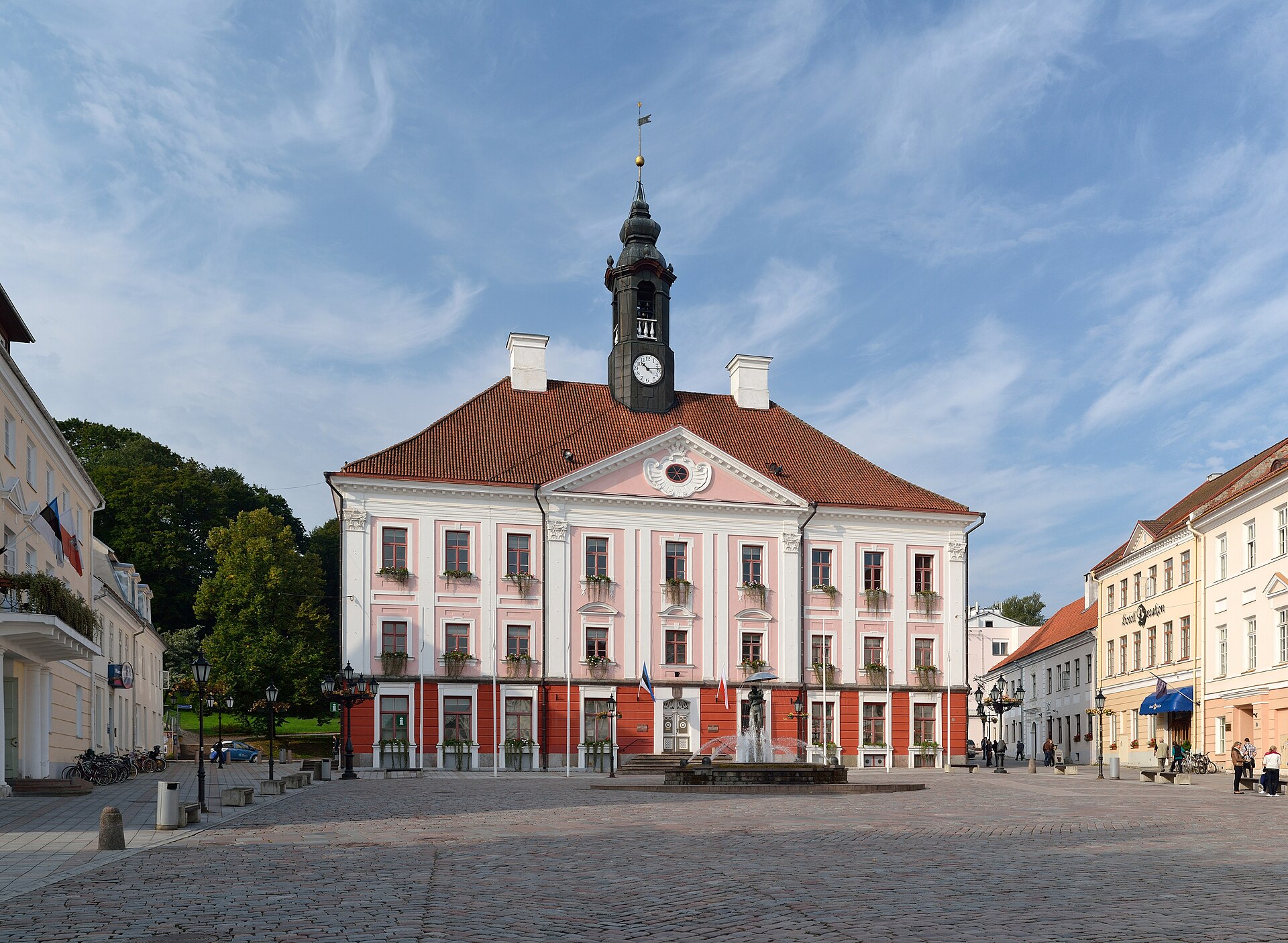
Tartu Town Hall is one of those buildings that quietly commands attention, not with grand flourishes, but with a kind of understated elegance that feels distinctly Estonian. Standing at the heart of the city’s main square, it has witnessed centuries of change, from the bustling trade of the Hanseatic era to the quiet resilience of Soviet occupation and the vibrant revival of modern Estonia. Built in the late 18th century, it replaced an earlier wooden structure that had served the city since medieval times, a practical necessity after fires repeatedly ravaged Tartu. The current building, designed by Johann Heinrich Bartholomäus Walter, is a fine example of late Baroque architecture, though its clean lines and balanced proportions give it a timeless quality that transcends any single style.
The hall’s facade is deceptively simple, with a pale yellow exterior that softens under the Baltic light. Three arched doorways lead into the building, their symmetry broken only by the central balcony, where city officials once addressed the public. Above it, a clock tower rises, its face marked with Roman numerals—a detail that feels almost anachronistic in today’s digital world. The tower isn’t particularly tall, but it’s just enough to make the building the focal point of the square, especially when the bells chime on the hour. Inside, the halls are more functional than ornate, though the grand staircase and high ceilings hint at the building’s civic importance.
What makes Tartu Town Hall interesting isn’t just its architecture, but the way it has adapted over time. Originally, it housed not only the city government but also a prison, a fire station, and even a market hall in its basement. The ground floor was once a hub of commerce, with merchants selling goods under its vaulted ceilings. Today, the building is still the seat of the city council, though its role has expanded to include cultural events and exhibitions. The basement, once a place of trade, now hosts a small museum dedicated to Tartu’s history, where visitors can see artifacts from the city’s past, including old maps, coins, and tools that tell the story of a place shaped by both war and peace.
The square around the town hall is just as much a part of its story as the building itself. Known as Raekoja plats, it has been the city’s main gathering place for centuries. In the Middle Ages, it was where markets were held, where executions took place, and where public announcements were made. Later, it became a stage for political rallies, festivals, and even ice skating in the winter. The square is lined with cafes and restaurants, their outdoor seating spilling onto the cobblestones in warmer months. On summer evenings, the area comes alive with music and laughter, while in winter, the Christmas market transforms it into a scene from a postcard, complete with twinkling lights and the scent of mulled wine.
Tartu itself is often called Estonia’s intellectual capital, and the town hall reflects that spirit. The city has been home to one of Northern Europe’s oldest universities since 1632, and its influence is visible everywhere, from the classical architecture of the university buildings to the lively student culture that fills the streets. The town hall, with its blend of civic pride and quiet dignity, seems to embody that balance between tradition and progress. It’s not a building that shouts for attention, but one that rewards those who take the time to notice its details—the way the light catches the clock face in the afternoon, or the faint echoes of footsteps on the worn stone steps.
For locals, the town hall is a familiar landmark, a backdrop to daily life. For visitors, it’s a starting point for exploring Tartu’s layered history. The building sits at the intersection of the city’s old and new quarters, with the university’s main building just a short walk away and the Emajõgi River flowing nearby. The river, which cuts through the city, has always been a lifeline for Tartu, connecting it to the wider world. In the past, goods arrived by boat, and today, it’s a place for leisurely walks or summer boat rides. The town hall, with its steady presence, seems to anchor the city, a reminder of the continuity that persists even as everything around it changes.
There’s something reassuring about a building that has seen so much and yet remains so unassuming. Tartu Town Hall doesn’t try to impress with gilded domes or towering spires. Instead, it stands as a testament to the idea that a city’s heart isn’t just in its grand monuments, but in the places where people gather, where decisions are made, and where history is quietly written. Whether you’re watching the sunset from the square, sipping coffee at one of the nearby cafes, or simply passing by on your way to somewhere else, it’s a building that invites you to pause, if only for a moment, and consider the stories it holds.