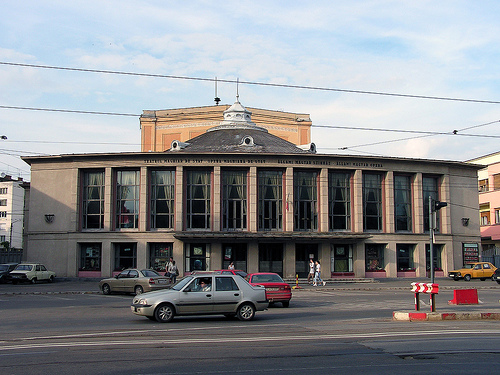
Cluj-Napoca has always been a city where culture feels alive, not just preserved in museums or performed on stage, but woven into the daily rhythm of its streets. The Lucian Blaga National Theatre stands as one of its most visible symbols, a grand building that dominates the central square with its imposing presence. Named after one of Romania’s most celebrated poets and philosophers, the theatre is more than just a venue for performances—it’s a landmark that carries the weight of the city’s artistic and historical identity.
The building itself is a striking example of early 20th-century architecture, designed in the Secession style, which was the local interpretation of Art Nouveau. Its construction began in 1904, when Cluj was still part of the Austro-Hungarian Empire, and it was completed two years later. The façade is adorned with intricate details, from the sculpted figures that seem to watch over the square to the ornate ironwork of the balconies. Inside, the auditorium is just as impressive, with a horseshoe-shaped layout, richly decorated ceilings, and a stage that has hosted generations of actors, dancers, and musicians. The theatre was originally built to serve the Hungarian community, but after Transylvania became part of Romania in 1918, it gradually transitioned into a Romanian cultural institution.
Over the decades, the theatre has witnessed countless transformations, both in its programming and its role in the city. During the communist era, it became a space where official culture was promoted, but also where subtle acts of artistic resistance could take place. Today, it remains a working theatre, staging everything from classical Romanian plays to contemporary international productions. The Lucian Blaga National Theatre is not just a place to see a show—it’s a living archive of the city’s cultural evolution, where the past and present coexist in the same space.
What makes the theatre particularly special is its connection to the city’s intellectual life. Lucian Blaga, the poet after whom it is named, was born in a village near Cluj and spent much of his life in the region. His work explored themes of identity, myth, and the relationship between humans and nature—ideas that still resonate in Transylvania today. The theatre’s programming often reflects this legacy, with performances that engage with both local traditions and universal questions. Even if you don’t catch a play during your visit, the building itself tells a story, one that’s deeply tied to the spirit of Cluj.
The square in front of the theatre is one of the city’s most lively gathering spots. On any given evening, you might find students chatting on the steps, street musicians playing near the fountain, or locals enjoying a coffee at one of the nearby cafés. The theatre’s presence gives the square a sense of grandeur, but it’s the people who bring it to life. During festivals, the area becomes even more animated, with open-air performances, film screenings, and public readings spilling out onto the pavement. The building, with its warm yellow façade, seems to glow in the evening light, inviting passersby to pause and take in the atmosphere.
For those who appreciate architecture, the theatre offers a fascinating contrast to the more modern buildings that surround it. While Cluj has seen rapid development in recent years, the Lucian Blaga National Theatre remains a reminder of the city’s layered history. The Secession style, with its flowing lines and organic motifs, feels almost rebellious next to the straight edges of contemporary design. Inside, the original details—like the stained-glass windows and the gilded accents—have been carefully preserved, offering a glimpse into the aesthetic ideals of a century ago.
Visiting the theatre is easy, as it sits right in the heart of Cluj, within walking distance of most major attractions. If you’re lucky enough to attend a performance, you’ll experience the space as it was meant to be enjoyed—filled with an audience, the murmur of anticipation, and the magic of live art. But even if you only pass by, the building leaves an impression. It’s one of those places that makes you slow down, look up, and appreciate the way history and culture shape a city. In Cluj, where the past is never far from the surface, the Lucian Blaga National Theatre stands as a quiet but powerful testament to the enduring power of art.