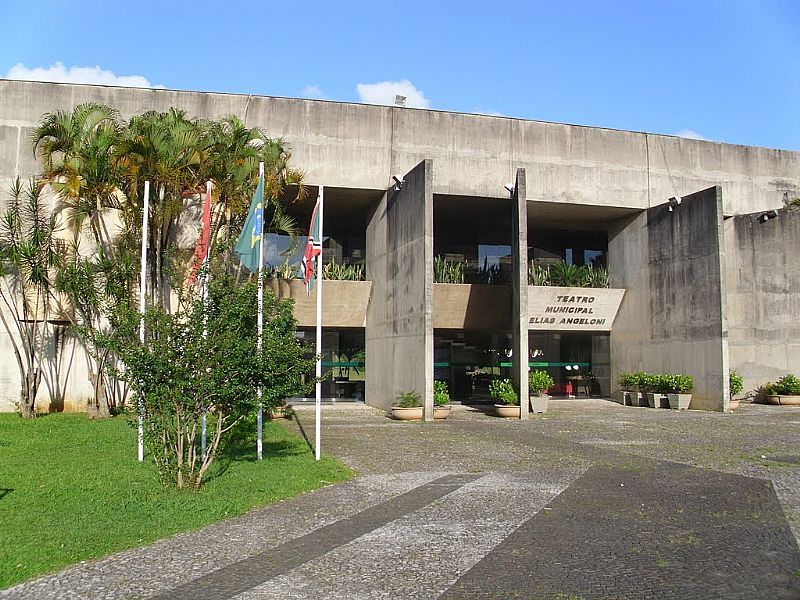
Criciúma isn’t the kind of city that usually makes it onto postcards. Nestled in the southern state of Santa Catarina, it grew up around coal mines and factories, its identity shaped by the rhythm of industry rather than the glamour of tourism. Yet amid the soot and steel, something unexpected took root—a theater that became a quiet testament to the city’s soul. The Elias Angeloni Theater stands not as a grand monument to art, but as a place where culture found its way into everyday life, proving that even in a town built on hard labor, there’s room for something softer.
The building itself doesn’t demand attention. Its facade is unassuming, almost modest, blending into the streets rather than standing out. But step inside, and the space reveals its warmth. The auditorium is intimate, with wooden balconies that curve gently around the stage, their edges worn smooth by decades of use. The seats, upholstered in faded fabric, bear the marks of countless performances, their creases holding the memory of laughter, applause, and the occasional rustle of a program being folded too tightly. The lighting is soft, casting a glow that feels more like lamplight than stagecraft, as if the theater itself is reluctant to let the outside world intrude too much.
Elias Angeloni, the man the theater is named after, wasn’t an actor or a director. He was one of those people who believed in the power of art to change a place, even when that place was more accustomed to pickaxes than poetry. In the mid-20th century, as Criciúma boomed with coal production, Angeloni and others like him saw something beyond the mines—a city where people might want more than just work and survival. The theater became their answer, a space where stories could be told, ideas could be shared, and the community could gather not just to watch, but to feel. It wasn’t about grandeur; it was about connection.
Today, the theater’s role has shifted. Criciúma has grown, and with it, the city’s cultural landscape. There are now museums, galleries, and newer venues where art and performance find a home. Yet the Elias Angeloni Theater hasn’t faded into the background. It still hosts plays, concerts, and festivals, drawing both locals and visitors who appreciate its unpretentious charm. What makes these events special isn’t the scale or the star power, but the way they reflect the city itself. The actors might be neighbors, the scripts might draw from local history, and the audience often knows the performers by name. There’s a sense that the theater isn’t just putting on a show—it’s continuing a conversation that started decades ago.
For travelers, the theater might not be an obvious stop. There are no towering columns or gilded ceilings, no famous names etched into the walls. But that’s precisely what makes it worth visiting. Here, you won’t find the polished veneer of a tourist attraction. Instead, you’ll get a glimpse of Criciúma as its residents know it—a place where culture isn’t something reserved for special occasions, but a living, breathing part of daily life. If you’re lucky, you might stumble upon a rehearsal, where the actors are still figuring out their lines, or a small concert where the music feels less like a performance and more like an invitation to join in.
The theater is deeply tied to the city’s history. In the 1950s and 60s, Criciúma was riding the wave of Brazil’s coal boom, its streets bustling with miners and merchants. The theater emerged during this time as a symbol of something more—a reminder that a city’s worth isn’t measured solely by its industry. It was a declaration that even in a place defined by hard work, there was room for beauty, for creativity, for the kind of moments that make life feel fuller. Today, as the coal mines have faded in importance, the theater remains, a quiet witness to the city’s evolution. It doesn’t shout its significance; it simply endures, a place where the past and present coexist without fanfare.
What makes the Elias Angeloni Theater special isn’t its architecture or its fame, but its authenticity. There are no crowds jostling for the best photo spots, no need to book tickets months in advance. Instead, there’s the chance to experience something rare: a theater that doesn’t try to be anything other than what it is. The performances might be modest, the stage might be small, but the connection between the actors and the audience is real. It’s the kind of place where a play about a local legend can feel as important as a Shakespearean tragedy, where a community comes together not because they have to, but because they want to.
In a world where so much of travel is about checking off landmarks and chasing the next big thing, the Elias Angeloni Theater offers something different. It’s a reminder that culture isn’t just found in grand opera houses or world-famous museums, but in the places where people gather simply because they love what they do. Here, the magic isn’t in the spectacle—it’s in the quiet moments, the shared laughter, the way a story can make a room full of strangers feel like a family. The theater doesn’t need to be extraordinary to matter. It just needs to be there, a steady presence in a city that has always known the value of things that last.