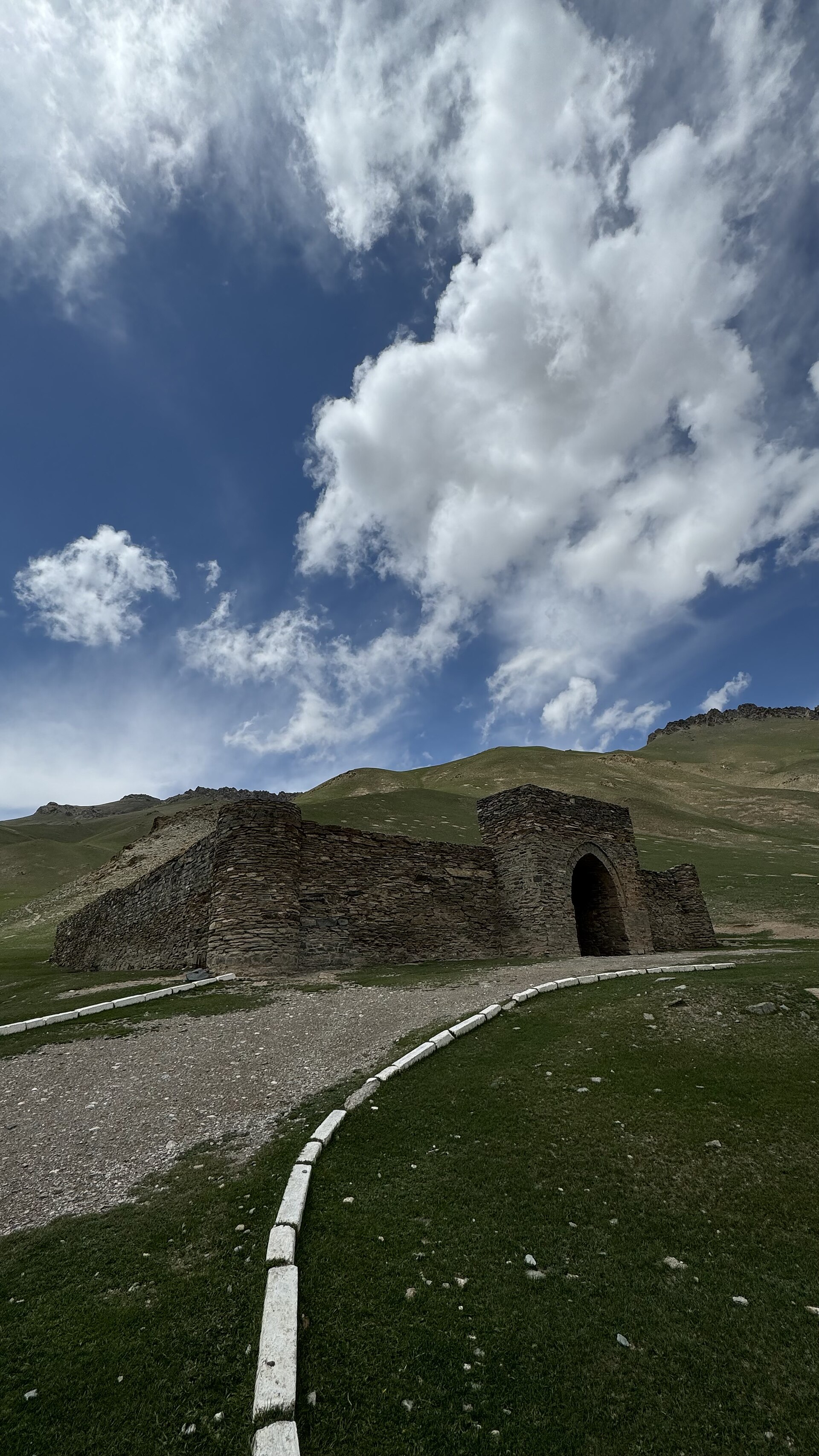
Tash-Rabat isn’t the kind of place you visit just to tick it off a list. It’s the kind of place where the journey itself becomes part of the experience. This stone caravanserai, tucked away in the mountains of the Central Tian Shan, sits along an ancient trade route that once connected China with the cities of Central Asia. Today, no merchants pass through with silk or spices, but travelers still come, drawn by the sense of history that lingers in every stone.
Built in the 15th century, Tash-Rabat served as more than just a shelter for weary travelers. It was a fortified stop along the Silk Road, its walls constructed from large stone blocks without mortar, enduring centuries of wind and snow. Inside, vaulted chambers remain where caravans once rested, and underground passages—still shrouded in legend—are said to have led to hidden storerooms or even distant valleys. Archaeologists continue to debate the exact purpose of some rooms; they may have been used as a mosque, a warehouse, or even a prison.
Reaching Tash-Rabat is no easy feat. From the nearest settlement, the village of At-Bashy, the journey covers about eighty kilometers of winding mountain roads that follow rivers and climb over passes. On clear days, the views stretch across endless pastures and jagged peaks, while in foggy weather, the mountains seem to dissolve into the mist, as if time itself has paused. Local drivers know every turn, though even they sometimes stop to catch their breath on the steepest stretches.
The caravanserai stands on a small plateau, surrounded by low hills. There are no trees or bushes, just rocks and grass that fades to a pale gold by late summer. As you approach, the scale of the structure becomes apparent—not as massive as some medieval fortresses in the Fergana Valley, but imposing in its own way. The entrance is a narrow gap in the thick walls, and inside, the play of light and shadow across the stone vaults is striking.
Even on the hottest days, the interior of Tash-Rabat stays cool. The walls, nearly a meter and a half thick, shield against wind and sun. In the main hall, niches remain where goods might have been stored or fires lit for warmth. One room still has the remnants of a hearth, while another features a small depression, possibly for water. In places, soot marks on the walls hint at the bustling life that once filled these spaces.
The area around Tash-Rabat is just as compelling as the caravanserai itself. A few kilometers away, the At-Bashy River flows through pastures where nomads still graze their horses and sheep in the summer. By autumn, the valley turns golden, and locals occasionally find old coins or fragments of pottery, though no official excavations have taken place here.
Tash-Rabat isn’t a museum; it’s a living monument that exists on its own terms. There are no crowds, no souvenir stalls, no guides with megaphones—just the wind, the mountains, and silence, broken only by the cry of a bird or the distant whinny of a horse. That’s part of why it leaves such a strong impression: it doesn’t try to impress. It simply is, just as it has been for centuries.
If you decide to visit, come prepared. There’s almost no infrastructure here, so bring water, food, and warm clothing—even summer nights in the mountains can be cold. Locals sometimes offer stays in yurts or arrange horseback rides, but it’s best to arrange these in advance. The journey itself is part of the experience, and the reward is a place where time feels different, where the past isn’t just remembered but still lingers in the air.