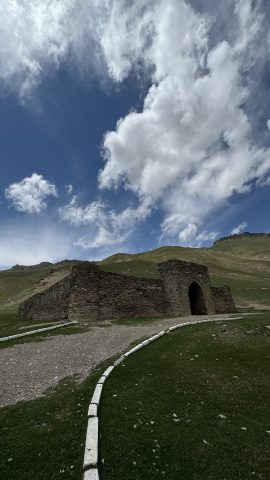
At-Bashy Mosque is one of those quiet places in Kyrgyzstan that doesn’t demand attention but lingers in memory long after you’ve left. It stands in the small town of the same name, nestled in a valley between the towering ranges of the Tian Shan mountains. At nearly two thousand meters above sea level, the air here is thin and crisp, the horizon stretching endlessly under a vast sky. The mosque isn’t grand like the monumental complexes of larger cities—it’s modest, unassuming, yet deeply rooted in the life of the local community, carrying the weight of history and tradition in its walls.
The architecture is simple and practical, much like the way of life in these parts. Built from adobe brick, a material long favored across Central Asia for its availability and ability to keep interiors warm in winter and cool in summer, the mosque blends seamlessly into the landscape. Its roof is covered in traditional clay tiles, and though the minaret is short, its slender form stands out against the backdrop of the mountains. Inside, there’s no opulence—just understated geometric patterns on the walls and carpets brought from nearby villages, their worn threads telling stories of generations. The space feels intimate, almost like a second home, inviting quiet reflection rather than awe.
The mosque’s history is intertwined with that of At-Bashy itself, a town that grew along an ancient caravan route connecting the Fergana Valley to Issyk-Kul and beyond, all the way to China. For centuries, merchants, pilgrims, and travelers passed through these highlands, and At-Bashy served as a vital stop on the Silk Road. The mosque likely dates back hundreds of years, though no one knows its exact origins. Like many religious sites in the region, it has probably been rebuilt and restored countless times, surviving wars, shifting rulers, and the harsh mountain climate.
For the people of At-Bashy, the mosque is more than a place of worship. It’s a community hub, especially during religious festivals when families from surrounding villages gather here. In Kyrgyzstan, Islam often blends with older traditions, and the mosque becomes a place where both faith and local customs are preserved. Elders meet to discuss village matters, children learn the basics of Arabic and Quranic teachings, and weddings or funerals bring the community together. The building isn’t just a religious site—it’s a living part of daily life.
The atmosphere around the mosque shifts with the seasons. In summer, when the mountains are lush and the air carries the scent of wild herbs, the courtyard buzzes with activity. Locals and the occasional traveler come not just to pray but to sit under the shade of the trees, sipping tea and watching the light play on the walls. Winter transforms the scene entirely. Snow blankets the valley, the cold bites sharply, and the mosque becomes a refuge—its thick walls holding the day’s warmth, its windows glowing softly in the long evenings.
Though unassuming, At-Bashy Mosque is a quiet landmark in Naryn Province, a reminder of how people have shaped their lives in these rugged highlands for centuries. Here, faith, nature, and everyday struggles coexist in a delicate balance. For travelers who make the journey, it’s an unexpected discovery. There are no crowds, no guided tours, no souvenir stalls—just the stillness of the mountains and the sense of stepping into a place untouched by time.
If you find yourself in At-Bashy, take a moment to visit. Step inside, listen to the silence, watch how the light filters through the windows. This is Central Asia as it truly is—not the postcard version, but the real, breathing one, where beauty lies in simplicity. The mosque asks nothing of its visitors except respect for its history and the traditions it holds. In return, it offers something rare: a chance to pause, to feel the weight of the past, and to understand why the simplest places often leave the deepest impression.