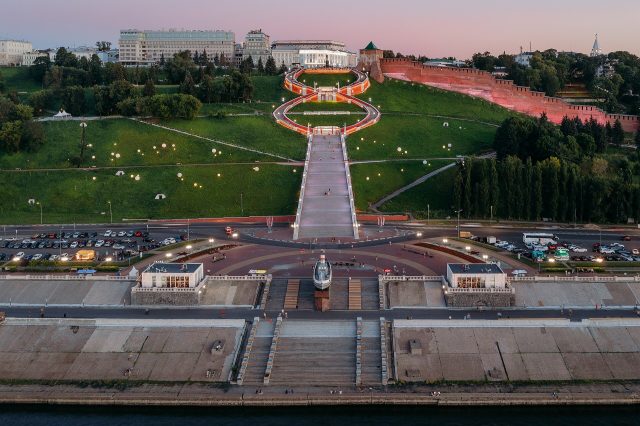
The Strelka is where the Oka and Volga rivers meet in Nizhny Novgorod, a natural landmark that offers one of the city’s most striking views. From this point, the two rivers flow together, their waters visibly distinct for kilometers—one lighter, the other darker—before blending into a single current. Across the water, the ancient walls of the Nizhny Novgorod Kremlin rise on the high opposite bank, their towers and battlements standing as they have for centuries. The spot has long been a quiet witness to the city’s life, though for much of the 20th century, it was hidden behind the fences of a working freight port, its potential as a public space overlooked.
That changed in the years leading up to the 2018 FIFA World Cup, when the area underwent a transformation. The port was relocated, the embankment was reimagined, and the once-industrial zone was opened to the city. The most visible addition was the Nizhny Novgorod Stadium, a modern arena that now hosts football matches and large-scale events. But the real revelation was the restoration of the old warehouses—elegant, lattice-like structures that had stood forgotten for decades. These were no ordinary buildings. Designed by the renowned engineer Vladimir Shukhov, they were originally part of the 1896 All-Russia Industrial and Art Exhibition, a grand showcase of the empire’s technological and artistic achievements. For years, their intricate metal frameworks were hidden behind crude siding, their origins unknown even to many locals. When the layers were finally stripped away, the warehouses were revealed as masterpieces of engineering, their delicate ironwork now encased in glass to house concerts, exhibitions, and cultural events.
Just steps away stands the Alexander Nevsky Cathedral, another legacy of the 1896 exhibition. Built to impress, it remains one of the tallest churches in Russia, its golden domes and towering silhouette a defining feature of the city’s skyline. The cathedral and the warehouses together tell a story of Nizhny Novgorod’s late 19th-century ambition—a moment when the city, already a vital trade hub, sought to assert itself as a center of industry and culture. The exhibition was a turning point, drawing visitors from across the empire and leaving behind structures that, over a century later, still shape the city’s identity.
The Strelka is at its most atmospheric in the evening, when the setting sun casts a warm glow over the water. The contrast between the two rivers becomes even more pronounced as the light fades, the Oka’s pale current running alongside the deeper, slower-moving Volga. In summer, the embankment comes alive with festivals, open-air performances, and crowds strolling along the promenade. The warehouses, with their soaring ceilings and industrial charm, host everything from jazz concerts to contemporary art shows, their glass walls reflecting the changing light. Winter, by contrast, brings a quieter rhythm. The wind sweeps across the open space, and the crowds thin out, leaving the rivers and the distant Kremlin to dominate the scene.
Getting here is simple. The Strelka metro station drops you a short walk from the water, and from there, the entire area unfolds before you. The embankment is open at all hours, free to explore, though the warehouses themselves require tickets for events. Nearby, the stadium looms, its modern lines a counterpoint to the older structures, while across the Volga, the cable car to Bor offers another perspective on the city. The cable car isn’t just a novelty—it’s a practical link between Nizhny Novgorod and its smaller neighbor, a quick ride over the water with views that rival those from the Strelka itself.
What makes this place special isn’t just the scenery, though that would be enough. It’s the layers of history visible in every direction—the medieval Kremlin, the industrial warehouses, the grand cathedral, and the modern stadium, all coexisting in a single frame. The Strelka is where the city’s past and present intersect, where the rivers that have shaped its fortunes for centuries meet under the watchful gaze of its oldest fortress. Whether you come for the views, the events, or simply to stand at the water’s edge and watch the currents merge, it’s a spot that lingers in the memory long after you’ve left.