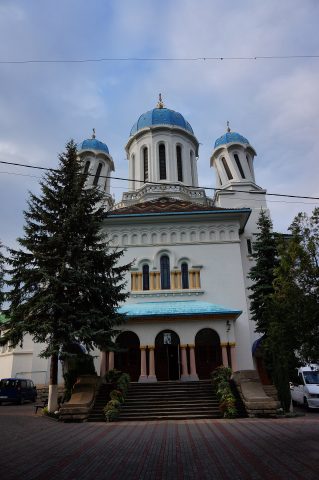
Storozhynets House of Culture is one of those quiet places that slowly become woven into the fabric of a town’s daily life. Tucked away at a busy intersection in the heart of Storozhynets, it stands where locals rush past on their way to work and visitors occasionally wander in, drawn to this corner of Bukovyna. The building doesn’t demand attention with flashy facades or grand architecture—its charm lies in how naturally it fits into the town. Over the years, it has become a gathering point for people of all ages, a place where the rhythm of the city seems to pause just long enough to let life unfold inside its walls.
The history of the House of Culture is closely tied to Storozhynets’ growth in the 20th century. Built during the Soviet era, it was designed as a hub for the town’s social and cultural life. Back then, such institutions were more than just venues for entertainment—they were vital spaces where communities shaped their identity. Meetings, concerts, lectures, and hobby groups all found a home here. While the role of these centers has evolved over time, the House of Culture has remained a constant, a place where people come together, share stories, and keep traditions alive.
The architecture is unmistakably Soviet in style—clean lines, symmetrical shapes, and large windows that flood the interior with light. The facade is modest, with subtle decorative touches that give it a slightly formal yet welcoming appearance. Inside, the spacious halls with high ceilings and wide corridors were clearly built to accommodate crowds. The interiors still carry the spirit of past decades, with old posters, faded photographs of events, and even some original furniture. Stepping inside feels like stepping back in time, where you can almost hear the echoes of dance nights, amateur performances, and gatherings of veterans.
Today, the House of Culture continues to serve the town, though its role has expanded. Concerts, festivals, exhibitions, and creative evenings still take place here, drawing both locals and visitors from across Bukovyna. Local choirs, dance troupes, and theater groups rehearse within its walls, while children attend workshops and clubs. In recent years, the building has become a venue for regional cultural events, particularly folk festivals where traditional music, embroidery, and crafts come to life. These gatherings offer a glimpse into the region’s rich heritage, with the sounds of Bukovynian songs and the aromas of local dishes filling the air.
For the people of Storozhynets, the House of Culture is more than just a building—it’s a part of their personal histories. Some remember their first time on stage here, others recall meeting friends after school, and many have fond memories of family celebrations held within its walls. During the Soviet era, such places were where people could escape the monotony of daily life, find like-minded souls, or simply enjoy each other’s company. That tradition lives on today, though in new forms. You might stumble upon a youth party, a pensioners’ gathering, or a children’s art class—all under the same roof.
While the House of Culture isn’t a tourist attraction in the traditional sense, it offers something rare for those curious about life in Ukraine’s smaller towns. It’s a place where you can feel the pulse of everyday existence, where local traditions are preserved and reinvented. If you visit during an event, the halls come alive with children’s laughter, music, and conversations in different languages—Bukovyna has always been a crossroads of cultures, and this diversity is still palpable here.
This isn’t a museum or a polished entertainment center, but a living space that evolves alongside the town. There’s no rigid formality here, just an atmosphere of openness and warmth. That’s probably why people keep coming back—to feel connected to something bigger than their own street or neighborhood. In an age where culture often exists online, places like this remind us of the value of face-to-face interaction and shared creativity.
If you find yourself in Storozhynets, it’s worth stopping by, even for a few minutes. You might catch a local ensemble rehearsing, stumble upon an exhibition of Bukovynian crafts, or simply sit in the foyer, watching life unfold around you. The House of Culture isn’t just a building—it’s a quiet witness to the stories of the town and the people who call it home.