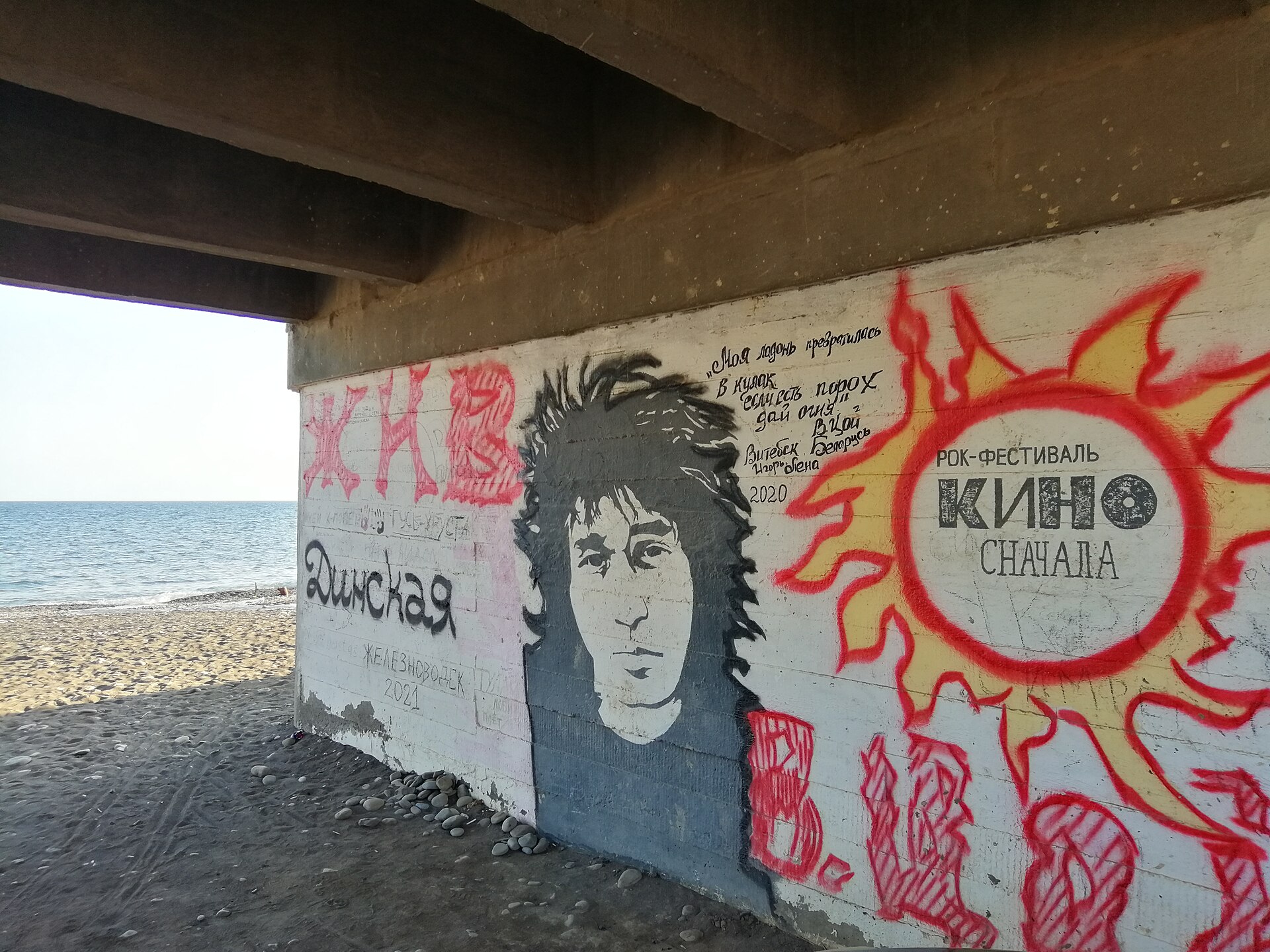
The wall in Morskoye known as the Tsoi Wall is one of those places that exist beyond tourist maps, thriving in its own quiet, almost mythical way. It wasn’t built by design or decree but emerged organically as a spontaneous monument to a man whose name became synonymous with an entire era. For many, Viktor Tsoi wasn’t just a musician—he was the voice of a generation. This wall, covered in handwritten messages, drawings, and lyrics from his songs, has become an unofficial shrine to his memory. There are no official plaques or signs here, yet everyone who visits understands that this isn’t just a wall. It’s a gathering point for those who feel a connection to the music, the history, and the people who shaped it.
Morskoye is a small coastal settlement where time moves slower than in the bustling resort towns nearby. In summer, families come to relax, drawn by the quiet and the sea air, while winter transforms the village into a sleepy, half-empty place. The Tsoi Wall sits on one of its streets, easily overlooked among the modest houses and fences. You wouldn’t stumble upon it by accident—you have to know where to look. But those who seek it out always find their way, whether through word of mouth, a friend’s recommendation, or some inner pull. Unlike other memorials, it’s never crowded, and that absence of tourists makes the atmosphere feel all the more genuine.
The wall’s story began in the 1990s, after Viktor Tsoi’s death, when fans started leaving their first messages on its surface. At first, they were simple—his name, his birth and death dates, lines from his songs. Over time, the wall grew, absorbing the emotions of those who visited. Drawings appeared alongside the words, portraits of Tsoi, symbols of the era. Some left personal notes, as if confiding in the wall itself. Others just touched its rough surface, as though trying to bridge the gap between themselves and a man they’d never met. What started as a few scattered messages became a living document of a generation, a place where anyone could leave their mark.
It’s hard to call this place architecture—it’s just a plain concrete wall, unremarkable at first glance. But that’s precisely what makes it special. There’s no marble, no bronze plaques, no formal ceremonies. Just concrete, paint, and words written by hand. The messages overlap, creating layers of names, dates, quotes, and sketches. Sometimes you can make out individual phrases; other times, it all blurs into an abstract pattern. But even if you don’t read a single word, standing there, you can feel the weight of it—the energy of all the people who’ve passed by, leaving something of themselves behind.
The Tsoi Wall isn’t a museum or a memorial in the traditional sense. There are no guides, no tickets, no rules. It’s a place where anyone can come and sit with their thoughts. In summer, it’s lively—fans of Tsoi, musicians, curious travelers. Some bring flowers, others guitars, and a few just sit on the grass nearby, listening to the sound of the sea. Winter gives the wall a different kind of beauty. The messages frost over, and the silence is broken only by the wind. In those moments, it feels like time has stopped, as if the wall holds not just the memory of Tsoi but of everyone who’s ever visited.
For many, this wall has become a pilgrimage site. People come not just from across Russia but from other countries—those who grew up with Kino’s music, who remember how those songs sounded during perestroika, who found comfort in them during difficult times. Here, there are no borders or nationalities, just a shared sense of belonging to something larger. Some come to honor the musician, others to revisit their youth, and a few simply because the place has a certain energy. It doesn’t ask for anything in return, but it gives something to everyone who’s open to it.
Over the years, the wall has woven itself into local folklore. There are stories—some say if you touch the wall and make a wish, it will come true. Others claim you can hear the echo of Tsoi’s voice if you listen closely. Of course, these are just myths, but they underscore how deeply this place is tied to memory and imagination. For the locals, the wall is just part of the landscape, but they never turn visitors away. Instead, many share their own stories—how they once left a message here, or how they’ve seen famous musicians pay their respects.
The Tsoi Wall in Morskoye isn’t just a landmark. It’s a living testament to how art can bring people together. It doesn’t belong to anyone, and yet it belongs to everyone. No one guards it, restores it, or tries to tidy it up. It exists as it is—weathered, layered with paint and time. And that’s its charm. There’s no formality here, just sincerity and memory. Maybe that’s why the wall endures, decades later. It reminds us that real values don’t fade, and the people who create them stay with us forever.