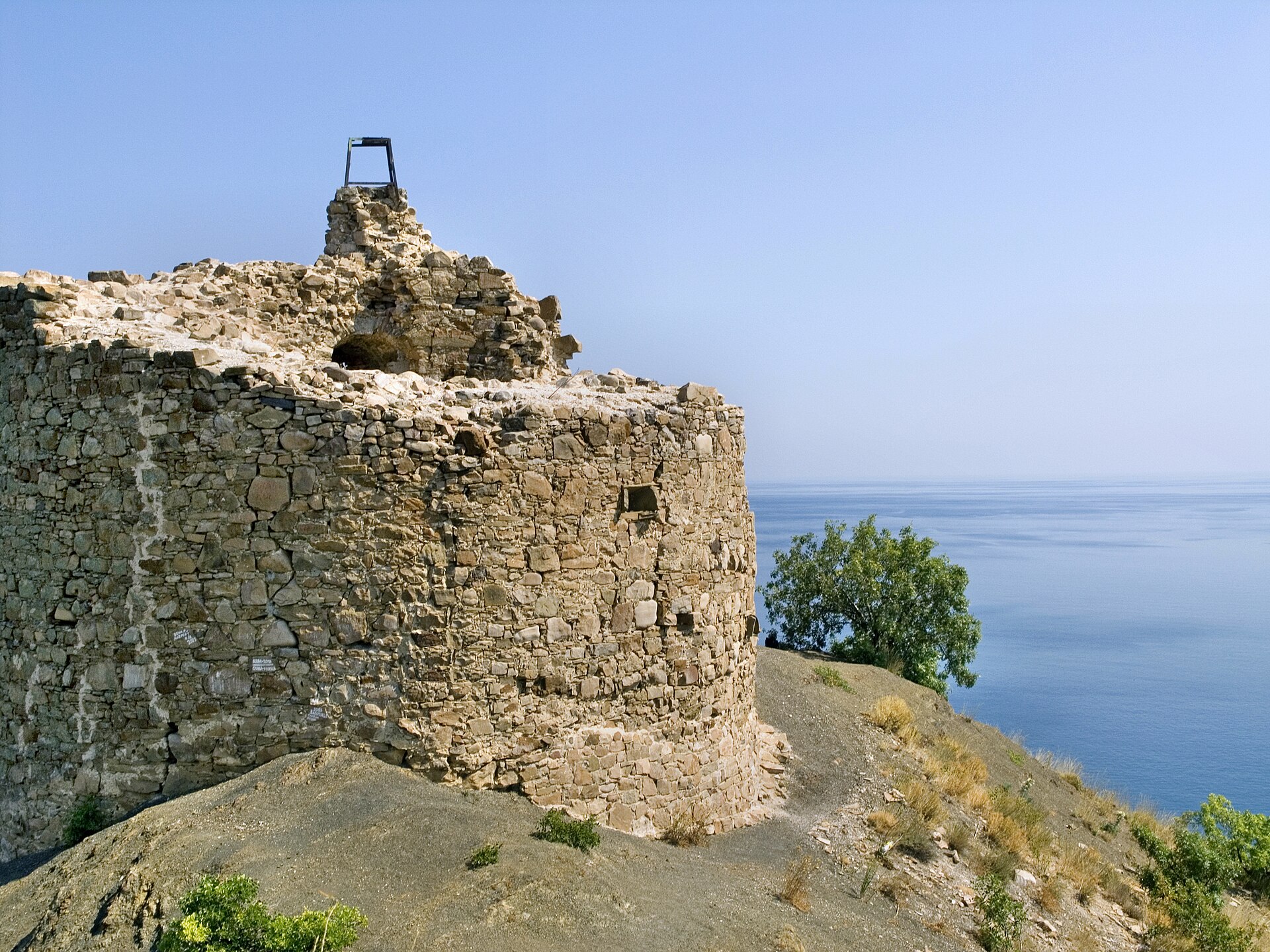
Perched on a windswept promontory along Crimea’s southern coast, Choban-Kule is one of those rare places where history feels alive not because it’s been polished for visitors, but because it’s been left to breathe. The ruins of this medieval fortress cling to the edge of a cliff, overlooking the Black Sea with a quiet defiance that has outlasted empires. Its name, which loosely translates to "Shepherd’s Tower," hints at a past far more layered than the pastoral image suggests. Over the centuries, it has been called Chufut-Kale-Burun, a nod to its strategic role as a lookout and stronghold, though today only fragments remain—crumbling walls of local stone, the skeletal outlines of towers, and the hollowed-out shells of rooms that once sheltered soldiers and sentinels.
The fortress didn’t rise in isolation. Its origins stretch back to the Byzantine era, when this stretch of coastline was a contested frontier of a vast empire. By the Middle Ages, Choban-Kule had become a critical waypoint between the coastal settlements and the Crimean interior, a place where Genoese merchants paused on their trade routes and Mongol horsemen passed through on their campaigns. In the 15th century, it fell under the control of the Crimean Khanate, another chapter in a long history of shifting powers. Each of these periods left its mark on the fortress, though time and the elements have blurred the details, leaving only hints of the past in the uneven stones and the way the walls curve to follow the natural contours of the cliff.
The location was no accident. The promontory is a fortress in itself, surrounded on three sides by the sea and on the fourth by steep, rocky slopes. In an age when surprise attacks were a constant threat, Choban-Kule was nearly impregnable. From its heights, the view stretches endlessly across the water, and on clear days, the distant shoreline shimmers like a mirage. In its prime, the fortress didn’t just guard the land—it commanded the sea routes, making it a prize worth fighting for. Even now, standing among the ruins, it’s easy to imagine the watchful eyes that once scanned the horizon for sails or dust clouds on the road below.
There are no museums here, no guided tours, no signs explaining what you’re looking at. That absence is part of the appeal. Choban-Kule exists in a kind of limbo, neither fully lost to time nor preserved for posterity. The ruins are slowly surrendering to the wind and salt air, their edges softened by centuries of erosion, but the silence that surrounds them is anything but empty. It’s the kind of place where you can wander along the remnants of walls, climb onto the rocks, and let your imagination fill in the gaps—the clatter of armor, the shouts of guards, the distant crash of waves against the base of the cliff. The past here isn’t curated; it’s something you stumble upon, half-buried in the earth or etched into the stone.
Reaching Choban-Kule is part of the experience. The nearest settlement is the small village of Morskoye, and from there, the journey is on foot. One path follows the coastline, winding along the water before turning inland toward the fortress. Another route cuts through the forest, steeper but shaded, with the scent of pine and wild herbs rising from the undergrowth. Neither trail is particularly easy, but the effort is rewarded long before you arrive. The views along the way are worth the trek—coves of turquoise water, jagged cliffs, and the occasional glimpse of a ship far out at sea. It’s best to come in the early morning or late afternoon, when the light is soft and the heat less oppressive. The walk itself becomes a quiet adventure, a chance to leave the modern world behind before you even reach the ruins.
This isn’t a place for those seeking entertainment or convenience. There are no souvenir stalls, no cafes, no crowds. Choban-Kule is for people who appreciate solitude, history without narration, and the kind of raw beauty that doesn’t need embellishment. The surrounding coastline is wild, with secluded beaches where the sea meets the shore in a tangle of driftwood and smooth stones. On the slopes of the promontory, rare plants thrive in the salty air—wormwood, lavender, and poppies that blaze red in the spring. The seasons here are vivid: in autumn, the sea turns a deep, almost unnatural blue, while in winter, storms lash the cliffs, and the wind howls through the ruins like a ghost.
It’s worth remembering that Choban-Kule is fragile. The stones may look sturdy, but centuries of weather and neglect have left them vulnerable. Climbing on the most precarious sections of the walls or pocketing a "souvenir" only accelerates the damage. The best way to experience the fortress is to leave it as you found it—untouched, so that others might one day stand in the same spot and feel the weight of history pressing in from all sides. The ruins don’t need to be saved; they need to be respected, allowed to exist as they are, slowly returning to the earth that birthed them.
For many visitors, Choban-Kule is a revelation. Crimea is famous for its grand palaces and crowded resorts, places where history is polished and packaged for tourists. But it’s the quieter sites, the ones that have been left to the elements, that often tell the most honest stories. There are no grand narratives here, no neatly labeled exhibits—just the wind, the sea, and the stones, each one a silent witness to the rise and fall of empires. If you’re lucky, you might catch a glimpse of that past, a fleeting sense of connection to the people who once stood where you’re standing. It doesn’t last long, but for a moment, the centuries between then and now feel thinner than the air.